Skip to content
wheretotravel.info
Morocco

Morocco travel guide

Old inland cities and coastal towns, at their best in March, April, October and November

Best: Mar, Apr, Oct, Nov

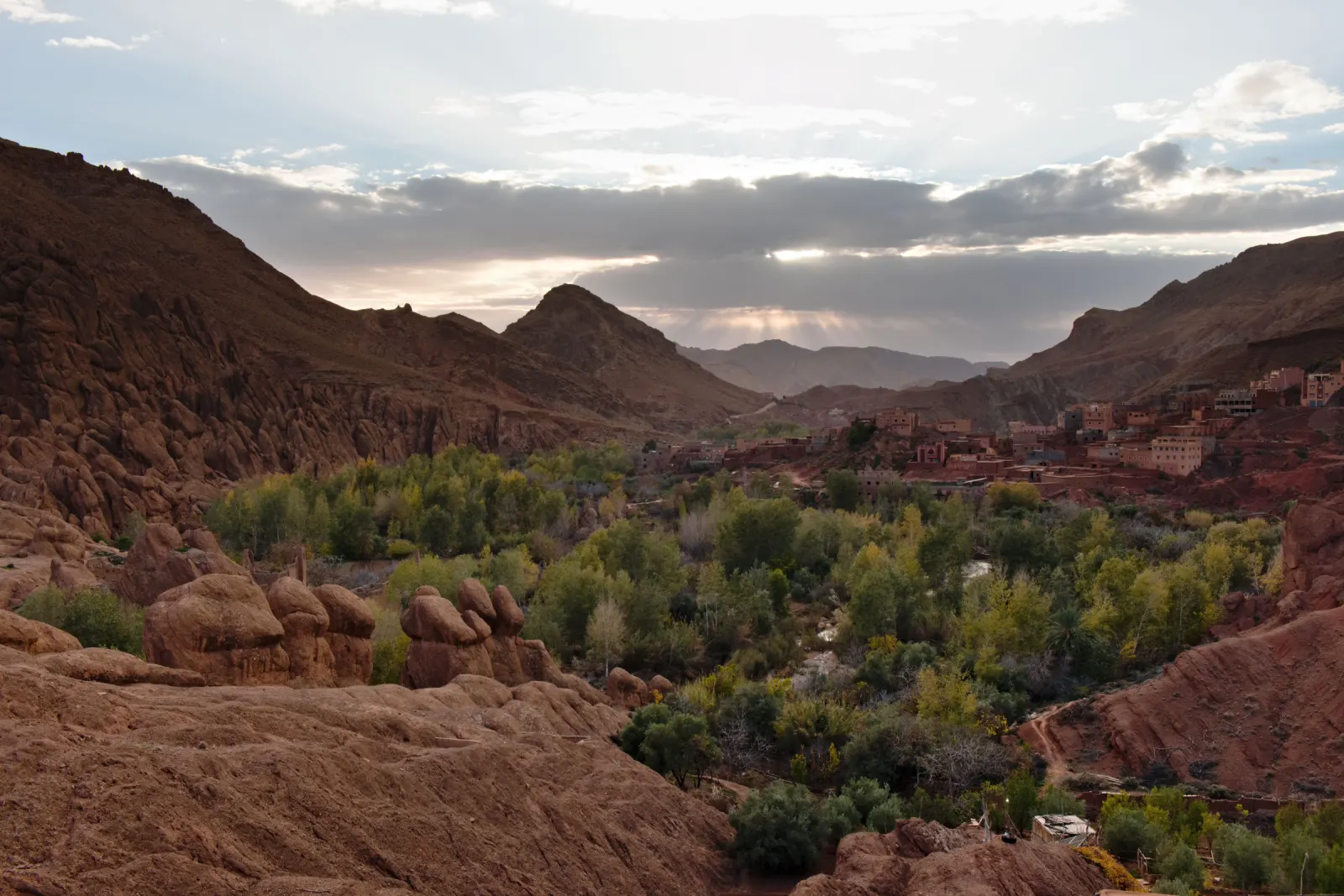
Photo: Tobias Waibl / Pexels

Capital
Rabat
Languages
Arabic, Standard Moroccan Tamazight
Currency
Moroccan dirham
Time zone
UTC
Plugs
Type C, E · 220 V / 127 V
Driving
On the right
Emergency
112

Why visit Morocco

Morocco suits travellers who want to mix city time with time by the sea. Inland, Fez, Marrakech and Chefchaouen are the classic stops. On the coast, you can choose Casablanca, Tangier, Essaouira or Agadir. The best months to go are March, April, October and November. One honest limitation: the country covers about 446,550 km², so the distances between these places are long. Plan fewer stops, or expect some long travel days.

  • Spring and autumn travel windows

    The best months to visit Morocco are March, April, October and November. These spring and autumn months give you two separate windows each year, so you can plan around school holidays or work. They also suit a trip that mixes coastal and inland cities.

  • A long Atlantic and Mediterranean coastline

    Five of Morocco's main cities sit on the coast: Tangier, Rabat, Casablanca, Agadir and Essaouira. Essaouira, with 82962 people, is far smaller than Casablanca, so a coastal trip can mix big-city life with a quieter town.

  • Two major inland cities

    Fez and Marrakech are both inland and each has more than 1 million people: 1167842 in Fez and 1002697 in Marrakech. Many travellers pair the two with a coastal city to see how life away from the sea compares.

  • Big city or small town

    Morocco covers a wide range of city sizes. Casablanca is the largest, with 3215935 people. Inland Chefchaouen has just 46168. Rabat, the capital, sits in between with 515619 people, so you can choose the pace of each stop.

  • Two languages and simple logistics

    Arabic and Standard Moroccan Tamazight are the official languages, and you pay in Moroccan dirham. The whole country uses one time zone, UTC, and cars drive on the right. For emergencies, dial 112.

Is Morocco right for you?

Great for

  • Spring city breaks: April highs around 23°C, with just 2.8 rain days
  • Autumn trips in October: highs near 23°C, lows around 12°C, about 3 rain days
  • Coastal city hoppers: Rabat, Casablanca, Tangier, Agadir and Essaouira all sit on the coast
  • Inland medina trips to Fez, Marrakech and Chefchaouen in March, April, October or November
  • Travellers who want dry weather: no month averages more than 4.6 rain days

Less ideal for

  • Heat-sensitive travellers in July: average highs near 36°C, with nights around 22°C
  • Winter visitors wanting warm evenings: January lows average 1.5°C, December lows about 3°C
  • Winter beach trips: highs only reach around 14–15°C from December to February

Morocco right now: October

9.3/10
Avg high
23°C
Avg low
12°C
Rain days
3

Averages for Morocco.

Weather by month

In the 2015–2024 data for Morocco (no single city is named), March, April, October and November score best, with highs of 18–23°C, 9.5–11.9 hours of sun a day and only 10–22 mm of rain. July and August have the toughest weather, with highs of 34–36°C and nights above 21°C, while January nights drop to 1.5°C.

Average highs and lows in Morocco by month January: high 14°C, low 2°C , 3 rain days . February: high 15°C, low 3°C , 3 rain days . March: high 19°C, low 6°C , 4 rain days . April: high 23°C, low 10°C , 3 rain days . May: high 27°C, low 14°C , 3 rain days . June: high 32°C, low 18°C , 1 rain days . July: high 36°C, low 22°C , 1 rain days . August: high 34°C, low 21°C , 2 rain days . September: high 29°C, low 17°C , 5 rain days . October: high 23°C, low 12°C , 3 rain days . November: high 18°C, low 6°C , 2 rain days . December: high 15°C, low 3°C , 2 rain days . 14°C 2°C JAN 3d 15°C 3°C FEB 3d 19°C 6°C MAR 4d 23°C 10°C APR 3d 27°C 14°C MAY 3d 32°C 18°C JUN 1d 36°C 22°C JUL 1d 34°C 21°C AUG 2d 29°C 17°C SEP 5d 23°C 12°C OCT 3d 18°C 6°C NOV 2d 15°C 3°C DEC 2d
Best months Other months (low–high) Nd = rain days

Morocco (country average) · averages 2015–2024

Best time to visit Morocco: month-by-month weather →

Sample itineraries

7 days

Marrakech and the Atlantic coast

  1. Day 1–3

    Marrakech

    Start inland in Marrakech, a city of about 1 million people. Spend 3 days walking its old streets and markets at your own pace, and rest in the middle of the day if it feels hot.

  2. Day 4–5

    Essaouira

    Head to Essaouira on the Atlantic coast. It is a much smaller town than Marrakech, so 2 days give you time to explore on foot and relax by the sea.

  3. Day 6–7

    Agadir

    Finish in Agadir, a larger coastal city. Use your last 2 days for the beach, easy walks along the seafront and a slower end to the trip.

10 days

Northern Morocco from Tangier to Casablanca

  1. Day 1–2

    Tangier

    Begin in Tangier on the northern coast. Spend 2 days getting your bearings, exploring the old town and watching the sea from the city's viewpoints.

  2. Day 3–4

    Chefchaouen

    Move inland to Chefchaouen, the smallest town on this route. Its calm pace suits 2 days of slow walks, photography and short hikes nearby.

  3. Day 5–7

    Fez

    Give Fez 3 days. This large inland city has an old medina that is easy to get lost in, so a local guide for your first visit can help.

  4. Day 8–9

    Rabat

    Continue to Rabat, the capital, on the Atlantic coast. Spend 2 days on its historic sites, quieter streets and coastal walks.

  5. Day 10

    Casablanca

    End in Casablanca, Morocco's largest city. Use your final day for a walk along the coast and a last look at modern city life.

Food to try in Morocco

Tagine

A slow-cooked stew of meat or vegetables, often with spices, olives or dried fruit. It is named after the cone-shaped clay pot it cooks in, and you find it in homes and restaurants across the country.

Couscous

Steamed semolina grains served with vegetables and meat. Many Moroccan families eat it as a shared meal on Fridays, after midday prayers.

Harira

A thick soup of tomatoes, lentils and chickpeas, flavoured with herbs and spices. It is a classic dish for breaking the daily fast during the Muslim fasting month, and it is eaten year-round too.

Mint tea

Green tea brewed with fresh mint and usually a lot of sugar, poured from a height into small glasses. It is offered to guests in homes, shops and cafés throughout the day.

Pastilla

A layered pie of thin, crisp pastry filled with spiced meat or seafood and almonds, often dusted with sugar and cinnamon. It is a dish for special occasions and festive meals.

Msemen

A square, flaky flatbread cooked on a griddle. People eat it at breakfast or with afternoon tea, often with honey or butter, and street stalls sell it fresh.

Know before you go

  • Plugs: Morocco uses plug types C and E. Both have 2 round pins. Bring a matching adapter if your chargers use a different plug.
  • Voltage: Voltage is listed as 220 V / 127 V. Check the label on your chargers and devices. Most phone and laptop chargers accept a wide range, but some hair dryers and older devices do not.
  • Driving side: Traffic drives on the right. Plan for this if you rent a car and usually drive on the left at home.
  • Emergency number: The emergency number is 112. Save it in your phone before you travel.
  • Currency: The local currency is the Moroccan dirham. Plan how you will get cash or pay by card before you arrive.
  • Language: The official languages are Arabic and Standard Moroccan Tamazight. A few basic Arabic greetings can help in everyday situations.
  • Calling code: The country calling code is +212. Add it in front of local numbers when you call or message from a foreign phone.

Morocco: frequently asked questions

When is the best time to visit Morocco?

November is the top month, followed by April, October and March. In these months, average daytime highs are 18–23°C and lows are 6–12°C. Rain stays at 10–22 mm a month. Our scores are 9.6 for November, 9.4 for April, 9.3 for October and 9.1 for March. These figures are country-wide averages for 2015–2024.

Is Morocco good to visit in July and August?

July and August are the hottest months and get the lowest scores of the year: 3.5 for July and 4 for August. Average highs reach 36°C in July and 34°C in August, and nights stay around 21–22°C. It is almost completely dry, with 0.5 rain days in July and about 12 hours of sun a day. This suits travellers who want long, dry, sunny days and can handle strong heat.

What is the weather like in Morocco in winter?

Days are mild in winter, but nights are cold. From December to February, average highs are 14–15°C and lows drop to 1.5–3°C. There are only 2–3 rain days a month and 9–10 hours of sun a day. December (8) and February (7.9) still rank among the best months, and January scores 7.3. Pack warm layers for the evenings.

Does it rain a lot in Morocco?

No, rain is low all year. The wettest month is September, with 25 mm over 4.6 days, and March is close behind with 22 mm over 4.4 days. From June to August there are fewer than 2 rain days a month, and July gets only 2 mm. Even the wettest months still get 10–11 hours of sun a day.

What currency, plugs and emergency number does Morocco use?

Morocco uses the Moroccan dirham. Plugs are type C and E, and the listed voltage is 220 V / 127 V, so check that your devices can handle it. The emergency number is 112 and the calling code is +212. Traffic drives on the right.

Similar destinations

Countries with a year of weather much like Morocco.