Skip to content
wheretotravel.info
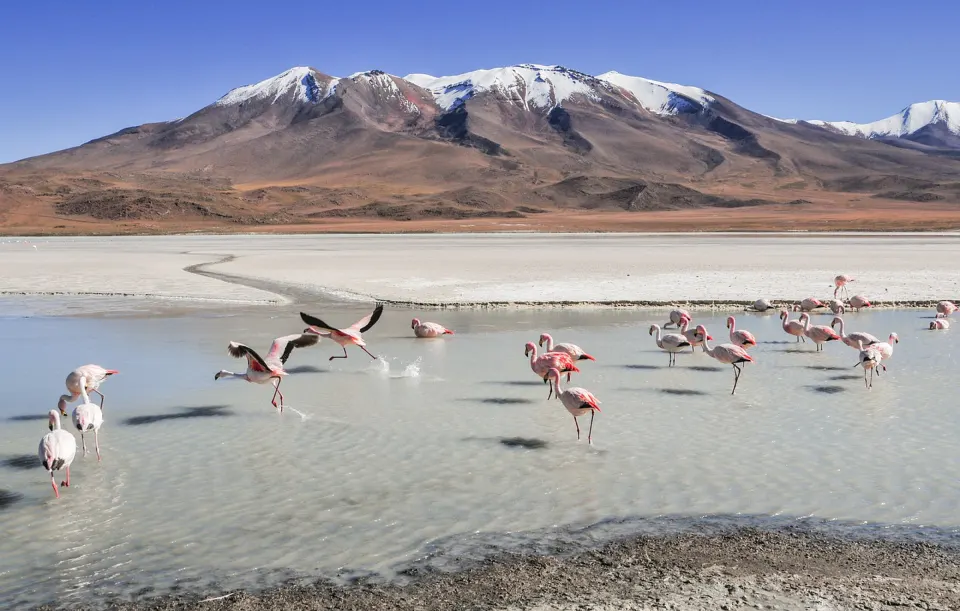
Flamingos wading in lagoon with snowy mountains

Bolivia travel guide

High plains, salt flats and Amazon jungle, all landlocked and all above sea level

Best: May, Jun, Jul, Aug

Photo: mtorrazzina / Pixabay

Capital
Sucre
Languages
Aymara, Guarani, Quechua
Currency
Bolivian boliviano
Time zone
UTC-04:00
Plugs
Type A, C · 230 V / 115 V
Driving
On the right
Emergency
911

Why visit Bolivia

Bolivia suits travellers who like altitude, open space and few crowds. La Paz sits high in the mountains, Uyuni's salt flats stretch flat and white, and Rurrenabaque opens onto the Amazon. May to August is the best window across the country, when La Paz, Sucre and Santa Cruz de la Sierra all line up for drier, clearer days. The catch: with no coastline, you're always dealing with thin air or long overland distances to get between regions.

  • Two capitals, two moods

    Bolivia has two capitals. Sucre, with 360,544 people, sits lower and milder, while La Paz, home to 755,732 people, is the world's highest seat of government. Visiting both in June to August shows two very different sides of Andean life.

  • Santa Cruz, the real metropolis

    Santa Cruz de la Sierra is Bolivia's biggest city by far, with 3,122,605 people, far outsizing La Paz. It sits in the lowlands, a contrast to the mountain cities, and is best visited July or August.

  • Uyuni outside the dry peak

    Uyuni's own best months are September, April, October and May, different from the national peak of May to August. That spread lets travellers time a visit to the salt flats separately from the rest of the country.

  • Rurrenabaque for the Amazon side

    Rurrenabaque, population 21,240, gives access to Bolivia's lowland jungle and rivers, a contrast to the highland cities. Its best months are June and July, inside the wider July-to-August dry season.

  • Copacabana on Lake Titicaca

    Copacabana's best months, July and August, line up with Bolivia's overall dry season. It's a small lakeside stop that pairs easily with La Paz, which shares the same two best months.

Is Bolivia right for you?

Great for

  • Dry-season travellers who can visit June to August, when La Paz gets only 2 to 3.7 rain days a month
  • Landlocked, high-altitude trips: there are no coastal cities, so this suits mountain and plateau travel over beach time
  • Salt flat and desert trips to Uyuni, best around April, May, September and October
  • Jungle trips to Rurrenabaque timed for June or July, the driest months listed
  • Travellers who don't mind cool nights, since La Paz lows drop to 1 to 2.8°C from May to August

Less ideal for

  • Beach seekers, since none of the listed cities are coastal
  • Travellers wanting warm nights, as even the warmest month (December) only reaches a 6.2°C low in La Paz
  • Visitors in January to March, when rain days in La Paz run 19.5 to 21.5 a month
  • People wanting one single best month countrywide, since Uyuni's best months (April, September, October) don't match La Paz's best months (June to August)

Bolivia right now: November

6.1/10
Avg high
18°C
Avg low
6°C
Rain days
13

Averages for La Paz.

Weather by month

Data for La Paz (2015–2024) shows May to August are driest, with just 2 to 5.5 rain days a month and highs near 15 to 16°C, making July the top-rated month. January and February are toughest, with around 20 rain days a month, 124 to 127mm of rain, and lows near 6°C, while nights turn coldest in June and July at 1°C.

Average highs and lows in La Paz by month January: high 16°C, low 6°C , 22 rain days . February: high 15°C, low 6°C , 20 rain days . March: high 15°C, low 6°C , 21 rain days . April: high 16°C, low 5°C , 12 rain days . May: high 16°C, low 3°C , 6 rain days . June: high 15°C, low 1°C , 3 rain days . July: high 16°C, low 1°C , 2 rain days . August: high 16°C, low 2°C , 4 rain days . September: high 17°C, low 3°C , 9 rain days . October: high 18°C, low 5°C , 13 rain days . November: high 18°C, low 6°C , 13 rain days . December: high 17°C, low 6°C , 19 rain days . 16°C 6°C JAN 22d 15°C 6°C FEB 20d 15°C 6°C MAR 21d 16°C 5°C APR 12d 16°C 3°C MAY 6d 15°C 1°C JUN 3d 16°C 1°C JUL 2d 16°C 2°C AUG 4d 17°C 3°C SEP 9d 18°C 5°C OCT 13d 18°C 6°C NOV 13d 17°C 6°C DEC 19d
Best months Other months (low–high) Nd = rain days

La Paz · averages 2015–2024

Best time to visit Bolivia: month-by-month weather →

Bolivia's climate regions

The weather varies across the country; each region has its own best months.

  • Andean Highlands

    La Paz, Sucre

    La Paz and Sucre sit high and stay mild all year, with highs near 17.5°C in both January and July. With about 144 rain days a year, the driest and clearest weather falls from May to August.

    Best: May, Jun, Jul, Aug

  • Lowland Tropics

    Santa Cruz de la Sierra, Rurrenabaque

    Santa Cruz de la Sierra and Rurrenabaque are warm and humid, with highs of 30.3°C in January cooling only to 26.3°C in July. Rain falls on about 171 days a year, so July stands out as the best month to visit.

    Best: Jul

  • Cold Southern Altiplano

    Potosí, Copacabana

    Potosí and Copacabana are cool year-round, with highs around 12-13°C in both January and July and roughly 162 rain days a year. July and August bring the calmest, driest conditions.

    Best: Jul, Aug

  • Uyuni Salt Flat Desert

    Uyuni

    Uyuni is the driest region, with only about 59 rain days a year and highs dropping from 17.6°C in January to 11.5°C in July. April, May, September and October offer a good balance between dry skies and milder temperatures.

    Best: Apr, May, Sep, Oct

Where to go in Bolivia

City guides with their own best months and weather.

Sample itineraries

7 days

La Paz, Lake Titicaca and the Salt Flats

  1. Day 1–3

    La Paz

    Settle into Bolivia's high-altitude seat of government. Walk the steep streets, browse the markets and take a cable car ride for views over the city.

  2. Day 4–5

    Copacabana

    Take the bus to this lakeside town on Lake Titicaca. Spend a day on the water and enjoy the slower pace away from La Paz.

  3. Day 6–7

    Uyuni

    Head out to the salt flats. Use your two days here for a tour across the blinding white Salar de Uyuni.

10 days

Andes, Lake Titicaca and the Salt Flats in Depth

  1. Day 1–3

    La Paz

    Start in the capital. Explore its markets, ride the cable cars and acclimatise to the altitude before heading further into the Andes.

  2. Day 4–5

    Copacabana

    Bus to this town on Lake Titicaca. Spend time on the lake and take a slower pace for a couple of days.

  3. Day 6–7

    Potosí

    Travel on to this former silver-mining city, one of the highest in the world. Visit the old mine sites and colonial centre.

  4. Day 8–10

    Uyuni

    Finish with three days around the Salar de Uyuni salt flats. Join a multi-day tour to see the flats and the surrounding high desert landscapes.

Getting around Bolivia

Typical journey times and fares between the main places.

Route By Time Price
La Paz → Copacabana Operators: Manco Kapac, Trans Titicaca and Vicuña Travel, from the La Paz bus terminal. Fares come from aggregator listings in USD; I couldn't find a Bs fare. Local buses take about 3 h and run hourly. Timetabled coaches take about 4 h (Busbud lists departures from 7:00). The trip includes a short boat crossing at the Strait of Tiquina. A traveller blog says tourist double-decker buses cost about Bs 50, run twice a day and should be booked ahead. bus 3 h 4–7 USD ↗
La Paz → Uyuni Overnight bus taking about 9–12 h. Bolivia Hop recommends Todo Turismo, which offers semi-cama and cama seats with blankets, a meal and a toilet. Fares start at about USD 43 (Bs fare not found). VIP seats cost extra. Another option is a bus to Oruro (about 4 h), then a train to Uyuni (about 7 h). bus 9 h 43 USD ↗
Sucre → Potosí Direct buses take about 3 h. There are about 13 departures a day between 6:00 and 19:00, run by companies including Trans Emperador. Potosí buses use the new terminal on Av. Las Banderas. A 2014-era traveller blog gives the fare as Bs 30; check current prices. Shared taxis are also available. bus 3 h 30 BOB ↗
Potosí → Uyuni 204 km on a paved road, about 3 h. Leaves from Potosí's old bus terminal on Av. Universitaria. A traveller report says Uyuni–Potosí buses leave around 9:00–9:30 and 18:00–18:30. Fare not found. bus 3 h – ↗

Staying connected

If your phone plan doesn't include Bolivia, an eSIM set up before you leave gives you data on arrival.

Where to stay

One good base in each main city and who it suits.

Rosario

La Paz

Good for first-timers, backpackers, budget

This is the traveller hub around Calle Sagárnaga and the Witches' Market, just above San Francisco church, with tour agencies, cafés and craft shops all close together. It is the easiest base for booking day trips and walking to the main sights. The streets are very steep, traffic is loud, and pickpockets work the busy areas.

Centro Histórico

Sucre

Good for first-timers, sightseeing, cafés

The grid of white colonial streets around Plaza 25 de Mayo puts you within walking distance of the main churches, museums, cafés and Spanish schools. It is the easiest base for a first visit. Rooms facing the plaza or busy streets can get traffic, horn and festival noise, especially on weekends.

Good for nightlife, business travellers, dining

This modern district north-west of the centre has the city's main cluster of bars, clubs, restaurants and newer hotels. Stay here if you want evenings out and a more upscale feel. Bars can be loud on weekends, and you will need a taxi to reach the old centre.

Centro Histórico

Potosí

Good for first-timers, sightseeing

The old colonial grid around Plaza 10 de Noviembre holds the main churches, the Casa Nacional de Moneda and most tour agencies for the Cerro Rico mine trips. You can walk to almost everything, which matters at this altitude. Streets are steep and narrow, and traffic and horns can be loud in the daytime.

Avenida Potosí

Uyuni

Good for budget travellers, tour shoppers

This street runs through the centre and is lined with tour offices, simple guesthouses and places to eat. It is handy for booking a salt flat trip and grabbing food before departure. Tour jeeps load and leave here early, so expect engine noise and activity in the morning.

Riverfront

Rurrenabaque

Good for couples, sunset views, short stays

The streets along the Beni River give views of the water and the forested hills on the far bank, with a cooling breeze in the evening. Boats to the national park and to San Buenaventura leave from here, and the centre is a short walk away. Low-lying spots can be damp and buggy, especially in the rainy season.

Plaza 2 de Febrero

Copacabana

Good for first-timers, sightseeing, short stays

This is the town's main square, beside the white Basilica of Our Lady of Copacabana. You can walk to the basilica, the market, the bus stops and the lake in a few minutes. Church bells, festivals and car blessings outside the basilica can make it noisy, especially at weekends.

Food to try in Bolivia

Salteñas

A baked pastry filled with meat or chicken, potato, olives and a slightly sweet, juicy sauce. Bolivians usually eat them as a mid-morning snack, often before noon.

Pique macho

A plate of chopped beef and sausage piled on fried potatoes, topped with onions, tomatoes, chili and sometimes a fried egg. It's a shared dish, popular in Cochabamba and often ordered with friends over drinks.

Anticuchos

Grilled beef heart skewers marinated in spices, sold by street vendors in the evening. They're a common quick bite in cities across Bolivia.

Chairo

A thick soup from the highlands made with chuño (freeze-dried potato), lamb or beef, and vegetables. It's a warming dish suited to the cold evenings of La Paz and the Altiplano.

Silpancho

A plate of flattened, breaded beef served over rice and potatoes, topped with a fried egg and fresh tomato-onion salad. It originated in Cochabamba and is now found nationwide.

Api con pastel

A thick, warm purple corn drink spiced with cinnamon and cloves, served with a sugar-dusted fried pastry. It's a classic breakfast combination sold at street stalls early in the morning.

Know before you go

  • Currency: The currency is the Bolivian boliviano. Carry cash in smaller towns, since card payments are less common outside major cities.
  • Language: Spanish is the main language, alongside Aymara, Guarani and Quechua. English is not widely spoken outside tourist hubs, so a few Spanish phrases help.
  • Plugs and voltage: Bolivia uses plug types A and C. Voltage is 230 V or 115 V depending on the outlet, so check your device before plugging in.
  • Driving side: Traffic drives on the right. Roads vary a lot in quality, especially in rural and mountain areas.
  • Emergency number: Dial 911 for emergencies anywhere in the country.
  • Calling code: Bolivia's international calling code is +591, useful for setting up a local SIM or calling home.
  • Altitude: Much of Bolivia, including La Paz and Lake Titicaca, sits at high altitude. Give yourself a day or two to adjust before heavy activity.

Bolivia: frequently asked questions

Is Bolivia good to visit in August?

Yes. August scores 7.8 out of 10 and carries a "best" verdict for La Paz. Days reach 16.2°C with lows near 1.6°C, and rain falls on only about 3.7 days with just 16 mm total, so skies stay clear with 11 hours of sun.

What is the best month to visit Bolivia?

July is the top-rated month, scoring 8.1 out of 10. It has only 2 rain days and 9 mm of rain in La Paz, the driest reading of the year, plus 10.8 hours of sun daily. June, August and May also rank as "best" months.

When is the rainy season in Bolivia?

The wettest months in La Paz run from December to March. January sees 21.5 rain days and 124 mm of rain, February has 127 mm, and March brings 112 mm. By contrast, June and July drop to just 9 mm each.

How many days do I need to travel around Bolivia?

The fact pack does not give a total trip length, but key legs take: La Paz to Copacabana 3 hours by bus, La Paz to Uyuni 9 hours, and Potosí to Uyuni 3 hours. Linking La Paz, Copacabana, Sucre, Potosí and Uyuni means several multi-hour bus rides.

Is La Paz cold at night?

Yes, nights are cold year-round. Lows drop to 1°C in July and 1.1°C in June, the coldest months, while even the warmest nights in December and January only reach about 6.1–6.2°C. Daytime highs stay mild, between 15°C and 18°C all year.

When is the best time to visit Uyuni's salt flats?

Uyuni's listed best months are September, April, October and May. This spans the transition between Bolivia's dry and wet seasons, which matters because the salt flats look different depending on rainfall: dry conditions give the classic white salt crust, while wetter periods can create the famous mirror effect.

Similar destinations

Countries with a year of weather much like Bolivia.