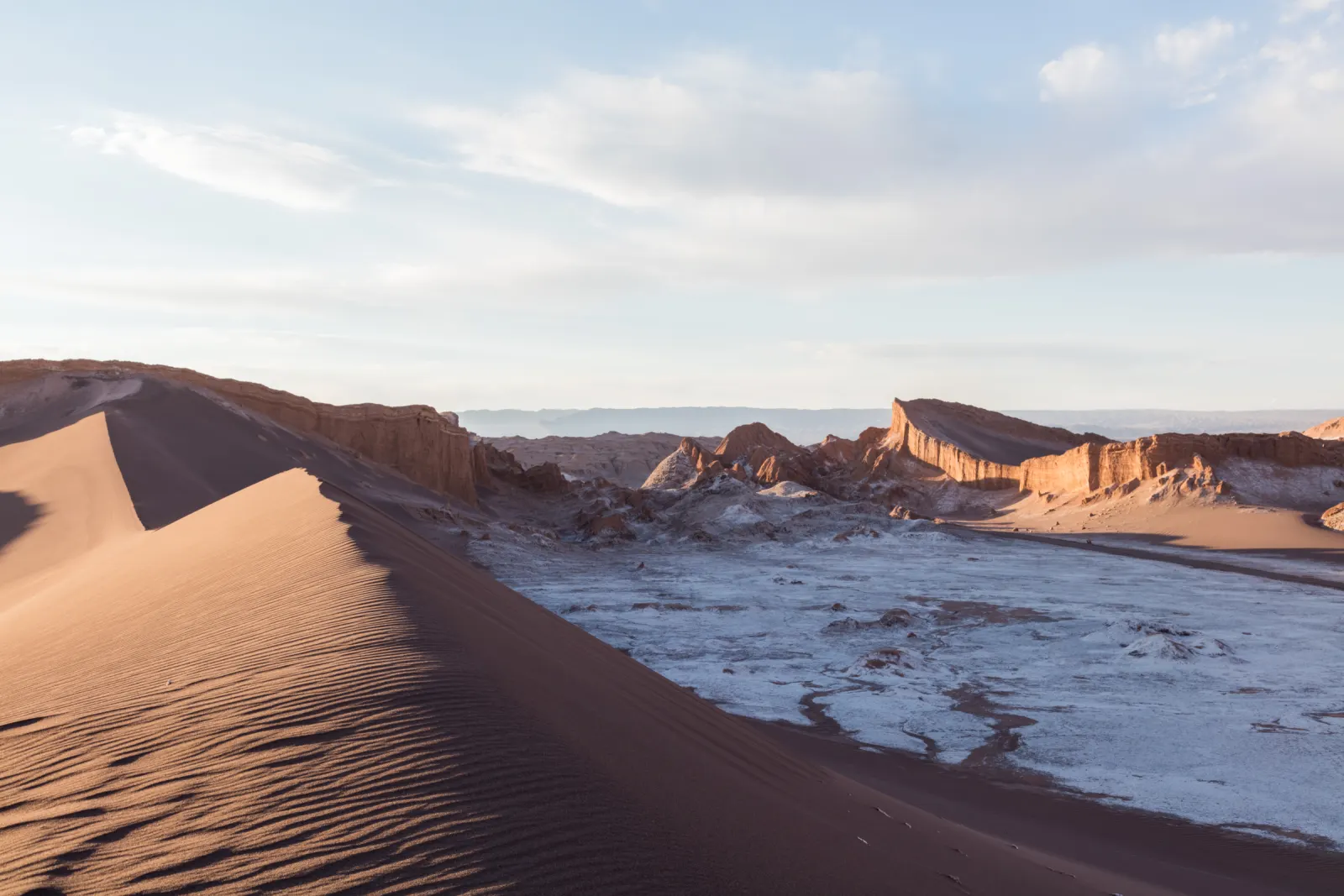
A long, narrow country of desert, coast and glaciers, best explored coast to coast in summer
Best: Jan, Feb, Mar, Dec
Photo: Diego Delso / Wikimedia Commons
Best months
Jan, Feb, Mar, Dec
Top score of 8.3, with hot days near 29°C, only 1.2 rain days and 12.7 sun hours.
Shoulder season
Apr, May, Sep, Oct
Capital
Santiago
Language
Spanish
Currency
Chilean peso (CLP)
Time zone
UTC-06:00, UTC-04:00
Plugs
Type C, L · 220 V
Driving
On the right
Emergency
130 / 131 / 132
Why visit Chile
Chile stretches from northern desert towns like Iquique to southern ports like Punta Arenas, covering a huge range of landscapes in one trip. December to March is the best window, when Valparaíso, La Serena and the south around Puerto Montt and Valdivia all get good weather at once. Santiago suits spring and autumn (April, May, October, November) better than peak summer. The honest limitation: with 756,102 km2 to cover, moving between regions takes real time and planning.
A country of extreme length
Chile stretches across 756,102 km2 but is famously narrow, running from the dry north to the far south. This means you can combine desert landscapes with southern coastal towns like Puerto Montt and Punta Arenas in one trip, each with its own climate and season.
Santiago, a major capital
Santiago is home to over 6,257,516 people, making it one of South America's largest cities. Its best months are April, May, October and November, giving travellers a clear window outside the busy summer season to explore the capital.
Colourful coastal Valparaíso
Valparaíso is a coastal city of 296,655 people with a best-season window of December to March, matching the warmer months. It sits close enough to Santiago for an easy add-on trip along the central coast.
Patagonia at the southern tip
Punta Arenas, with 123,403 residents, is the gateway to Chilean Patagonia. Its best months are January and February, when the far south gets its warmest and most stable weather for exploring this remote coastal region.
Northern desert cities with a short clear season
Iquique, a coastal city of 188,003 people, has a tight best-season window of just February and March. This narrow timing reflects the dry, desert-edge climate of northern Chile, distinct from the wetter south around Valdivia and Puerto Montt.
Is Chile right for you?
Great for
Sun seekers in January to March, when Santiago has about 1 rain day a month and 12–13.5 sun hours
Seaside city trips to Valparaíso, Iquique, Puerto Montt or Punta Arenas, all at their best in February
City breaks in Santiago in April, May, October or November, with highs of 19–26 °C
Long, slow trips across a big country of 756,102 km² with many coastal cities
Less ideal for
Winter trips hoping for warm days: Santiago highs are about 15 °C in June and July
Travellers who want dry weather in June to September, with 5–6 rain days and up to 79 mm
Short trips trying to cover the whole country: 756,102 km² across 2 time zones
Travellers with no Spanish, as it is the only listed language
Chile right now: October
6.9/10
Avg high
22°C
Avg low
10°C
Rain days
5
Averages for Santiago.
Weather by month
This data is for Santiago: January, February, March and December score best, with highs near 28-30°C, under 1.2 rain days a month and over 12 sunshine hours daily. June through August are the toughest, with highs of only 15-16°C, up to 6.3 rain days a month and rainfall reaching 79mm in June, plus the fewest sunshine hours of the year.
The weather varies across the country; each region has its own best months.
Central Chile / Atacama fringe
Santiago, Valparaíso, La Serena, Iquique
Santiago, Valparaíso, La Serena and Iquique see dry weather with only 22.6 rain days a year. Highs reach 24.5°C in January and 16°C in July, making February, March, April and November the best months to visit.
Best: Feb, Mar, Apr, Nov
Lake District South (Puerto Montt)
Puerto Montt
Puerto Montt is wet, with 193.7 rain days a year. Highs average 18°C in January and 9.7°C in July, so January and February are the driest and warmest months to go.
Best: Jan, Feb
Valdivia Rainforest Coast
Valdivia
Valdivia gets 138.7 rain days a year but is milder and sunnier in summer, with highs of 22.2°C in January against 10.5°C in July. December through March are the best months.
Best: Jan, Feb, Mar, Dec
Patagonia (Punta Arenas)
Punta Arenas
Punta Arenas is cool year-round, with January highs of only 13.4°C and July highs of 4°C, plus 177.8 rain days a year. January and February bring the mildest, driest conditions for visiting.
Best: Jan, Feb
Where to go in Chile
City guides with their own best months and weather.
Start in the capital, home to 6,257,516 people. Explore the historic center, ride the funicular up Cerro San Cristóbal, and visit local markets before heading to the coast.
End the trip in La Serena, a coastal city of 195,382 people. Enjoy the beaches and the clear night skies that make this region popular with stargazers.
Head further south to Valdivia, a city of 150,048 people set among rivers and forests. Visit the riverside market and explore the surrounding countryside by boat.
Finish in Puerto Montt, a coastal city of 169,736 people and gateway to Chile's Lake District. Use the last days to take in views of water and volcanoes nearby.
A compact area of old buildings, small cafés, bookshops and galleries next to Cerro Santa Lucía, with the historic centre and Bellavista within walking distance. It is a good base for seeing the main sights on foot. Weekend evenings can be loud, and bag snatching is a known problem, so stay alert.
A hill of painted houses, murals and steep lanes, with many guesthouses, restaurants and viewpoints close together. It is the easiest base for exploring on foot and sits near the old funiculars down to the flat centre. The streets are steep and cobbled, which is hard work with heavy luggage, and it gets crowded with day visitors.
The old centre has colonial-style churches, the Plaza de Armas, museums, markets and plenty of places to eat, all within walking distance. Most buses and tours leave from here or nearby, so it makes a practical base. The beach is a bus or taxi ride away, and some streets feel empty in the evening once the shops close.
This is Iquique's main beach area, with a long seafront promenade, calm water for swimming and plenty of cafés and restaurants. Staying here puts you on the sand and within a short taxi or colectivo ride of the centre. The drawback is that it is built up with tall apartment blocks and gets crowded and noisy on summer weekends.
This working fishing port west of the centre has the city's best-known seafood market, craft stalls and small boats across to Isla Tenglo. Staying here puts you next to cheap, fresh food and the sea. It is a working area with fish smells and heavy traffic by day, and it feels deserted after dark.
The compact grid around Plaza de la República puts you within walking distance of the riverside Costanera, the fish market and the boat departures. Cafés, restaurants and buses to the coast are all close by. Streets near the plaza and main roads can be noisy with traffic and weekend crowds.
The grid of streets around Plaza Muñoz Gamero holds most restaurants, cafés, tour agencies and museums, so you can do nearly everything on foot. It is the easiest base for booking trips to penguin colonies or Torres del Paine. Many shops close on Sundays, and some streets feel quiet and empty after dark.
Food to try in Chile
Empanada de pino
A baked pastry filled with minced beef, onion, olive, raisin and hard-boiled egg. Bakeries sell them all year, and families eat them in large numbers during the national holidays.
Pastel de choclo
A baked dish of minced meat and chicken, topped with a sweet layer of ground corn. It is a summer dish, when fresh corn is in season, and often comes in a clay bowl.
Completo
A hot dog piled with tomato, avocado and mayonnaise. It is cheap street and snack-bar food, eaten at lunch or late at night in towns across the country.
Cazuela
A clear soup with a large piece of beef or chicken, potato, pumpkin and corn. It is a home-style dish, and many small restaurants serve it as a set lunch.
Pisco sour
A cocktail of pisco (a grape brandy), lemon juice, sugar and egg white. Bars and restaurants serve it everywhere, often as a drink before dinner.
Curanto
A mix of shellfish, meat, potatoes and dumplings, cooked over hot stones in a pit and covered with leaves. It comes from the island of Chiloé in the south.
Know before you go
Plugs and voltage:
Chile uses plug types C and L, and the voltage is 220 V. Check that your chargers work at 220 V. Bring an adapter if your plugs are a different type.
Driving side:
Traffic in Chile drives on the right. If you come from a country that drives on the left, take extra care at junctions and roundabouts for the first few days.
Emergency numbers:
The emergency numbers in Chile are 130, 131 and 132. Save them in your phone before you arrive, so you are not searching for them when something goes wrong.
Currency:
The currency is the Chilean peso (CLP). Check the exchange rate before you travel, so you can quickly judge whether a price seems fair.
Language:
Spanish is the language of Chile. Learn a few basic phrases, and keep a translation app on your phone for menus, signs and bus stations.
Time zones:
Chile has 2 time zones, listed as UTC-06:00 and UTC-04:00. Check which one applies to your destination when you book flights, tours or transfers.
Calling code:
The country calling code for Chile is +56. Use it when you save local numbers, such as your hotel or tour operator, in your phone.
Chile: frequently asked questions
Is Chile good to visit in August?
August is an ok month, scoring 5.6 out of 10 in Santiago. It's one of the coolest, wettest months, with a high of just 16.4°C, a low of 7.1°C, and 6.3 rain days averaging 66 mm. Sun hours drop to 8.4, so plan for overcast, cooler days if you travel then.
What is the best time to visit Chile?
The best months are February, January, March and December, each scoring 8 or higher out of 10. These are Chile's summer months in Santiago, with highs between 27.8°C and 29.5°C, almost no rain (0.4 to 1.2 rain days), and 11.6 to 13.5 hours of sunshine a day.
Is Chile good in November?
Yes, November is rated 'best' with a score of 7.6 out of 10. Santiago sees highs of 25.6°C, lows of 12.1°C, only 2.3 rain days, and 12.3 hours of sunshine, making it a warm, dry transition into summer.
When is the rainy season in Chile?
Santiago's wettest months run from May to September, with June the wettest at 79 mm over 5.9 rain days. July and August also stay cool, with highs near 15°C and only 6.8 to 8.4 hours of sun, so expect grey, damp weather in this stretch.
What's the weather like in Santiago in April?
April is mild and scores 7.3 out of 10, rated 'good'. Expect a high of 23.3°C, a low of 12°C, 2.2 rain days, and 33 mm of rain. Sun hours drop to 9.7, marking the shift from dry summer toward Chile's cooler, wetter winter months.
Do coastal cities like Valparaíso and Punta Arenas have different best months than Santiago?
Valparaíso shares Santiago's best months of February, January, March and December. Punta Arenas, much further south, peaks only in February and January, reflecting its shorter, cooler summer season. La Serena and Puerto Montt also lean toward these same summer months for the best conditions.