Skip to content
wheretotravel.info
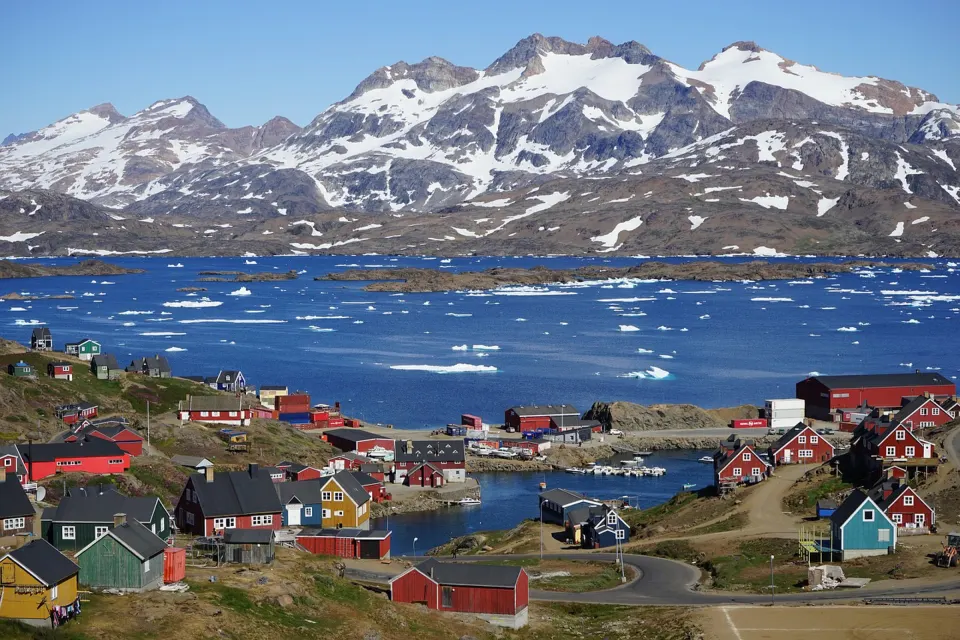
Colorful town by fjord with icebergs and snowy peaks

Greenland travel guide

Huge ice, tiny towns, and a short window to see both

Best: Jul, Aug

Photo: Barni1 / Pixabay

Capital
Nuuk
Language
Greenlandic
Currency
Danish krone (DKK)
Time zone
UTC-04:00, UTC-03:00 +2
Plugs
Type C, E, F, K · 230 V
Driving
On the right
Emergency
112

Why visit Greenland

Greenland suits travellers who want glaciers, icebergs and small coastal towns rather than crowds. With just 56,945 people spread over 2,166,086 km2, distances between settlements are large and travel between them usually means a boat or a flight. July and August are the best months, when Nuuk, Sisimiut, Ilulissat, Tasiilaq and Uummannaq are most accessible. The honest limitation: outside this short summer season, weather and transport links become far less reliable.

  • A whole continent-sized emptiness

    Greenland covers 2,166,086 km2 but has only 56,945 people. That's one of the lowest population densities anywhere, so most of the land is ice, fjords and open coast with almost no one around.

  • Towns built along the coast

    Every settlement in the country, from the capital Nuuk (18,326 people) to small Uummannaq (1,407 people), sits on the coast. There are no inland roads linking towns, so travel between them happens by boat or plane.

  • Ilulissat and its ice

    Ilulissat, with 4,737 residents, is best visited in June or July, earlier than most other towns, which peak in July and August. This timing lines up with the season when the famous icefjord is most accessible.

  • July and August for the whole country

    July and August are the best months almost everywhere, from Nuuk and Sisimiut to Tasiilaq and Uummannaq. This is a narrow window, reflecting how short Greenland's ice-free, navigable season really is.

  • East coast remoteness in Tasiilaq

    Tasiilaq, population 1,985, is the main town on Greenland's east coast and one of the smallest on this list. Its isolation from the larger west-coast towns gives a sense of how spread out and disconnected Greenland's communities are.

Is Greenland right for you?

Great for

  • Travellers who want a true wilderness trip, not crowds, in a country of just 56945 people
  • Visitors keen on summer hiking and boat trips, with highs of 11 to 12°C in July and August
  • Anyone chasing long polar night skies for aurora, with sun hours dropping to around 1 to 2 hours in December and January
  • People who enjoy small coastal towns, since even Nuuk, the capital, has only 18326 residents

Less ideal for

  • Beach holiday seekers, since sea temperatures stay between -1.7°C and 5.9°C all year
  • Travellers who dislike rain or snow often, with 9 to 14 rain days recorded in most months
  • Anyone wanting warm, sunny days, since even peak summer highs average only 11 to 12°C
  • Visitors hoping for long daylight sightseeing in winter, when sun hours fall below 4 from November to February

Greenland right now: November

1.4/10
Avg high
-4°C
Avg low
-9°C
Rain days
11
Sea
1°C

Averages for Nuuk.

Weather by month

Based on data for Nuuk, July and August are the mildest months, with highs of 11–12°C, sea temperatures up to 5.9°C, and around 9 hours of sun a day, making them the best window for a visit. The toughest weather runs from December to February, when highs stay below -6°C, lows drop near -16°C, and sunshine falls to just 1–4 hours daily.

Average highs and lows in Nuuk by month January: high -9°C, low -14°C , 14 rain days . February: high -10°C, low -16°C , 12 rain days . March: high -7°C, low -12°C , 11 rain days . April: high -1°C, low -6°C , 10 rain days . May: high 2°C, low -2°C , 9 rain days . June: high 8°C, low 3°C , 12 rain days . July: high 12°C, low 6°C , 10 rain days . August: high 11°C, low 6°C , 10 rain days . September: high 7°C, low 2°C , 12 rain days . October: high 1°C, low -4°C , 11 rain days . November: high -4°C, low -9°C , 11 rain days . December: high -6°C, low -12°C , 11 rain days . -9°C -14°C JAN 14d -10°C -16°C FEB 12d -7°C -12°C MAR 11d -1°C -6°C APR 10d 2°C -2°C MAY 9d 8°C 3°C JUN 12d 12°C 6°C JUL 10d 11°C 6°C AUG 10d 7°C 2°C SEP 12d 1°C -4°C OCT 11d -4°C -9°C NOV 11d -6°C -12°C DEC 11d
Best months Other months (low–high) Nd = rain days

Nuuk · averages 2015–2024

Best time to visit Greenland: month-by-month weather →

Greenland's climate regions

The weather varies across the country; each region has its own best months.

  • Nuuk and the Southwest Coast

    Nuuk

    Winters average -8.5°C in January, summers reach 11.6°C in July. Rain falls on about 132 days a year, making this the wettest of the main towns. July and August bring the mildest, driest weather for walking and boat trips.

    Best: Jul, Aug

  • Sisimiut and the Central Coast

    Sisimiut

    January highs average -11.6°C and July highs reach 10.5°C. With around 115 rain days a year, conditions are a bit drier than Nuuk. July and August are the best months, with longer daylight and calmer seas.

    Best: Jul, Aug

  • Ilulissat and the Disko Bay Icefjord

    Ilulissat, Uummannaq

    This is the driest region, with about 80 rain days a year. January highs average -12.4°C and July highs reach 10.5°C. July and August give the clearest skies for viewing the icefjord and icebergs.

    Best: Jul, Aug

  • Tasiilaq and the East Coast

    Tasiilaq

    Winters are milder here, with January highs around -5.4°C, but summer highs only reach 8.3°C in July. It's the wettest region, with roughly 153 rain days a year. July and August still offer the calmest conditions for travel.

    Best: Jul, Aug

Sample itineraries

7 days

Icebergs and Coastal Towns in a Week

  1. Day 1–3

    Ilulissat

    Start in Ilulissat, a coastal town of 4,737 people. July and June are its best months, giving long daylight hours to walk near the icebergs along the coast.

  2. Day 4–5

    Uummannaq

    Move on to Uummannaq, a small coastal settlement of 1,407 residents. Best visited in July or August, it offers a quieter pace than the bigger towns.

  3. Day 6–7

    Nuuk

    Finish in Nuuk, Greenland's capital and largest city with 18,326 people. July and August are the best months to explore the waterfront and town center before departing.

10 days

Ten Days Along Greenland's West and East Coasts

  1. Day 1–2

    Nuuk

    Begin in the capital, Nuuk, home to 18,326 people. Visit in July or August, when the weather is at its mildest for walking around the coastal capital.

  2. Day 3–4

    Sisimiut

    Continue to Sisimiut, a coastal town of 5,582 people. July and August are best for exploring this northern settlement by the sea.

  3. Day 5–7

    Ilulissat

    Spend three days in Ilulissat, population 4,737, known for its coastal icebergs. June and July give the longest daylight for sightseeing.

  4. Day 8–9

    Uummannaq

    Head to Uummannaq, a small coastal community of 1,407 people. Visit in July or August for calmer coastal conditions.

  5. Day 10

    Tasiilaq

    End the trip in Tasiilaq on the east coast, home to 1,985 people. July and August are its best months for a final day by the water.

Food to try in Greenland

Suaasat

This is Greenland's national soup, usually made with seal, whale, or reindeer meat, onions, and rice or barley. It is eaten year-round, especially in colder months, as a warming family meal.

Dried fish (ammassat)

Small capelin fish are dried outdoors on racks, often in spring when they run close to shore. Locals snack on them whole, bones and all.

Whale and seal meat

Minke whale (mattak, the skin and blubber) and seal are traditional Inuit foods still served at local gatherings. Mattak is often eaten raw or pickled.

Musk ox and reindeer

Both animals are hunted on land and their meat appears in stews, steaks, and burgers in restaurants, particularly in South Greenland where herds are common.

Arctic char and halibut

These cold-water fish are caught locally and served smoked, grilled, or raw as part of modern Nordic-style menus in Nuuk and other towns.

Kaffemik baked goods

A kaffemik is a traditional open-house coffee gathering, often held for birthdays or celebrations, where guests are offered coffee alongside cakes and pastries.

Know before you go

  • Currency: Greenland uses the Danish krone (DKK). Cards are widely accepted, so you don't need to carry much cash for daily spending.
  • Language: Greenlandic is the official language. Danish is also common, and many people in towns speak some English, especially those working in tourism.
  • Plugs and voltage: Power sockets are type C, E, F and K, running at 230 V. Bring an adapter if your home country uses a different plug shape.
  • Emergency number: Dial 112 for police, fire or medical emergencies anywhere in Greenland.
  • Driving side: Traffic drives on the right. Note that most towns are not connected by roads, so you'll often travel between them by boat, plane or snowmobile instead of car.
  • Calling code: Greenland's international calling code is +299. Check your phone plan before arrival, as roaming costs can be high in such a remote area.
  • Time zones: Greenland spans four time zones, from UTC-04:00 to UTC+00:00. Double-check the local time for the specific town you're visiting, since it varies widely across the country.

Greenland: frequently asked questions

Is Greenland good to visit in August?

Yes, August is one of the two best months to visit, alongside July. In Nuuk, August highs reach 11°C with lows around 5.5°C, sea temperature hits 5.9°C, and there are 8.7 hours of sun a day. Rain still falls on about 10 days, but temperatures are the mildest of the year.

What is the best month to visit Greenland?

July scores highest overall, followed closely by August. In Nuuk, July highs average 11.6°C with 10.6 hours of sunshine daily and the warmest sea temperature of the year at 5.2°C. These two months offer the mildest, driest conditions for travel around the coast.

Is Greenland cold in winter?

Yes, winter in Greenland is very cold. In Nuuk, January highs average -8.5°C and lows drop to -14°C, with only 1.5 hours of sunlight a day. December and February are similarly dark and cold, with sun hours as low as 1.1 in December. These months score lowest on our climate scale.

When is the rainiest time in Greenland?

September and June bring the most rain in Nuuk, with 109 mm and 107 mm respectively. January also sees frequent rain, falling on 14 days that month. Spring months like May and March are drier, with rainfall around 55-60 mm, though temperatures then are still well below freezing.

Is the sea warm enough to swim in Greenland?

No, sea temperatures stay cold year-round in Nuuk. Even at the warmest point, August, the sea only reaches 5.9°C. For most of the year, from November through June, sea temperatures sit at or below 2.5°C, and from December to March they drop below 0°C.

How many daylight hours does Greenland get in winter?

Very few. Nuuk averages just 1.1 hours of sun in December and 1.5 hours in January, the darkest months of the year. Daylight increases through spring, reaching 10.8 hours by May, before peaking in summer when July and August still average around 9 to 10.6 hours.

Similar destinations

Countries with a year of weather much like Greenland.