Skip to content
wheretotravel.info
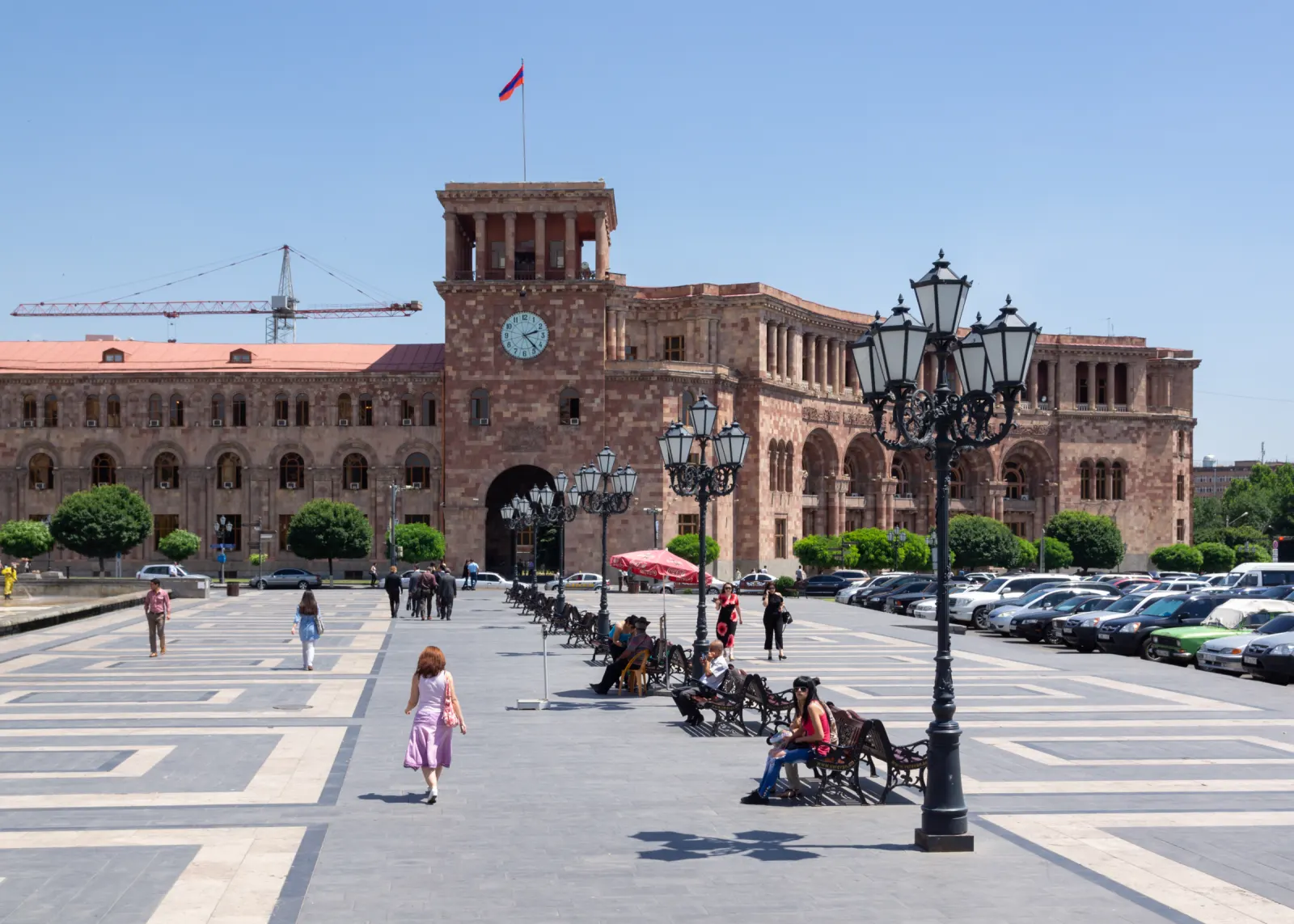
Republic Square building with clock tower

Armenia travel guide

A compact, mountainous country for travellers who want ancient monasteries without the crowds

Best: Sep

Photo: Vyacheslav Argenberg / Wikimedia Commons

Capital
Yerevan
Language
Armenian
Currency
Armenian dram
Time zone
UTC+04:00
Plugs
Type C, F · 220 V
Driving
On the right
Emergency
112

Why visit Armenia

Armenia suits independent travellers who like history, hiking and slow road trips between stone churches and mountain villages. The capital Yerevan and other cities such as Gyumri and Hrazdan are busiest with good weather around September, when days are warm but not scorching. Being landlocked and mountainous, Armenia has cold winters and hot summers, so shoulder-season months give the most comfortable conditions for exploring on foot.

  • Yerevan, a capital of over a million

    Yerevan holds 1,106,300 people, more than a third of Armenia's total population of 3,103,900. The best months to visit are October, September, April and May, giving travellers a spring and autumn window to explore a capital of this size.

  • A compact country, easy to cross

    Armenia covers just 29,743 km2, so cities like Gyumri (121,976 people), Hrazdan (52,283) and Alaverdi (13,000) sit within reach of each other, letting independent travellers combine capital and smaller towns without long transit times.

  • September works almost everywhere

    September is the single best month listed across the whole country and appears in the top months for Yerevan, Gyumri, Hrazdan and Alaverdi alike. That overlap makes it the simplest time to plan a trip touching multiple cities.

  • Summer suits the regional towns

    Gyumri, Hrazdan and Alaverdi all list July and August among their best months, alongside September. This points to a warmer-weather travel pattern outside the capital, distinct from Yerevan's spring-and-autumn preference.

  • A single time zone and currency to manage

    Armenia runs on one time zone, UTC+04:00, and uses the Armenian dram throughout, with Armenian as the main language. For travellers moving between Yerevan and smaller cities, this keeps logistics simple.

Is Armenia right for you?

Great for

  • Travellers who enjoy warm, dry summers: Yerevan hits 33.6°C in August with just 1.8 rain days
  • Landlocked-country explorers, since Armenia has no coastline and all four listed cities are inland
  • Shoulder-season visitors, as September brings warm 28.3°C highs and only 2.7 rain days
  • Spring travellers who like greenery, when May rainfall peaks at 84mm over 12 rain days
  • Sun seekers, with June to August offering 12.6 to 13.6 hours of sunshine a day

Less ideal for

  • Beach holidaymakers, since the country has no coastal cities in the data
  • Winter warmth seekers, as January highs only reach 3.2°C and lows drop to -4.8°C
  • Travellers who dislike spring rain, since March to May bring 10 to 12 rain days a month

Armenia right now: November

4.9/10
Avg high
12°C
Avg low
3°C
Rain days
5

Averages for Yerevan.

Weather by month

In Yerevan, September stands out with highs near 28°C, low rainfall (14mm) and plenty of sun, making it the top-scoring month. January and February bring the toughest weather, with highs around 3–6.5°C, lows below freezing and limited sunshine, while July and August turn hot and dry with highs above 33°C.

Average highs and lows in Yerevan by month January: high 3°C, low -5°C , 6 rain days . February: high 7°C, low -3°C , 6 rain days . March: high 12°C, low 2°C , 12 rain days . April: high 18°C, low 7°C , 11 rain days . May: high 23°C, low 11°C , 12 rain days . June: high 30°C, low 17°C , 5 rain days . July: high 33°C, low 20°C , 3 rain days . August: high 34°C, low 20°C , 2 rain days . September: high 28°C, low 16°C , 3 rain days . October: high 20°C, low 9°C , 7 rain days . November: high 12°C, low 3°C , 5 rain days . December: high 6°C, low -2°C , 7 rain days . 3°C -5°C JAN 6d 7°C -3°C FEB 6d 12°C 2°C MAR 12d 18°C 7°C APR 11d 23°C 11°C MAY 12d 30°C 17°C JUN 5d 33°C 20°C JUL 3d 34°C 20°C AUG 2d 28°C 16°C SEP 3d 20°C 9°C OCT 7d 12°C 3°C NOV 5d 6°C -2°C DEC 7d
Best months Other months (low–high) Nd = rain days

Yerevan · averages 2015–2024

Best time to visit Armenia: month-by-month weather →

Armenia's climate regions

The weather varies across the country; each region has its own best months.

  • Yerevan Basin

    Yerevan

    Yerevan has hot summers, with highs around 33.3°C in July, and cold winters near 3.2°C in January. Rain falls on about 77 days a year, and the best months are April, May, September and October.

    Best: Apr, May, Sep, Oct

  • Gyumri and Alaverdi Highlands

    Gyumri, Alaverdi

    This region has milder summers than Yerevan, with July highs around 26.2°C, and cool winters near 2.6°C in January. It sees more rain, about 121 days a year, with July, August and September being the best months to visit.

    Best: Jul, Aug, Sep

  • Hrazdan Uplands

    Hrazdan

    Hrazdan is the coolest region, with July highs of just 23.3°C and winter highs dropping to -2°C in January. It gets the most rain of the three regions, about 131 days a year, with July, August and September the best months.

    Best: Jul, Aug, Sep

Where to go in Armenia

City guides with their own best months and weather.

Sample itineraries

7 days

Yerevan and Northern Armenia in a Week

  1. Day 1–3

    Yerevan

    Spend three days in the capital, home to 1106300 people. Walk around the central squares and museums, and use the city as a base for day trips.

  2. Day 4–5

    Alaverdi

    Head north to this small town of 13000 residents. It sits in a steep gorge and is a good base for exploring the surrounding hills and old monasteries.

  3. Day 6–7

    Gyumri

    Finish in Armenia's second city, with a population of 121976. Explore its 19th-century black-stone architecture and local craft workshops before heading back.

10 days

Ten Days Across Armenia's Cities

  1. Day 1–3

    Yerevan

    Start in the capital, population 1106300, and take time to explore its markets, museums and squares at an easy pace.

  2. Day 4–5

    Hrazdan

    Visit this smaller city of 52283 people, known for its lake views and quieter streets, a short trip from the capital.

  3. Day 6–7

    Alaverdi

    Continue to Alaverdi, a town of 13000 set deep in a gorge, with old bridges and monastery ruins nearby to explore on foot.

  4. Day 8–10

    Gyumri

    End the trip in Gyumri, home to 121976 residents, known for its black-stone buildings, museums and strong craft traditions.

Getting around Armenia

Typical journey times and fares between the main places.

Route By Time Price
Yerevan → Gyumri Run by South Caucasus Railway from Yerevan Central Station. One timetable lists an express taking 2 h 10 min for 2,500 AMD and regular trains taking about 3 h for 1,000–1,200 AMD. Express trains have run mainly on Friday to Sunday. Buy your ticket at the station; one guide says arriving 30 minutes early is enough. Check the current timetable before you travel. train 2 h 10 min 1000–2500 AMD ↗
Yerevan → Gyumri Marshrutka (minibus) from the parking area next to Sasuntsi David metro station. They run 08:00–20:00 and leave when full, with no fixed schedule. The trip takes 2–2.5 h. The last minibus back from Gyumri leaves around 19:00. They are often crowded. bus 2 h 1500 AMD ↗
Yerevan → Alaverdi Marshrutka. Sources disagree on where it leaves from: one says the Northern Bus Station, a traveller report says the Central (Kilikia) Bus Station. Reported fares range from 1,500 to 2,500 AMD. The trip takes about 3 h, and up to 4 h in some reports. There are only a few departures a day, so check times locally. Shared taxis are faster and cost more. bus 3 h 1500–2500 AMD ↗
Alaverdi → Gyumri Wikivoyage says a daily marshrutka runs between Alaverdi and Gyumri, and Rome2rio shows about 2 h. We could not confirm the fare. You can also take a marshrutka to Vanadzor (about 1 h, 500 AMD per Wikivoyage) and change there. bus 2 h 5 min – ↗
Yerevan → Hrazdan These figures come only from Rome2rio, not an operator. Rome2rio gives a fare of USD 1–3 and a fastest time of 42 min, which may be the time by car rather than by minibus. Minibuses leave from the Azatutyun area of Yerevan. The distance is about 50 km. Check the time and fare locally. bus 42 min 1–3 USD ↗

Staying connected

If your phone plan doesn't include Armenia, an eSIM set up before you leave gives you data on arrival.

Where to stay

One good base in each main city and who it suits.

Kentron (around Republic Square)

Yerevan

Good for first-timers, short stays, walkers

This is the city centre, with museums, cafes, shops and the metro all close by. You can see most of the main sights on foot from here. Streets near the square and main avenues can be noisy with traffic late into the evening.

Vardanants Square and the city centre

Gyumri

Good for first-timers, short stays

The main square and the streets around it hold the key churches, cafés and the town hall area, and they link directly to the old town. It is the easiest base for getting around, finding food and catching taxis. Expect more traffic and some evening noise than in quieter side streets.

Kentron

Hrazdan

Good for first-timers, short stays, public transport

The town centre has the main square, shops, cafés and the stop for minibuses to Yerevan, so it is the easiest base for a first visit. Most daily needs are within walking distance. Hrazdan is a working town rather than a resort, so the centre is plain and there is little to do in the evening.

Sanahin

Alaverdi

Good for first-timers, monastery visitors, quiet

Sanahin sits on the plateau above the Debed canyon, and you can walk to Sanahin Monastery, a UNESCO World Heritage site. Most of the town's guesthouses are up here, and the air feels cleaner than down in the valley. The drawback is the steep road down to the centre and the few shops or cafés, so you may need taxis.

Food to try in Armenia

Khorovats

This is Armenia's classic barbecue, usually pork, lamb, or chicken marinated and grilled over coals. It's a centerpiece of weekend family gatherings and celebrations across the country.

Lavash

A thin, soft flatbread baked in a clay oven called a tonir. It's used to wrap other foods and is eaten with nearly every meal in Armenia.

Dolma

Grape leaves or vegetables stuffed with a mix of minced meat, rice, and herbs. It's a common dish at home-cooked meals and festive tables.

Khash

A hearty soup made from boiled cow parts, traditionally eaten for breakfast in winter months with garlic and lavash on the side.

Gata

A sweet pastry with a buttery, flaky layer inside, often shaped like a spiral. It's served with coffee or tea and appears at holidays and church feasts.

Armenian brandy

A grape spirit aged in oak barrels, produced in the Yerevan and Ararat Valley region. It's a popular drink to share after meals or offer as a gift.

Know before you go

  • Currency: Armenia uses the Armenian dram. Carrying some cash is useful outside Yerevan, as smaller towns may rely less on cards.
  • Language: Armenian is the official language. Russian is widely understood by older generations, and English is common in Yerevan's tourist areas.
  • Plugs and voltage: Armenia runs on 220 V with plug types C and F, the standard two-round-pin sockets used across most of continental Europe. Bring an adapter if your plugs differ.
  • Driving side: Cars drive on the right in Armenia. Mountain roads can be narrow and winding, so take extra care outside main highways.
  • Emergency number: Dial 112 for emergency services anywhere in Armenia.
  • Calling code: Armenia's international calling code is +374. You'll need this to dial in from abroad or set up a local SIM.
  • Time zone: Armenia is on UTC+04:00 year-round, which is useful to know when booking flights or calling home.

Armenia: frequently asked questions

What is the best month to visit Armenia?

September is the best month, with a score of 8.4 out of 10. In Yerevan, September highs reach 28.3°C and lows drop to 15.9°C, with only 2.7 rain days and 14 mm of rain. It also has 11.6 hours of sun a day, making it warm but not extreme.

Is Armenia good to visit in August?

Yes, August is rated good, scoring 6.6 out of 10. It is the hottest month in Yerevan, with highs of 33.6°C and lows of 20.4°C. Rain is rare, with just 1.8 rain days and 8 mm total, and sun hours sit at 12.6, so expect dry, intense heat.

Is January a good time to visit Armenia?

No, January scores 3.7 out of 10 and is rated avoid. Yerevan highs only reach 3.2°C and lows fall to -4.8°C, with 6.1 rain days and 29 mm of rain. Sun hours are low at 7.7, making it the coldest, greyest month on record.

How is the weather in Armenia in spring?

Spring (April and May) is rated good, scoring 6 and 7 out of 10. April highs reach 18.2°C and May highs climb to 22.7°C in Yerevan. May is the wettest month overall, with 84 mm of rain over 12 rain days, so pack for showers alongside the warmth.

How do I travel between Yerevan and Gyumri?

You can take a train or a bus. The train takes 2 hours 10 minutes and costs 1000–2500 AMD, while the bus takes about 2 hours for 1500 AMD. Both are affordable, so choose based on whether you prefer the train's slightly longer ride or the bus's faster timing.

Is November a good time to visit Armenia?

November is rated ok, with a score of 4.9 out of 10. Yerevan highs drop to 11.8°C and lows to 2.5°C, with 5 rain days and 30 mm of rain. Sun hours fall to 8.4, so days turn cooler and greyer compared with autumn's earlier months.

Similar destinations

Countries with a year of weather much like Armenia.