Skip to content
wheretotravel.info
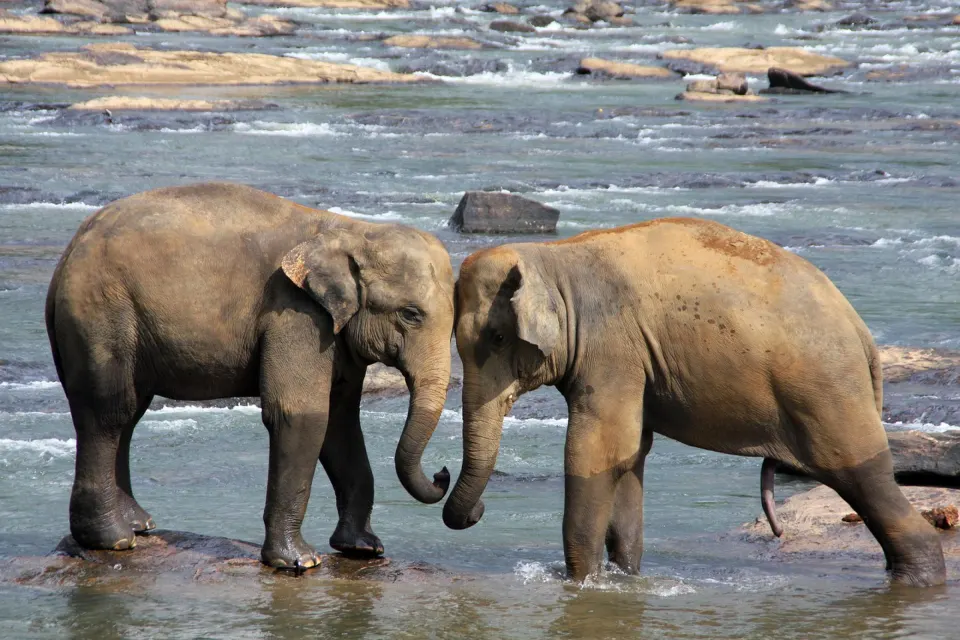
Two elephants greeting each other in river

Sri Lanka travel guide

Beaches, hill country and ancient cities on one compact island

Best: Jan, Feb

Photo: TiBine / Pixabay

Capital
Sri Jayawardenepura Kotte
Languages
Sinhala, Tamil
Currency
Sri Lankan rupee
Time zone
UTC+05:30
Plugs
Type D, G · 230 V
Driving
On the left
Emergency
110 / 119

Why visit Sri Lanka

Sri Lanka packs coastal towns like Galle and Negombo, hill retreats such as Kandy and Nuwara Eliya, and the old city of Anuradhapura into an area of just 65,610 km2, so short trips can still cover very different landscapes. January and February are the best months to go, with drier, calmer weather across most of the island. The honest catch: outside those two months, rain patterns shift by coast, so the west and east coasts rarely suit the same travel dates.

  • A small island, a lot of variety

    Sri Lanka covers just 65,610 km2, yet it packs in coastal towns like Galle and Trincomalee, hill country around Kandy and Nuwara Eliya, and the inland plains near Anuradhapura. A small country means short travel times between very different landscapes.

  • Cool hill station escape

    Nuwara Eliya sits in the highlands and is far smaller than the coastal cities, with about 27,500 people. Its elevation makes it noticeably cooler than Colombo, a contrast worth building into a trip.

  • Coastal cities with different characters

    Negombo, Galle, Trincomalee and Jaffna are all coastal but differ in size and feel, from Negombo's 142,136 residents near the airport to Jaffna's 88,138 in the north. Each gives a different angle on Sri Lanka's long coastline.

  • Kandy as an inland anchor

    Kandy, population 120,087, is one of the few major cities not on the coast, sitting in the central hill zone. It works as a base for exploring the highlands away from beach-town routines.

  • January and February for drier weather

    The best months to visit are January and February, which fall outside the main monsoon periods that affect different parts of the island at different times. Planning around these months gives a better shot at consistent conditions.

Is Sri Lanka right for you?

Great for

  • Travellers who dislike extreme heat: average highs stay between 24°C and 29°C all year
  • Mid-year trips: June and July are the driest months, with about 90 mm of rain
  • Sun seekers: 10 to 11 hours of sun a day from February to August
  • Coastal city stays in Colombo, Galle, Negombo, Trincomalee or Jaffna
  • Trips mixing the coast with inland Kandy, Anuradhapura and Nuwara Eliya in 1 compact country

Less ideal for

  • Trips from October to December, with 279 to 360 mm of rain and 24 to 26 rain days
  • Travellers who need fully dry weather: every month averages at least 15 rain days
  • Self-drivers who are not used to driving on the left

Sri Lanka right now: November

7.0/10
Avg high
25°C
Avg low
18°C
Rain days
26

Averages for Sri Lanka.

Weather by month

The chart's data is labelled Sri Lanka, with no single city given, for 2015–2024, and January and February score best, with highs of about 24°C and around 10 hours of sun a day. June to September score lowest, but October to December is wettest, with 279–360 mm of rain on 24–26 days, so expect heavy showers then.

Average highs and lows in Sri Lanka by month January: high 24°C, low 17°C , 19 rain days . February: high 24°C, low 17°C , 18 rain days . March: high 26°C, low 18°C , 16 rain days . April: high 28°C, low 19°C , 20 rain days . May: high 28°C, low 20°C , 21 rain days . June: high 29°C, low 20°C , 16 rain days . July: high 29°C, low 20°C , 15 rain days . August: high 29°C, low 20°C , 16 rain days . September: high 28°C, low 19°C , 18 rain days . October: high 27°C, low 19°C , 24 rain days . November: high 25°C, low 18°C , 26 rain days . December: high 24°C, low 18°C , 24 rain days . 24°C 17°C JAN 19d 24°C 17°C FEB 18d 26°C 18°C MAR 16d 28°C 19°C APR 20d 28°C 20°C MAY 21d 29°C 20°C JUN 16d 29°C 20°C JUL 15d 29°C 20°C AUG 16d 28°C 19°C SEP 18d 27°C 19°C OCT 24d 25°C 18°C NOV 26d 24°C 18°C DEC 24d
Best months Other months (low–high) Nd = rain days

Sri Lanka (country average) · averages 2015–2024

Best time to visit Sri Lanka: month-by-month weather →

Sample itineraries

7 days

Coast, Culture and Hill Country in a Week

  1. Day 1–2

    Colombo

    Start in the capital city, home to 647,557 people. Use these two days to settle in and explore the city before heading onward.

  2. Day 3

    Negombo

    Visit this coastal town of 142,136 people, close to Colombo, with its stretch of shoreline to walk along.

  3. Day 4–5

    Kandy

    Head inland to Kandy, population 120,087, a non-coastal city in the hills that makes a good base for two days.

  4. Day 6–7

    Nuwara Eliya

    Finish in Nuwara Eliya, a small hill town of about 27,500 people, for a cooler, higher-altitude close to the trip.

10 days

Full Island Loop: Coast, Hills and North

  1. Day 1–2

    Colombo

    Begin in Sri Lanka's capital, population 647,557, on the coast, to get oriented before travelling further.

  2. Day 3

    Negombo

    Spend a day in this coastal city of 142,136 people, a short stop near the capital.

  3. Day 4–5

    Kandy

    Move inland to Kandy, population 120,087, for two days away from the coast.

  4. Day 6

    Nuwara Eliya

    Spend a day in Nuwara Eliya, a hill town of around 27,500 residents.

  5. Day 7–8

    Anuradhapura

    Continue to Anuradhapura, an inland city of 63,208 people, for two days.

  6. Day 9–10

    Trincomalee

    End on the east coast in Trincomalee, population 99,135, for two final coastal days.

Food to try in Sri Lanka

Rice and curry

This is Sri Lanka's everyday meal, found in homes and small eateries across the island. It usually combines rice with several vegetable, fish, or meat curries, plus sambols.

Hoppers (appa)

These bowl-shaped pancakes are made from fermented rice flour and coconut milk. They are popular at breakfast or dinner, often served with an egg cracked into the centre.

Kottu roti

This dish is made by chopping roti bread with vegetables, egg, and meat or seafood on a hot griddle. It's a common street food snack, especially in the evening.

Lamprais

This dish has Dutch Burgher origins and features rice, meat, and sambol wrapped in a banana leaf and baked. It's traditionally found in areas with Burgher communities, including Colombo.

Pol sambol

This is a spicy mix of grated coconut, chili, lime, and onion. It's served as a side dish with rice and curry or hoppers throughout the country.

Ceylon tea

Sri Lanka's highlands produce tea that's drunk strong and often with milk and sugar. It's available everywhere, from roadside stalls to hill country plantations.

Know before you go

  • Plugs and voltage: Sri Lanka uses type D and type G plugs, running on 230 V. If your devices use a different plug shape, bring an adapter.
  • Driving side: Traffic drives on the left in Sri Lanka. Keep this in mind if you plan to rent a car, scooter, or tuk-tuk.
  • Emergency numbers: The emergency number in Sri Lanka is 110 or 119, depending on the service you need.
  • Currency: The local currency is the Sri Lankan rupee. It's useful to carry small notes for local transport and markets.
  • Languages: Sinhala and Tamil are the official languages of Sri Lanka. English is widely used in tourist areas and business.
  • Calling code: Sri Lanka's international calling code is +94. Keep this in mind when dialling local numbers from abroad.
  • Time zone: Sri Lanka runs on a single time zone, UTC+05:30, with no daylight saving changes during the year.

Sri Lanka: frequently asked questions

Is Sri Lanka good to visit in August?

August is an ok month, scoring 4.5 out of 10. Highs reach 29°C with 15.5 rain days and 110 mm of rain, so it is hot and drier than the autumn months, but not among the top-rated times to go.

What is the best time to visit Sri Lanka?

January and February are the best-rated months, both scoring 7 out of 10. January has highs of 23.6°C, 19.4 rain days and 184 mm of rain, while February is slightly drier at 138 mm with 18.2 rain days and more sun at 10.3 hours a day.

Which months have the most rain in Sri Lanka?

November is the wettest month, with 360 mm of rain over 26 rain days and only 7.9 hours of sun. October is close behind, with 299 mm of rain over 24.2 rain days. These two months also score lowest on sunshine for the year.

Is Sri Lanka hot all year?

Yes, temperatures stay warm year-round. Monthly highs range from 23.6°C in January to 29.1°C in July, and lows never drop below 16.9°C. The main difference between months is rainfall and sunshine, not temperature.

What is the driest month in Sri Lanka?

July is the driest month, with 90 mm of rain over 15.4 rain days. August is similar, with 110 mm over 15.5 rain days. Both months get around 10 hours of sunshine a day, more than the wetter months of October and November.

Similar destinations

Countries with a year of weather much like Sri Lanka.