Skip to content
wheretotravel.info
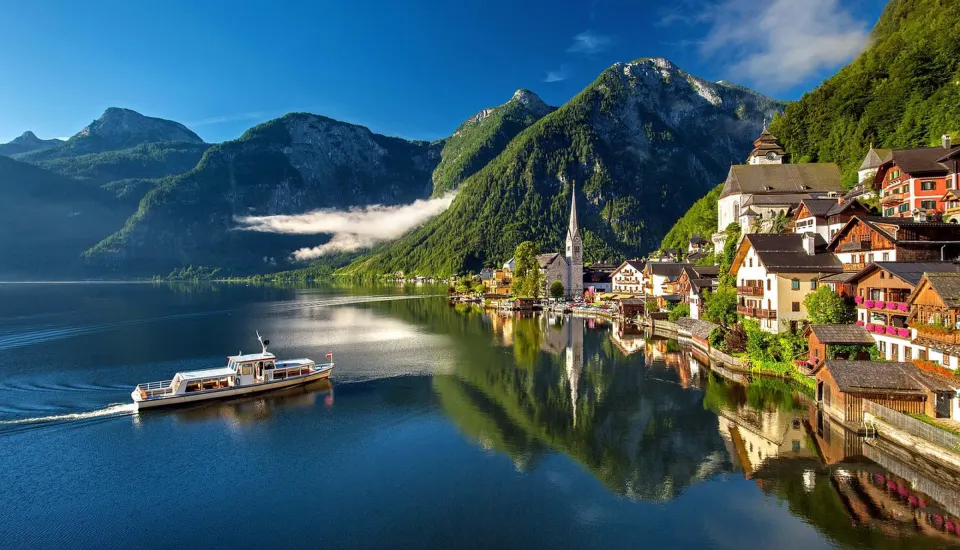
Hallstatt lakeside village with boat and mountains

Austria travel guide

Central European cities, lakes and mountains, best visited in June and July

Best: May, Sep

Photo: Julius_Silver / Pixabay

Capital
Vienna
Language
German
Currency
Euro
Time zone
UTC+01:00
Plugs
Type C, F · 230 V
Driving
On the right
Emergency
112
Entry
EU and Schengen area

Why visit Austria

Austria suits travellers who want city culture and mountain scenery in one trip. Vienna, the capital, is the main base, and you can combine it with Salzburg, Graz or Innsbruck. Lake towns such as Klagenfurt am Wörthersee and Gmunden offer a slower pace. The best months are June and July. One honest limitation: Austria is landlocked, so there is no sea and no beach. If a coast matters to you, choose somewhere else.

  • Summer is the best time

    Our data rates June and July as the best months to visit Austria. If you can choose your dates, aim for this window. Outside it, conditions score lower, so a trip in other months may be less rewarding.

  • More cities than just Vienna

    Vienna is the capital, but Austria has several other sizeable cities. Graz has 306971 people, Linz 211944, Salzburg 155021 and Innsbruck 132499. The country covers only 83871 km², so you can combine a few of them in one trip.

  • Smaller towns for a quieter stay

    If big cities are not your style, Klagenfurt am Wörthersee has 101403 residents and Gmunden just 13191. Be aware that none of Austria's main cities is on the coast. If a beach holiday is your goal, look at another country.

  • Simple money and language

    Austria uses the Euro, so travellers from other eurozone countries need no currency exchange. The official language is German. The emergency number is 112, the same as in many other European countries.

  • Easy practical setup

    Plugs are types C and F at 230 V, and cars drive on the right. The time zone is UTC+01:00. For many European visitors, this means no adapters, no new driving habits and little or no jet lag.

Is Austria right for you?

Great for

  • Summer travellers who dislike heat: July and August highs are only about 20°C
  • Visitors in June and July, the best months, with about 12 sun hours a day
  • City-hoppers who want to combine Vienna with Graz, Linz, Salzburg and Innsbruck
  • Travellers from the eurozone, since Austria uses the Euro

Less ideal for

  • Beach holidays: none of the main cities listed is on the coast
  • Travellers who want dry weather: May has 20 rain days and 169 mm of rain
  • Winter visitors who dislike cold: January lows average -8.9°C and highs about 0°C
  • Sun-seekers in winter: December averages only about 5 sun hours a day

Austria right now: October

6.3/10
Avg high
16°C
Avg low
7°C
Rain days
13

Averages for Salzburg.

Weather by month

The climate data covers Austria as a whole for 2015–2024, not a single city, and shows June and July are best, with highs of 19–20°C and 11.5–11.7 hours of sun a day, though rain falls on about 18 days a month. Avoid November to April, when highs stay between 0.2°C and 9.4°C and January nights drop to -8.9°C.

Average highs and lows in Salzburg by month January: high 5°C, low -4°C , 16 rain days . February: high 8°C, low -2°C , 13 rain days . March: high 11°C, low 1°C , 14 rain days . April: high 15°C, low 4°C , 15 rain days . May: high 19°C, low 8°C , 19 rain days . June: high 24°C, low 13°C , 16 rain days . July: high 25°C, low 15°C , 17 rain days . August: high 25°C, low 15°C , 15 rain days . September: high 20°C, low 11°C , 13 rain days . October: high 16°C, low 7°C , 13 rain days . November: high 10°C, low 2°C , 13 rain days . December: high 7°C, low -2°C , 15 rain days . 5°C -4°C JAN 16d 8°C -2°C FEB 13d 11°C 1°C MAR 14d 15°C 4°C APR 15d 19°C 8°C MAY 19d 24°C 13°C JUN 16d 25°C 15°C JUL 17d 25°C 15°C AUG 15d 20°C 11°C SEP 13d 16°C 7°C OCT 13d 10°C 2°C NOV 13d 7°C -2°C DEC 15d
Best months Other months (low–high) Nd = rain days

Salzburg · averages 2015–2024

Best time to visit Austria: month-by-month weather →

Where to go in Austria

City guides with their own best months and weather.

Sample itineraries

7 days

A week through Salzburg, Gmunden, Linz and Graz

  1. Day 1–2

    Salzburg

    Start in Salzburg, a city of about 155021 people. Use two days to walk the centre at an easy pace and get used to German signs and paying in Euro.

  2. Day 3

    Gmunden

    Slow down in Gmunden, a small town of about 13191 people. One quiet day here breaks up the trip between two larger cities.

  3. Day 4–5

    Linz

    Spend two days in Linz, home to about 211944 people. It is big enough for a full day of city sightseeing and a second, looser day.

  4. Day 6–7

    Graz

    End in Graz, the largest city on this route with about 306971 people. Give yourself two days to explore it without rushing before you head home.

10 days

Ten days across six Austrian cities

  1. Day 1–2

    Innsbruck

    Begin in Innsbruck, a city of about 132499 people. Take two days to settle in. If you rent a car, remember Austria drives on the right.

  2. Day 3–4

    Salzburg

    Move on to Salzburg, home to about 155021 people. Two days give you time to see the centre and still have slow afternoons.

  3. Day 5

    Gmunden

    Stop for one day in Gmunden, a town of about 13191 people. It is the smallest place on the trip and a calm pause between cities.

  4. Day 6–7

    Linz

    Spend two days in Linz, a city of about 211944 people. Use one day for sightseeing and keep the other free for whatever caught your interest.

  5. Day 8–9

    Graz

    Head to Graz, the largest city on this route with about 306971 people. Two days here let you explore at a relaxed pace.

  6. Day 10

    Klagenfurt am Wörthersee

    Finish in Klagenfurt am Wörthersee, a city of about 101403 people. Keep this last day light before your journey home.

Where to stay

One good base in each main city and who it suits.

Altstadt

Salzburg

Good for first-timers, sightseeing

The Old Town on the left bank of the Salzach is the historic core, with Getreidegasse, the cathedral and the fortress above. You can walk to most major sights in minutes. Daytime crowds fill the narrow lanes, and cobbles plus car restrictions make arriving with luggage awkward.

Food to try in Austria

Wiener Schnitzel

A thin slice of veal, breaded and fried until golden. It is often served with lemon and potato salad. You will find it on menus across Austria, especially in traditional Vienna restaurants.

Sachertorte

A dense chocolate cake with a thin layer of apricot jam, usually served with unsweetened whipped cream. It comes from Vienna and is a classic order in the city's coffee houses.

Apfelstrudel

Thin pastry rolled around spiced apple, often with raisins. People eat it as a dessert or with coffee in the afternoon. It is sold in cafés and bakeries all over the country.

Tafelspitz

Beef boiled slowly in broth, served with sides such as apple and horseradish sauce and potatoes. It is a traditional Viennese main dish and is often eaten at lunch.

Kaiserschmarrn

A thick, fluffy pancake torn into pieces and dusted with sugar, often served with fruit compote. It is common in mountain huts and cafés, as a dessert or a sweet main meal.

Grüner Veltliner

Austria's best-known white wine grape, which makes a fresh, dry wine. Try it at a Heuriger, a simple wine tavern run by local winemakers, found around Vienna and in wine regions.

Know before you go

  • Plugs and voltage: Austria uses plug types C and F, and the voltage is 230 V. Bring an adapter if your plugs are a different type. Check that your devices work at 230 V before you plug them in.
  • Driving side: Traffic in Austria drives on the right. If you come from a country that drives on the left, take extra care at junctions and roundabouts.
  • Emergency number: Call 112 for emergencies in Austria. Save it in your phone before you travel so you can find it quickly.
  • Currency: Austria uses the Euro. If you arrive from another Euro country, you do not need to change money.
  • Language: The official language is German. Learning a few basic German words for greetings and thanks is useful, especially outside Vienna, the capital.
  • Phone calls: The country calling code for Austria is +43. Use it before the local number when you call an Austrian number from a foreign phone.
  • Time zone: Austria's standard time is UTC+01:00. Check the time difference with home before you book transport or plan calls.

Austria: frequently asked questions

What is the best time to visit Austria?

June and July are the best months to visit Austria. Both score 7 out of 10 in our data. Average highs are 19.1°C in June and 20.3°C in July, with about 11.5 to 11.7 hours of sun a day. August also scores 7, and September scores 6. These figures are averages for the whole country from 2015–2024, so mountain areas will feel cooler.

Is Austria good in August?

Yes, August is a good month for Austria and scores 7 out of 10. The average high is 20.4°C and the low is 9.1°C, so bring a warm layer for evenings. Expect about 15.9 rain days and 160 mm of rain, with 10.7 hours of sun a day. Pack a rain jacket.

Should I visit Austria in winter?

For a general trip, we suggest you avoid winter. January scores 1.4 and December 1.5, the lowest of the year. The January average high is only 0.2°C, the low is -8.9°C, and there are just 5.5 hours of sun a day. November to April all get an avoid rating in our data, so plan your trip for summer if you can.

Does it rain a lot in Austria?

Yes, it rains often in Austria, and summer is the wettest time. May has the most rain, with 169 mm over 20 rain days. July follows with 163 mm. November has the fewest rain days, at 11.6. Even in the best months, you should expect rain on more than half of the days, so bring waterproof clothes.

Are May and October good months to visit Austria?

May and October are both ok, but not the best choice. May scores 4.8 and has an average high of 13.5°C, but it is very wet, with 20 rain days. October scores 4.5 and has an average high of 12.1°C. It is drier, with 12.2 rain days, but nights are cold, with an average low of 1.8°C.

What plugs, currency and emergency number does Austria use?

Austria uses type C and F plugs at 230 V, and the currency is the euro. The emergency number is 112. The phone calling code is +43. Cars drive on the right, and the time zone is UTC+01:00. German is the official language.

Similar destinations

Countries with a year of weather much like Austria.