Skip to content
wheretotravel.info
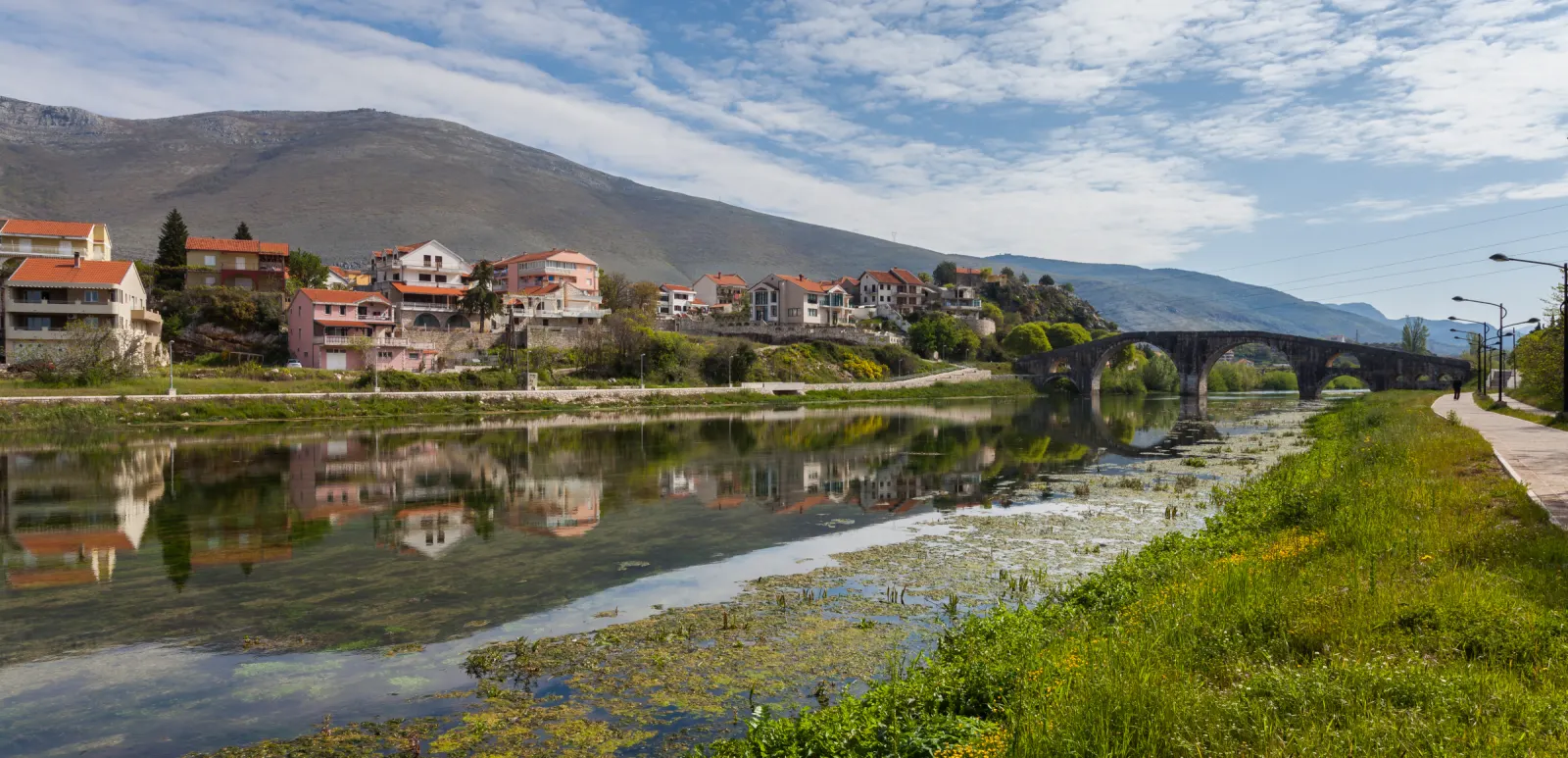
Riverside town with old bridge and mountains

Bosnia and Herzegovina travel guide

Mountains, river canyons and Ottoman-era towns in the heart of the Balkans

Best: Apr, Jun, Sep, Oct

Photo: Diego Delso / Wikimedia Commons

Capital
Sarajevo
Languages
Bosnian, Croatian, Serbian
Currency
Bosnia and Herzegovina convertible mark (BAM)
Time zone
UTC+01:00
Plugs
Type C, F · 230 V
Driving
On the right
Emergency
112

Why visit Bosnia and Herzegovina

Bosnia and Herzegovina suits travellers who want old town streets, river gorges and mountain scenery without the crowds of the Adriatic coast. Sarajevo and Mostar carry a mix of Ottoman and Austro-Hungarian history, while Trebinje and Bihać sit near rivers good for walking and rafting. Go in September, October, April or June for mild weather. The country is landlocked, so there's no beach time here.

  • Sarajevo's layered history

    The capital, Sarajevo, has about 275524 people and mixes Ottoman, Austro-Hungarian and modern influences in a small city center. Walking between the old bazaar and newer districts takes you through centuries of change in under an hour.

  • Mostar's old town

    Mostar is home to around 105448 people and is known for its historic stone bridge over the Neretva river. It's a compact city, easy to explore on foot in a day.

  • Banja Luka's shoulder-season appeal

    Banja Luka, with a population of about 185042, has its best travel months in October, September, April and June, avoiding summer heat and winter cold. These months suit walking tours and outdoor cafés along the Vrbas river.

  • Smaller towns with character

    Bihać and Trebinje offer a quieter pace, with populations of about 56261 and 31433. Both sit near rivers and give a sense of regional life away from the bigger cities.

  • A compact country to explore

    Bosnia and Herzegovina covers 51209 square kilometers, small enough to combine Sarajevo, Mostar and smaller towns like Trebinje in one trip. The best months to travel nationwide are October, September, April and June, balancing mild temperatures with fewer crowds.

Is Bosnia and Herzegovina right for you?

Great for

  • Travellers who want historic cities like Sarajevo and Mostar without coastal crowds
  • Visitors who like warm, dry summers, with July highs near 29°C and only 9 rain days
  • Shoulder-season travellers: September and October bring mild highs of 18-23°C and fewer rain days
  • Spring visitors who don't mind rain: May has 15.9 rain days and 129mm, the wettest month
  • People planning trips around Banja Luka, Sarajevo, Mostar, Bihać or Trebinje for city and river scenery

Less ideal for

  • Beach holidaymakers, since Bosnia and Herzegovina has almost no coastline and no coastal cities listed
  • Winter sun seekers: December to February highs stay below 11°C with only 5-7 sun hours a day
  • Travellers who want a single dry month: every month in the fact pack has at least 63mm of rain

Bosnia and Herzegovina right now: November

4.5/10
Avg high
13°C
Avg low
4°C
Rain days
11

Averages for Banja Luka.

Weather by month

Using data for Banja Luka, the best weather falls in April, June, September and October, when highs of 17-26°C pair with 8-12 sun hours and fewer rain days than other months. December through February is toughest, with cold highs of 7-10°C, low light around 5-6.5 sun hours, and frequent rain, while May stands out for its heavy rainfall at 129mm over nearly 16 days.

Average highs and lows in Banja Luka by month January: high 7°C, low -2°C , 12 rain days . February: high 10°C, low 1°C , 10 rain days . March: high 13°C, low 3°C , 11 rain days . April: high 18°C, low 6°C , 11 rain days . May: high 21°C, low 11°C , 16 rain days . June: high 26°C, low 15°C , 12 rain days . July: high 29°C, low 17°C , 9 rain days . August: high 29°C, low 17°C , 9 rain days . September: high 23°C, low 13°C , 10 rain days . October: high 19°C, low 9°C , 9 rain days . November: high 13°C, low 4°C , 11 rain days . December: high 8°C, low 1°C , 10 rain days . 7°C -2°C JAN 12d 10°C 1°C FEB 10d 13°C 3°C MAR 11d 18°C 6°C APR 11d 21°C 11°C MAY 16d 26°C 15°C JUN 12d 29°C 17°C JUL 9d 29°C 17°C AUG 9d 23°C 13°C SEP 10d 19°C 9°C OCT 9d 13°C 4°C NOV 11d 8°C 1°C DEC 10d
Best months Other months (low–high) Nd = rain days

Banja Luka · averages 2015–2024

Best time to visit Bosnia and Herzegovina: month-by-month weather →

Sample itineraries

7 days

Sarajevo to Herzegovina in a Week

  1. Day 1–3

    Sarajevo

    Spend your first days in the capital. Walk the old town, learn about its history, and use it as a base to adjust before heading south.

  2. Day 4–5

    Mostar

    Explore the historic core and its famous bridge over the river. This is a good base for two relaxed days of walking and sightseeing.

  3. Day 6–7

    Trebinje

    Finish the trip in this smaller, quieter town near the border. Enjoy a slower pace and local cafe culture before departing.

10 days

Bosnia and Herzegovina: Capital to Countryside

  1. Day 1–3

    Sarajevo

    Start in the capital with three days to see its museums, markets and mixed architectural history at an unhurried pace.

  2. Day 4–5

    Banja Luka

    Head to this riverside city. September, October, April and June are the best months here for comfortable walking weather.

  3. Day 6–7

    Bihać

    Continue to this smaller city near the river, a good stop for a quieter two days away from the bigger cities.

  4. Day 8–9

    Mostar

    Travel south to see the old town and its bridge. Two days gives time to wander the stone streets without rushing.

  5. Day 10

    Trebinje

    End the trip with a single day in this small, relaxed town close to the southern border before heading home.

Food to try in Bosnia and Herzegovina

Ćevapi

Small grilled minced-meat sausages served in flatbread called somun, often with raw onion and kajmak. It is a staple lunch and dinner dish found in grill houses across Sarajevo and Mostar.

Burek

A rolled pastry filled with minced meat, baked in a spiral and cut into portions. Bakeries sell it for breakfast or a quick snack throughout the day.

Bosanski lonac

A slow-cooked pot of meat and mixed vegetables, traditionally simmered for hours over low heat. It is a hearty winter dish often served at family gatherings.

Dolma

Vegetables such as peppers, onions, or cabbage leaves stuffed with rice and minced meat. It is common at home-cooked meals and on restaurant menus countrywide.

Bosanska kafa

Coffee brewed in a small copper pot called a džezva and served unfiltered with a sugar cube and a piece of lokum. It is drunk slowly, often in the afternoon in Sarajevo's old town cafés.

Rakija

A strong fruit brandy, usually made from plums or grapes, served as a welcome drink or digestif. It is offered on social occasions across the country.

Know before you go

  • Currency: The currency is the Bosnia and Herzegovina convertible mark (BAM). It's a good idea to carry some cash, especially outside Sarajevo and Mostar, since smaller towns may not take cards everywhere.
  • Language: Bosnian, Croatian and Serbian are all spoken across the country. They're mutually understandable, so you'll get by with basic phrases in any of the three almost anywhere you go.
  • Plugs and voltage: Power sockets use plug types C and F, running at 230 V. Travellers from countries with different plug types or voltage will need an adapter.
  • Driving: Cars drive on the right-hand side of the road. Many mountain roads are narrow and winding, so allow extra time if you're self-driving between towns.
  • Emergency number: Dial 112 for emergency services anywhere in the country, covering police, fire and ambulance.
  • Calling code: The international calling code for Bosnia and Herzegovina is +387. Keep this in mind if you need to give out a local number while travelling.
  • Mine awareness: Decades after the 1990s war, some rural and off-trail areas still have landmine risks. Stick to marked paths and roads, especially near former front lines, and ask locals before wandering off-trail.

Bosnia and Herzegovina: frequently asked questions

Is Bosnia and Herzegovina good in August?

Yes, but it's hot. August highs reach 28.5°C with lows of 17.3°C, based on Banja Luka data. Rain is light, with just 8.9 rain days and 63 mm for the month. The month scores 6 out of 10, rated good, so it works for travel but isn't the top pick.

What is the best month to visit Bosnia and Herzegovina?

October is the top-rated month, scoring 8.3 out of 10. It brings mild highs of 18.7°C, lows of 8.7°C, and only 8.6 rain days. September, April and June also score as best months, each offering warm days without the peak summer heat of July and August.

When is the rainiest time to visit Bosnia and Herzegovina?

May is the wettest month, with 129 mm of rain spread over 15.9 days, the highest of any month in the Banja Luka data. November follows with 101 mm. If you want drier conditions, July, August and October all have fewer than 9 rain days each.

Is winter a good time to visit Bosnia and Herzegovina?

Winter scores low: December rates 2.5, January 2.1, and February 3.8, all marked as 'avoid' months. January is the coldest, with highs of just 6.9°C and lows of -1.5°C. Sunshine is also low then, around 5.2 to 6.5 hours a day, though this is when snow and winter conditions show up.

What is the currency and emergency number in Bosnia and Herzegovina?

The currency is the Bosnia and Herzegovina convertible mark (BAM). The emergency number is 112, the same as across most of Europe. The country runs on 230 V electricity with plug types C and F, and the calling code is +387.

What languages are spoken in Bosnia and Herzegovina?

Three official languages are spoken: Bosnian, Croatian and Serbian. They are mutually understandable and use both Latin and Cyrillic scripts in different regions. This reflects the country's three main ethnic groups across its 3,412,000 population.

Similar destinations

Countries with a year of weather much like Bosnia and Herzegovina.