Skip to content
wheretotravel.info
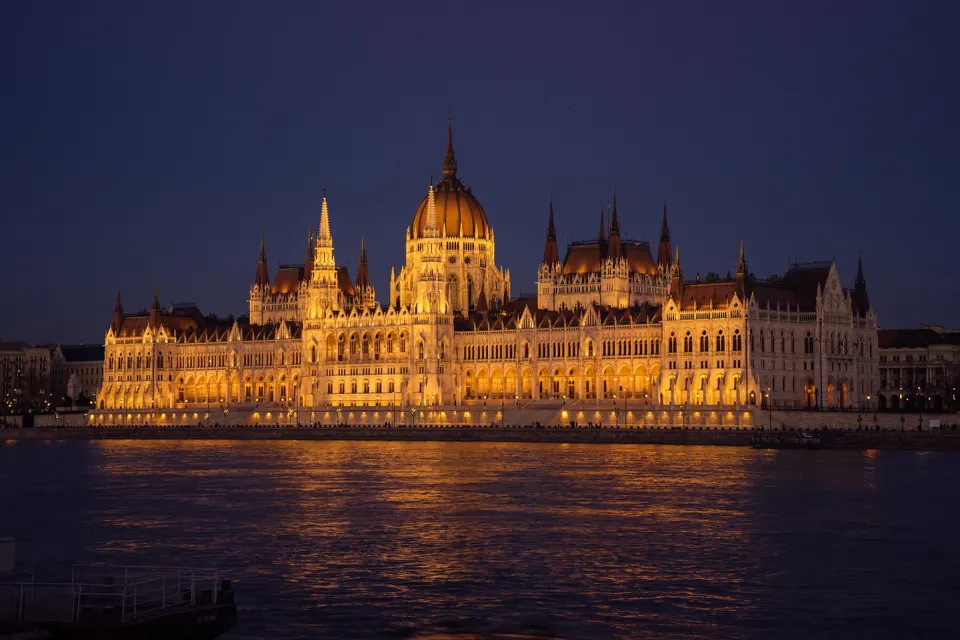
Parliament building lit at dusk beside Danube river

Hungary travel guide

Thermal baths, river views and old towns in the middle of Europe

Best: Apr, May, Sep, Oct

Photo: Leonhard_Niederwimmer / Pixabay

Capital
Budapest
Language
Hungarian
Currency
Hungarian forint
Time zone
UTC+01:00
Plugs
Type C, F · 230 V
Driving
On the right
Emergency
112
Entry
EU and Schengen area

Why visit Hungary

Hungary suits travellers who want historic cities, thermal baths and an easy landlocked base for exploring Central Europe. Budapest, Szeged, Pécs and Gyula all work well as stops, with no coastline to plan around. April, May, September and October bring the mildest weather across the country and its cities. Summers can turn hot, so shoulder-season months are the more comfortable choice for walking and sightseeing.

  • Shoulder-season sweet spot

    September and October, plus April and May, are Hungary's best months. Daytime sightseeing in Budapest, Szeged or Pécs is comfortable without peak-summer heat or winter cold.

  • A capital split across two sides

    Buda, on the hilly west bank, and Pest form Budapest's core. Buda's own best months run September through June, giving a wider window than most Hungarian cities for exploring its castle district and viewpoints.

  • City-sized but manageable

    Beyond Budapest, Hungary's secondary cities are compact: Szeged has 157,282 people, Miskolc 141,440 and Pécs 139,412. That makes them easy to cover on foot in a day or two.

  • Southern towns with a longer warm stretch

    Pécs extends its recommended visiting months into June and August, unlike most Hungarian cities that peak only in spring and autumn. That gives travellers wanting summer heat an extra option.

  • A small country, easy to combine

    At 93,028 km2 with a population of 9,488,428, Hungary is compact enough to pair Budapest with towns like Gyula or Szeged in one trip without long travel days.

Is Hungary right for you?

Great for

  • Travellers who like warm, dry city days in July and August, with highs near 28-29°C
  • Spring visitors who want mild weather, with April highs of 17°C and May highs of 21°C
  • Autumn trips timed for September and October, when highs run 17-23°C and sun hours stay near 7-10
  • Landlocked, inland touring where cities like Szeged, Miskolc and Pécs are the main stops, not beach trips
  • Visitors happy with a single time zone (UTC+1) and a right-hand drive, 230V/Type C-F plug setup

Less ideal for

  • Beach seekers, since Hungary is landlocked with no coastal cities in this list
  • Travellers who dislike short, dark winter days, with December and January sun hours down near 4-5 and lows below 0°C
  • Anyone avoiding wetter spells, since May and June bring the most rain days (12.6 and 11.5) and most rain (79mm and 73mm)

Hungary right now: October

7.9/10
Avg high
17°C
Avg low
8°C
Rain days
8

Averages for Buda.

Weather by month

Based on data for Buda, the best weather runs April to May and September to October, with highs of 17–23°C, plenty of sun (8–11 hours a day) and lower rain than summer. January and December are the toughest months, with highs near 4–5°C, lows below freezing and only 4–5 hours of sun a day.

Average highs and lows in Buda by month January: high 4°C, low -2°C , 10 rain days . February: high 8°C, low -0°C , 9 rain days . March: high 12°C, low 2°C , 8 rain days . April: high 17°C, low 6°C , 9 rain days . May: high 21°C, low 11°C , 13 rain days . June: high 26°C, low 16°C , 12 rain days . July: high 29°C, low 18°C , 9 rain days . August: high 28°C, low 18°C , 8 rain days . September: high 23°C, low 13°C , 8 rain days . October: high 17°C, low 8°C , 8 rain days . November: high 10°C, low 3°C , 9 rain days . December: high 5°C, low -1°C , 9 rain days . 4°C -2°C JAN 10d 8°C 0°C FEB 9d 12°C 2°C MAR 8d 17°C 6°C APR 9d 21°C 11°C MAY 13d 26°C 16°C JUN 12d 29°C 18°C JUL 9d 28°C 18°C AUG 8d 23°C 13°C SEP 8d 17°C 8°C OCT 8d 10°C 3°C NOV 9d 5°C -1°C DEC 9d
Best months Other months (low–high) Nd = rain days

Buda · averages 2015–2024

Best time to visit Hungary: month-by-month weather →

Sample itineraries

7 days

Seven Days Across Central Hungary

  1. Day 1–3

    Buda

    Spend your first days exploring the hilly side of the capital. Walk the historic streets and enjoy views over the Danube, best done in the mild air of April, May, June or September.

  2. Day 4–5

    Pécs

    Move south to this university city known for its museums and old town streets. June, August, September and October bring comfortable temperatures for walking around.

  3. Day 6–7

    Szeged

    End the trip in this sunny city on the Tisza river. April, May, September and October are the best months to wander its squares and riverside paths.

10 days

Ten Days Through Hungary's Regions

  1. Day 1–3

    Buda

    Start in the capital's quieter district, exploring castle-area streets and riverside views. Visit in April, May, June or September for pleasant weather.

  2. Day 4–5

    Miskolc

    Head northeast to this regional city, a good base for exploring the surrounding hills. September, May and June offer the most comfortable conditions.

  3. Day 6–7

    Gyula

    Travel to this smaller town known for its castle and spa heritage. April, May, September and October are the recommended months to visit.

  4. Day 8–9

    Szeged

    Continue to this riverside city with wide squares and a relaxed pace. September, October, April and May suit outdoor sightseeing best.

  5. Day 10

    Pécs

    Finish with a short stop in this southern city, taking in its old town before heading home. June, August, September and October are its best months.

Food to try in Hungary

Gulyás (goulash)

A beef soup with onions, potatoes and plenty of paprika. You find it on menus across Hungary, and it is often eaten as a filling lunch with bread.

Lángos

Deep-fried flatbread, usually topped with sour cream, grated cheese and garlic. It is a street food sold at markets, festivals and lakeside beaches such as those around Lake Balaton.

Halászlé (fisherman's soup)

A spicy, bright red paprika soup made with river fish such as carp. It is linked to towns on the Danube and Tisza rivers, and many families eat it on Christmas Eve.

Csirkepaprikás (chicken paprikash)

Chicken cooked slowly in a paprika and sour cream sauce. It is usually served with nokedli, small soft egg dumplings, and is a common home-style main course.

Kürtőskalács (chimney cake)

Sweet dough wrapped around a spit, baked over heat and rolled in sugar, cinnamon or nuts. Stalls sell it warm at markets and winter Christmas markets, including in Budapest.

Tokaji aszú

A sweet white wine from the Tokaj wine region in north-eastern Hungary, made with grapes affected by noble rot. It is often served with dessert or tasted in local wine cellars.

Know before you go

  • Plugs and voltage: Hungary uses plug types C and F, the round two-pin plugs common in much of Europe. The supply is 230 V. Bring an adapter if your devices use a different plug.
  • Driving side: Traffic in Hungary drives on the right. If you come from a country that drives on the left, take extra care at junctions and roundabouts during your first days.
  • Emergency number: Call 112 for police, ambulance or fire services anywhere in Hungary. Save the number in your phone before you travel.
  • Currency: The currency is the Hungarian forint. Check the exchange rate before you go so you can judge prices quickly when you shop or eat out.
  • Language: The official language is Hungarian. It is not closely related to most other European languages, so learning a few basic words, like hello and thank you, can help.
  • Time zone: Hungary is on UTC+1, the same standard time as much of Central Europe. Check the time difference with home to plan calls and connections.
  • Phone calls: The country calling code for Hungary is +36. Use it when you share your Hungarian contact details or call local numbers from a foreign phone.

Hungary: frequently asked questions

What is the best time to visit Hungary?

September, October, April and May score highest, all rated "best" with scores between 7.6 and 8.4. September is the top month at 8.4. These months bring mild temperatures, from 12°C to 22.7°C highs, and fewer rain days than May or June, making them comfortable for sightseeing in Budapest and other cities.

Is Hungary good in August?

Yes, August is rated "good" with a score of 7.2. Expect warm weather with highs of 28.4°C and lows of 17.8°C in Buda. Rain is limited to about 7.7 days with 57mm, and sunshine averages 11.9 hours a day, so it's a reliable month for outdoor travel despite the summer heat.

What is winter like in Hungary?

Winter in Hungary is cold and grey, scoring low from December to February, between 2.2 and 3.1. Highs stay between 4.1°C and 8°C, with lows dropping to -2.4°C in January. Sunshine is scarce, only 4 to 6.3 hours a day, and rain or snow falls on about 9 days a month.

Which month has the most rain in Hungary?

May has the most rain, with 79mm falling over 12.6 days, the highest of any month in Buda's climate data. June follows closely with 73mm over 11.5 days. Despite the rain, both months still score well for travel, between 7.4 and 7.6, because temperatures are warm and sunshine hours are high.

What is the weather like in Budapest in spring?

Spring in Budapest, based on Buda's data, warms up quickly. March highs reach 12°C, April climbs to 16.9°C, and May hits 21.1°C. Sun hours rise from 8.4 in March to 11.1 in May. April and May are both rated "best" months, scoring 7.7 and 7.6.

Similar destinations

Countries with a year of weather much like Hungary.