Skip to content
wheretotravel.info
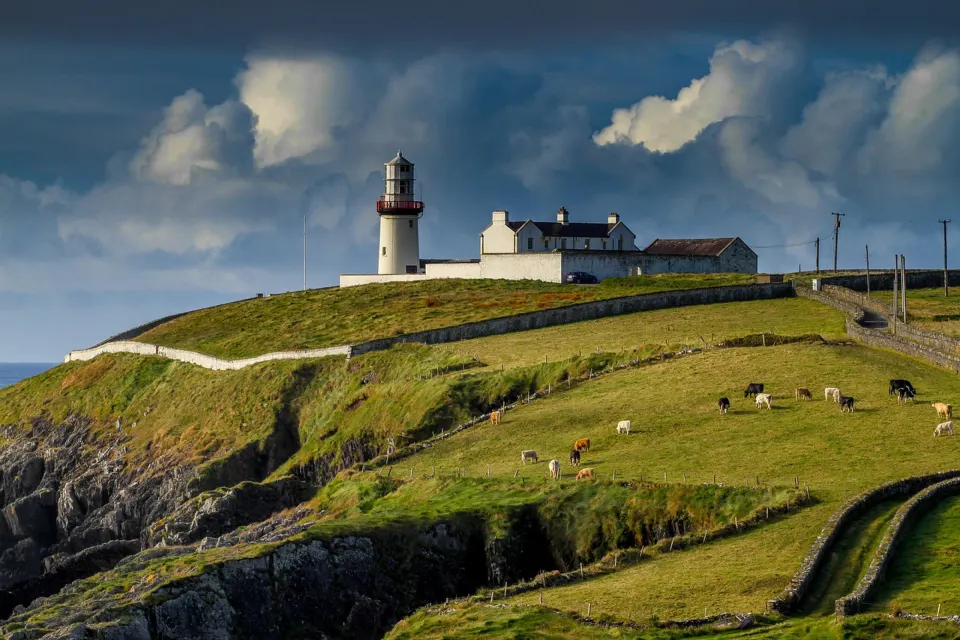
Lighthouse on green cliff with grazing cattle

Ireland travel guide

Dublin plus smaller towns like Galway, Kilkenny and Westport, best visited in June and August

Best: Jul, Aug

Photo: rolandmey / Pixabay

Capital
Dublin
Languages
English, Irish
Currency
Euro
Time zone
UTC
Plugs
Type G · 230 V
Driving
On the left
Emergency
112
Entry
EU member (not Schengen)

Why visit Ireland

Ireland suits a trip that pairs one capital with a string of smaller towns. Dublin has about 592,713 people. Most other stops, such as Galway, Kilkenny and coastal Westport, are much smaller. The whole country covers 70,273 km², so distances between towns stay manageable. The best months are June and August, and July is also good for Galway. One honest limitation: traffic drives on the left, so hiring a car takes some getting used to if you normally drive on the right.

  • Dublin, a capital by the sea

    Dublin is the capital and a coastal city of about 592,713 people. That makes it large enough for a full city break but still small by European capital standards. June and August are its best months, so plan a city trip for then.

  • Galway for a summer stay

    Galway is a coastal city of about 83,456 people, small enough to explore on foot. Its best months are July and August, a little later than Dublin's. This makes it a good second stop on a summer trip.

  • Short distances between cities

    Ireland covers 70,273 km² and has about 5,525,600 people, so you can combine several cities in one trip. Cork (222,333 people), Limerick (62,702) and Waterford (48,369) give you a mix of inland and coastal bases. Remember that traffic drives on the left.

  • Small towns with a slower pace

    Kilkenny has about 22,179 people and is at its best in June and August. Killarney (14,412) and coastal Westport (6,872) are even smaller. They suit travellers who want quieter bases than the larger cities.

  • Simple for English speakers

    English and Irish are the official languages, and Ireland uses the Euro. The country runs on UTC time. Plugs are type G at 230 V, so bring the right adapter. June and August are the best months overall, so book ahead for those.

Is Ireland right for you?

Great for

  • Travellers who dislike heat: Dublin's July highs average 19.2°C
  • English speakers, since English is an official language alongside Irish
  • Long summer days in June, with about 11.4 sun hours in Dublin
  • Road trippers happy driving on the left, linking Galway, Killarney and Westport
  • Visitors from other euro countries, as Ireland uses the Euro

Less ideal for

  • Beach and swimming trips: the sea peaks at only 17.2°C in August
  • Anyone wanting dry weather, with 12 to 15 rain days in every month
  • Winter sun seekers: December brings 3.3 sun hours and 9.5°C highs
  • Drivers who are not confident driving on the left

Ireland right now: September

6.4/10
Avg high
17°C
Avg low
11°C
Rain days
13
Sea
16°C

Averages for Dublin.

Weather by month

In Dublin, June to August are the best months, with highs of 18–19°C, lows of 11–13°C and about 10–11 hours of sun a day, though rain still falls on 13–15 days a month. Avoid November to March, when highs reach only 8–11°C, sunshine drops to 3–7 hours a day and December is the wettest month at 95 mm.

Average highs and lows in Dublin by month January: high 8°C, low 4°C , 13 rain days . February: high 9°C, low 4°C , 13 rain days . March: high 10°C, low 4°C , 15 rain days . April: high 12°C, low 6°C , 12 rain days . May: high 15°C, low 9°C , 13 rain days . June: high 18°C, low 11°C , 13 rain days . July: high 19°C, low 13°C , 15 rain days . August: high 19°C, low 13°C , 13 rain days . September: high 17°C, low 11°C , 13 rain days . October: high 14°C, low 9°C , 14 rain days . November: high 11°C, low 6°C , 13 rain days . December: high 10°C, low 5°C , 15 rain days . 8°C 4°C JAN 13d 9°C 4°C FEB 13d 10°C 4°C MAR 15d 12°C 6°C APR 12d 15°C 9°C MAY 13d 18°C 11°C JUN 13d 19°C 13°C JUL 15d 19°C 13°C AUG 13d 17°C 11°C SEP 13d 14°C 9°C OCT 14d 11°C 6°C NOV 13d 10°C 5°C DEC 15d
Best months Other months (low–high) Nd = rain days

Dublin · averages 2015–2024

Best time to visit Ireland: month-by-month weather →

Sample itineraries

7 days

Dublin to Galway via Kilkenny and Cork

  1. Day 1–2

    Dublin

    Start in the capital, home to about 592713 people. Use 2 days to explore the centre on foot. June and August are its best months, so plan ahead if you travel then.

  2. Day 3

    Kilkenny

    Kilkenny is a small inland city of about 22179 people. One day is enough to walk its streets at an easy pace. June and August are good months to visit.

  3. Day 4–5

    Cork

    Cork is the largest city after Dublin on this route, with about 222333 people. Spend 2 days getting to know its centre. June is its best month.

  4. Day 6–7

    Galway

    Finish in coastal Galway, a city of about 83456 people. July and August are its best months. If you hire a car for this trip, remember that Ireland drives on the left.

10 days

Ten days from Dublin to Galway

  1. Day 1–2

    Dublin

    Begin in the capital, with about 592713 people. Spend 2 days in the centre before leaving the city. June and August are its best months.

  2. Day 3

    Kilkenny

    Kilkenny has about 22179 people, so it feels much quieter than Dublin. One day lets you see it without rushing. June and August suit it best.

  3. Day 4

    Waterford

    Waterford is a coastal city of about 48369 people. Spend 1 day here by the water, then continue on to Cork.

  4. Day 5–6

    Cork

    Cork is the second-largest city on this list, with about 222333 people. Give it 2 days to explore at your own pace. June is its best month.

  5. Day 7–8

    Killarney

    Killarney is the smallest stop on this route, a town of about 14412 people. Use 2 slower days here to rest before the last leg of the trip.

  6. Day 9–10

    Galway

    End in coastal Galway, home to about 83456 people. July and August are its best months. If you drive, keep in mind that traffic in Ireland is on the left.

Food to try in Ireland

Irish stew

A slow-cooked stew of lamb or mutton with potatoes, onions and often carrots. It is a common home dish and appears on many pub menus, especially in colder weather.

Soda bread

A dense bread raised with baking soda and buttermilk instead of yeast. It is eaten with butter at breakfast, with soup at lunch or next to smoked salmon.

Full Irish breakfast

A cooked plate of bacon, sausages, eggs, black and white pudding, tomatoes and toast. Hotels, guesthouses and cafés serve it, usually in the morning.

Colcannon

Mashed potato mixed with cabbage or kale and butter. It is served as a side dish with meat and is a traditional food at Halloween.

Boxty

A potato pancake made from grated raw potato and mashed potato. It comes from the north-west and midlands and is served as a side or filled like a wrap.

Guinness stout

A dark, creamy beer first brewed in Dublin, the capital. You can order it in almost any pub across the country, often with a meal.

Know before you go

  • Plugs and voltage: Ireland uses Type G plugs, with 3 rectangular pins, and the supply is 230 V. Bring a Type G adapter. Check that your chargers and devices work at 230 V.
  • Driving side: Traffic drives on the left. If you normally drive on the right, take extra care at junctions and roundabouts, especially in your first few days.
  • Emergency number: Call 112 for police, ambulance or fire services. The call is free and works from mobile phones.
  • Currency: Ireland uses the Euro. Northern Ireland is part of the UK and uses pounds sterling, so plan for this if you cross the border.
  • Language: English is spoken everywhere. Irish is also an official language. You will see it on road signs, and it is spoken daily in some western communities.
  • Phone calling code: The country calling code is +353. Use it before the local number when you call an Irish number from abroad.
  • Tap water: Tap water is generally safe to drink. Occasionally a local area has a temporary boil-water notice. If you see one where you are staying, follow it.

Ireland: frequently asked questions

When is the best time to visit Ireland?

June to September is the best time to visit Ireland. Our scores rate all 4 months as good. August scores highest at 7.3 and June is close behind at 7.2. In Dublin, average highs in June, July and August are 17.6 to 19.2°C. June has the most sun, with 11.4 hours a day. These figures are Dublin averages for 2015–2024.

Is Ireland worth visiting in December or January?

For most travellers, no. We rate November to March as months to avoid. December scores 1.4 and January scores 1.5. In Dublin, December averages a high of 9.5°C, 15 rain days, 95 mm of rain and only 3.3 hours of sun a day. January is a little drier, with 63 mm, but its average high is just 8.3°C.

Does it rain a lot in Ireland in summer?

Yes, it still rains often in summer, so pack a rain jacket. July has 15.1 rain days in Dublin, which is more than any other month. August brings 82 mm of rain, more than any month from January to July. Summer is warmer and brighter, but it is not dry.

Is April, May or October a good time to go to Ireland?

These are acceptable shoulder months, but they are not the best. April and October each score 4.5, and May scores 5.9. May is the strongest of the three. It has 11 hours of sun a day and an average high of 14.9°C in Dublin. October is wetter, with 88 mm of rain and a high of 14.1°C.

Is the sea warm enough to swim in Ireland?

Only if you like cold water. Near Dublin, the sea is warmest in August, when it averages just 17.2°C. It stays around 16°C in June and July. From December to March, it falls to between 7.2 and 8.6°C. Most visitors will find it too cold for a long swim.

What currency, plugs and emergency number does Ireland use?

Ireland uses the Euro. Plugs are type G, and the voltage is 230 V. Cars drive on the left. The emergency number is 112. English and Irish are the official languages, and the country calling code is +353.

Similar destinations

Countries with a year of weather much like Ireland.