Skip to content
wheretotravel.info
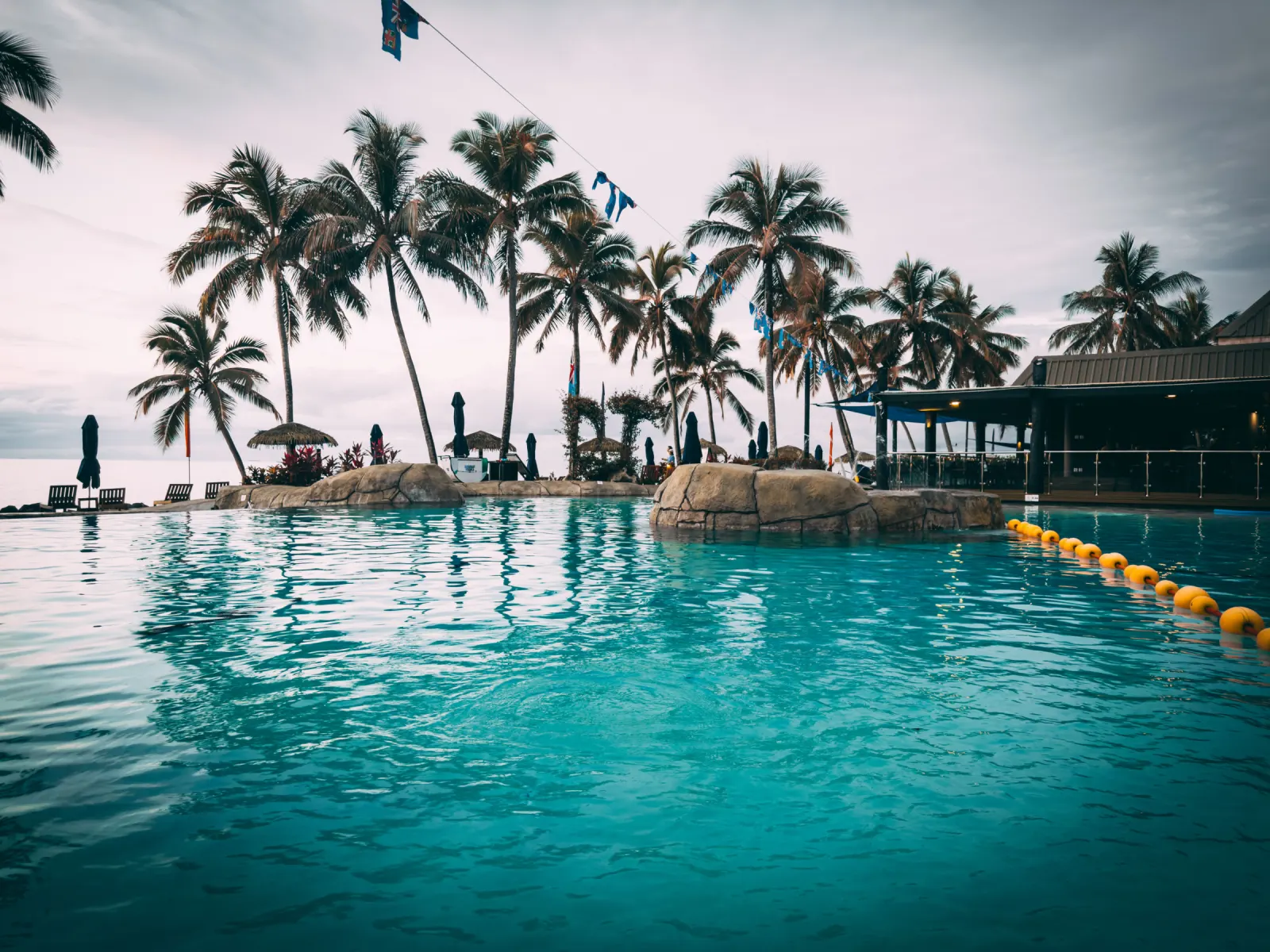
Resort pool with palm trees and cloudy sky

Fiji travel guide

A small Melanesian country of coastal towns, at its best from May to August

Best: Jun, Jul, Aug, Sep

Photo: Navi Prasad / Pexels

Capital
Suva
Languages
English, Fijian, Fiji Hindi
Currency
Fijian dollar (FJD)
Time zone
UTC+12:00
Plugs
Type I · 240 V
Driving
On the left
Emergency
911 / 000

Why visit Fiji

Fiji suits a slow trip along the coast. Most of its main towns, from Nadi and Lautoka to Savusavu and Levuka, sit by the sea. English is spoken alongside Fijian and Fiji Hindi. The best months are May to August, and Sigatoka stays good into September. One honest limit: this is a small country of about 902,623 people, and the capital, Suva, has only 88,271. If you want big-city life, look elsewhere.

  • A clear best-travel window

    Our data rates May, June, July and August as the best months to visit Fiji. July and August come out on top. Outside this window the data does not rate any month as best, so plan around it if you can.

  • Nadi as a coastal base

    Nadi is a coastal town of about 71,048 people. Its best months match the country's: May to August. It works well as a first stop before moving on to other parts of Fiji.

  • Suva, the capital city

    Suva is the capital and the largest city in our list, with about 88,271 people. It sits on the coast. Come here for city life, as a contrast to the smaller towns.

  • Small coastal towns

    Savusavu has about 5,000 people, and its best months are May to August. Sigatoka, with about 9,622 people, has a slightly later window, from June to September. Levuka is another coastal town to add to your route.

  • Easy for English speakers

    English is spoken alongside Fijian and Fiji Hindi, so getting around is simple. The currency is the Fijian dollar (FJD), and cars drive on the left. The country covers 18,272 km2 and has about 902,623 people.

Is Fiji right for you?

Great for

  • Swimmers and snorkellers: sea temperature near Nadi stays between 26.4°C and 30.5°C all year.
  • Dry-season trips from May to September, when Nadi averages only 4.5 to 8.5 rain days a month.
  • Sun-seekers: Nadi gets 9 to 10.9 hours of sunshine a day in every month.
  • English speakers: English is an official language, alongside Fijian and Fiji Hindi.
  • Coastal town trips: Suva, Nadi, Lautoka, Sigatoka, Savusavu and Levuka all lie on the coast.

Less ideal for

  • January to March trips: Nadi gets 341 to 355 mm of rain over 22.7 to 24.4 days.
  • Travellers who dislike heat: daytime highs reach about 30°C from December to February.
  • Big-city lovers: the largest city, Suva, has only 88271 people.
  • Nervous drivers used to the right: traffic in Fiji drives on the left.

Fiji right now: September

7.8/10
Avg high
29°C
Avg low
21°C
Rain days
9
Sea
27°C

Averages for Nadi.

Weather by month

In Nadi, the best months are May to August, when highs sit at 28 to 29°C and July has just 4.5 rain days and 39 mm of rain. Avoid December to March if you want dry days, as each month brings 22.5 to 24.4 rain days and up to 355 mm of rain in February.

Average highs and lows in Nadi by month January: high 30°C, low 24°C , 24 rain days . February: high 30°C, low 24°C , 24 rain days . March: high 30°C, low 24°C , 23 rain days . April: high 30°C, low 24°C , 13 rain days . May: high 29°C, low 22°C , 8 rain days . June: high 28°C, low 21°C , 5 rain days . July: high 28°C, low 21°C , 5 rain days . August: high 28°C, low 21°C , 6 rain days . September: high 29°C, low 21°C , 9 rain days . October: high 29°C, low 22°C , 14 rain days . November: high 30°C, low 23°C , 17 rain days . December: high 30°C, low 24°C , 23 rain days . 30°C 24°C JAN 24d 30°C 24°C FEB 24d 30°C 24°C MAR 23d 30°C 24°C APR 13d 29°C 22°C MAY 8d 28°C 21°C JUN 5d 28°C 21°C JUL 5d 28°C 21°C AUG 6d 29°C 21°C SEP 9d 29°C 22°C OCT 14d 30°C 23°C NOV 17d 30°C 24°C DEC 23d
Best months Other months (low–high) Nd = rain days

Nadi · averages 2015–2024

Best time to visit Fiji: month-by-month weather →

Fiji's climate regions

The weather varies across the country; each region has its own best months.

  • Nadi and the Coral Coast

    Nadi, Sigatoka

    Warm all year, with average highs of 29.8°C in January and 27.4°C in July. It has about 172 rain days a year, far fewer than Savusavu. The best months are May to August, when it is slightly cooler.

    Best: May, Jun, Jul, Aug

  • Savusavu

    Savusavu

    Similar heat, with average highs of 29.1°C in January and 26°C in July, but much wetter at about 262 rain days a year. Go from May to August. Expect some rain even then.

    Best: May, Jun, Jul, Aug

Sample itineraries

7 days

Nadi to Suva in 7 days

  1. Day 1–2

    Nadi

    Start in Nadi, a coastal town of about 71,048 people. Its best months are May to August, so plan this trip for then if you can. Take the first 2 days slowly.

  2. Day 3

    Lautoka

    Spend 1 day in Lautoka, a coastal city of about 52,220 people. Walk around and get a feel for an everyday Fijian town.

  3. Day 4–5

    Sigatoka

    Sigatoka is much smaller, with about 9,622 people. Its best months are June to September. Use these 2 quieter days to rest by the sea.

  4. Day 6–7

    Suva

    Finish in Suva, the capital and the largest city on this route, with about 88,271 people. Spend your last 2 days exploring the city and its coast.

10 days

Fiji's capital, coast and quiet towns

  1. Day 1–2

    Nadi

    Begin in Nadi, a coastal town of about 71,048 people. June to August falls within the best months for Nadi, Sigatoka and Savusavu, so this route suits a mid-year trip.

  2. Day 3–4

    Sigatoka

    Spend 2 days in Sigatoka, a coastal town of about 9,622 people. Its best months are June to September. Keep your plans loose and enjoy the slower pace.

  3. Day 5–6

    Suva

    Move on to Suva, the capital, with about 88,271 people. It is the biggest city on this route, so use these 2 days for city life before the quieter stops.

  4. Day 7–8

    Levuka

    Spend 2 slow days in Levuka, a coastal town. There is no need for a full schedule here. Walk, rest and take time to look around.

  5. Day 9–10

    Savusavu

    End in Savusavu, a coastal town of about 5,000 people. Its best months are May to August. Use your final 2 days to relax before heading home.

Food to try in Fiji

Kokoda

Raw fish marinated in lime or lemon juice, then mixed with coconut milk, onion, tomato and chilli. It is served as a starter in homes and restaurants across Fiji.

Lovo

A feast cooked in an earth oven. Meat, fish and root crops are wrapped in leaves and cooked on hot stones in a pit. Families make it for special occasions, and many resorts hold lovo nights.

Kava (yaqona)

A drink made from the ground root of a pepper plant mixed with water. It is shared in the sevusevu welcome when you visit a village. It tastes earthy and can make your mouth feel slightly numb.

Palusami

Taro leaves wrapped around thick coconut cream, often with onion and sometimes corned beef, then baked. It is often cooked in a lovo and eaten at family meals and gatherings.

Rourou

Taro leaves cooked slowly in coconut milk until soft. It is a common side dish at everyday Fijian meals, usually eaten with root crops such as taro or cassava.

Indo-Fijian curry and roti

Curries served with roti reflect Fiji's large Indo-Fijian community. You find them at cheap cafés and market stalls in towns such as Suva, Nadi and Lautoka, often at lunchtime.

Know before you go

  • Plugs and voltage: Fiji uses Type I plugs, with two flat pins set in a V shape. The supply is 240 V. Bring an adapter, and check that your chargers and devices accept 240 V before you plug them in.
  • Driving side: Traffic in Fiji drives on the left. If you come from a country that drives on the right, take extra care at junctions and when you pull out, especially on your first day.
  • Emergency number: For emergencies in Fiji, the listed numbers are 911 and 000. Save them in your phone before you arrive. You can also ask your hotel which number works best locally.
  • Currency: The local currency is the Fijian dollar (FJD). Carry some cash for small purchases, and check with your bank about card fees abroad before you travel.
  • Language: Fiji has 3 main languages: English, Fijian and Fiji Hindi. English is one of the official languages, so you can usually get by in English.
  • Time zone: Fiji is on UTC+12:00. It is one of the first places each day to see the date change, so check your flight times and bookings carefully.
  • Calling code: The international calling code for Fiji is +679. Use it when someone abroad calls a Fijian number, or when you save local numbers in your phone.

Fiji: frequently asked questions

When is the best time to visit Fiji?

May to October is the best time, and July is the top month. Our scores peak at 8.8 in July, 8.7 in August and 8.5 in June. In Nadi, July has about 4.5 rain days and 39 mm of rain. January has 24.4 rain days and 341 mm. Days stay warm in the dry months, with highs of about 28°C (Nadi data, 2015–2024).

Is Fiji good to visit in January?

Yes, but expect rain on most days. January scores 7 out of 10. Nadi gets about 24.4 rain days and 341 mm of rain in January. February and March are just as wet, with 355 mm and 350 mm. The upside is heat and warm water: highs of 30°C and a sea of about 30°C. If you want dry weather, go between May and September instead.

Is August a good month for Fiji?

Yes. August is one of the best months, with a score of 8.7. Nadi has about 6 rain days, 89 mm of rain and 10.1 hours of sun a day. It is the coolest month, with highs of 27.6°C, lows of 20.5°C and a sea of 26.4°C. The water is still warm enough for swimming, but it is the coolest of the year.

How warm is the sea in Fiji?

The sea off Nadi is warm all year, between 26.4°C and 30.5°C. It is warmest in February, at 30.5°C, and coolest in August, at 26.4°C. From December to April it stays at about 30°C. From June to September it is between 26.4°C and 27.9°C.

What plug type and voltage does Fiji use?

Fiji uses type I plugs and 240 V. Bring an adapter if your devices use a different plug, and check that they accept 240 V. Two other basics: the currency is the Fijian dollar (FJD), and cars drive on the left.

What language is spoken in Fiji, and what time zone is it?

English is spoken, along with Fijian and Fiji Hindi. Fiji is on UTC+12:00. The country calling code is +679, and the emergency number is 911 / 000.

Similar destinations

Countries with a year of weather much like Fiji.