Skip to content
wheretotravel.info
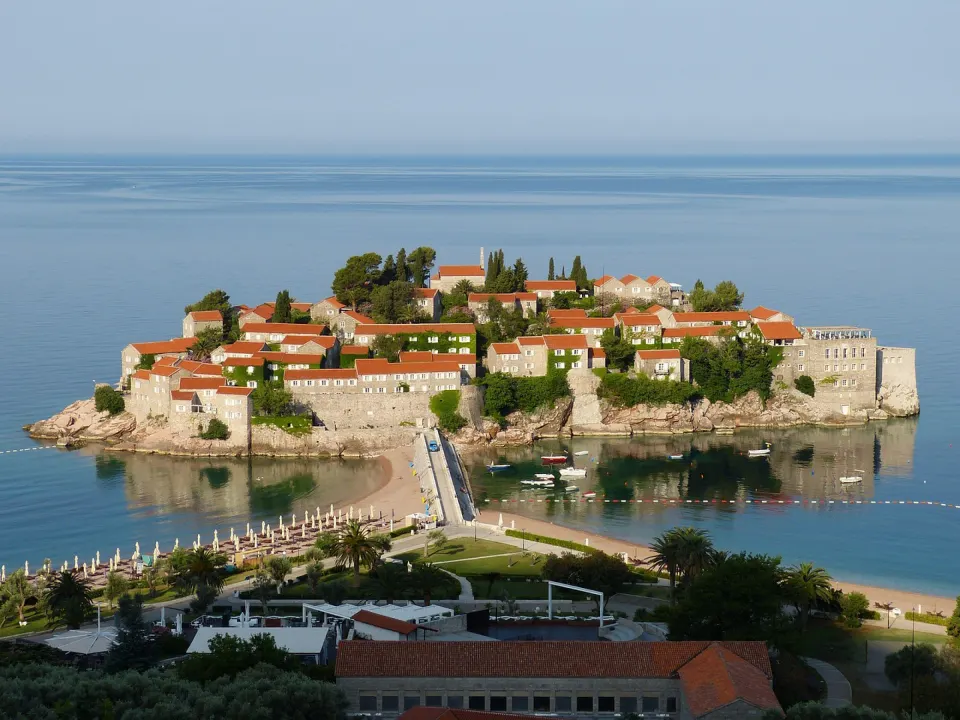
Aerial view of Sveti Stefan island resort

Budva travel guide

What to see, where to stay and the best time to visit Budva, Montenegro.

Best: Jun, Jul, Aug, Sep

Photo: falco / Pixabay

Country
Montenegro

About Budva

Budva is a small beach city on Montenegro's Adriatic coast, with about 13,338 people living there year-round. Its walled Old Town sits right next to sandy beaches like Slovenska Plaža, and nearby spots such as Mogren, Jaz and Sveti Stefan make it easy to mix history with sea time. Go in July or August for full summer heat and the busiest beach scene, or choose June and September for warm weather with fewer crowds.

How many days do you need in Budva?

Two to three days cover the Old Town, Citadel, museum and a beach or two. Add a day for Sveti Stefan or Jaz Beach if you want a slower pace.

Top attractions in Budva

  1. 1Budva Old Town

    2–3 hours

    Stari Grad

    The walled old town sits on a small peninsula, with narrow stone lanes, small squares, churches and cafés. Walk the lanes and the walls for sea views. It is busiest in the middle of the day in summer, so early morning or evening is quieter.

  2. 2Citadel

    30–60 minutes

    Stari Grad

    The Citadel is a fortress at the sea end of the old town. Its terraces look out over the old town roofs, Mogren Beach and Sveti Nikola Island. It also holds small exhibitions.

  3. 3Holy Trinity Church

    15–30 minutes

    Stari Grad

    This Orthodox church stands on the main square of the old town, close to the Citadel. Its striped stone front is easy to spot, and the inside has painted icons. Dress modestly to go in.

  4. 4Museum of the City of Budva

    1 hour

    Stari Grad

    This museum inside the old town shows finds from the area, including Greek and Roman objects from local excavations. It explains how old the settlement is and is a good choice on a hot or rainy day.

  5. 5Mogren Beach

    Half a day

    Mogren

    Mogren is a pair of small sandy coves under the cliffs just west of the old town. You reach it on a footpath along the rocks from the old town walls. The water is clear, but the beach fills up quickly in summer.

  6. 6Dancer of Budva statue

    15 minutes

    Mogren path

    A bronze statue of a dancing woman stands on a rock above the sea, on the path between the old town and Mogren Beach. It is a common photo stop on the way to the beach.

  7. 7Slovenska Beach

    2–4 hours

    Budva centre

    Slovenska is the long town beach east of the old town, lined with a seafront promenade. It is the easiest beach to reach from most hotels, with sunbeds, bars and water sports. Expect it to be crowded in peak summer.

  8. 8Sveti Nikola Island

    Half a day

    Off Budva

    Sveti Nikola is the wooded island facing Budva's waterfront. In the summer season, small boats from the marina take visitors to its pebble beaches. It is a short trip for swimming away from the town beaches.

  9. 9Jaz Beach

    Half a day

    Jaz

    Jaz is a long pebble and sand beach west of Budva, set in a wide bay with hills behind. It has more space than the town beaches and is also known as a venue for large summer music events.

  10. 10Sveti Stefan

    1–2 hours

    Sveti Stefan

    Sveti Stefan is a small fortified island village joined to the coast by a narrow strip of sand, along the coast south-east of Budva. The island itself is a private hotel, so most visitors view it from the shore, the road above and the nearby public beach.

Budva by month

Average weather and our month score, from 10 years of climate data.

Weather by month and month scores for Budva
Month High / low Rain days Sunshine Sea temp Score
January 11°C / 5°C 13 days (245 mm) 6.5 h/day 15°C 1.4/10
February 13°C / 7°C 12 days (221 mm) 7.5 h/day 14°C 1.8/10
March 15°C / 8°C 14 days (237 mm) 8.9 h/day 15°C 1.6/10
April 18°C / 11°C 13 days (146 mm) 10.6 h/day 16°C 2.8/10
May 22°C / 16°C 15 days (172 mm) 11.7 h/day 20°C 4.8/10
Best month: June 27°C / 21°C 9 days (81 mm) 13.2 h/day 24°C 8.8/10
Best month: July 31°C / 24°C 5 days (45 mm) 13.7 h/day 27°C 9.3/10
Best month: August 31°C / 24°C 7 days (68 mm) 12.9 h/day 26°C 9.0/10
Best month: September 26°C / 20°C 11 days (175 mm) 10.6 h/day 25°C 8.5/10
October 21°C / 16°C 11 days (225 mm) 8.9 h/day 22°C 6.3/10
November 17°C / 12°C 14 days (374 mm) 6.5 h/day 20°C 3.0/10
December 13°C / 7°C 13 days (276 mm) 6.4 h/day 17°C 1.5/10
  1. Jan

    Expect a high of 11°C with rain on about 13 days and a cool sea at 15°C; this is one of the quietest, wettest months, better for budget stays than beach time.

  2. Feb

    Highs reach 13°C with around 12 rain days and sea temp of 14.3°C; still cold and damp, so it suits short city breaks rather than swimming.

  3. Mar

    Temperatures climb to 14.7°C with roughly 14 rain days, the wettest month by frequency; the sea stays chilly at 14.5°C, keeping this a low-score month for beach travel.

  4. Apr

    Highs hit 18.1°C with about 12 rain days and sea at 16.4°C; weather is improving but still unsettled, scoring low for a full holiday.

  5. May

    With highs of 22.2°C, 15 rain days and sea warming to 19.8°C, conditions turn workable, giving an ok score as spring showers ease off.

  6. Jun

    Highs of 27.1°C, only 9 rain days and sea at 24.3°C mark the start of the best stretch for sun and swimming.

  7. Jul

    The hottest conditions arrive with a high of 30.5°C, just 5 rain days and sea temp of 26.5°C, the top-scoring month overall.

  8. Aug

    Highs stay near 30.6°C with 7 rain days and sea at 26.4°C, keeping August firmly in the best-rated range for warm, dry days.

  9. Sep

    Highs ease to 25.7°C with 11 rain days and sea still warm at 25°C, holding a strong score as summer crowds thin out.

  10. Oct

    Highs drop to 21.4°C with about 11 rain days and sea at 22°C; a good month for mild, less crowded travel.

  11. Nov

    Highs fall to 17.2°C and rainfall jumps sharply, with 374mm over roughly 14 days; this wet, grey stretch scores low for outdoor plans.

  12. Dec

    Highs of 13.2°C, 12 rain days and 276mm of rain make this a cold, wet month better suited to indoor sightseeing than beach time.

Climate averages 2015–2024 · Best time to visit Montenegro →

Where to stay in Budva

The best areas to base yourself and who each one suits.

Old Town

Good for first-timers, couples, sightseeing

Budva's walled old quarter sits on a small headland, with stone lanes, churches and small beaches just outside the walls. You can walk to the main sights, cafés and the seafront promenade. Rooms are often small, and summer evenings bring crowds and noise from nearby bars.

Slovenska Plaža

Good for first-timers, nightlife, beach-goers

This is the area behind Budva's long main beach, east of the Old Town, lined with a promenade, restaurants and clubs. It is flat and central, so the beach, bus station and Old Town are an easy walk. In peak season the beach is very crowded and music from clubs can carry late into the night.

Bečići

Good for families, beach holidays

Bečići is a resort area just east of central Budva, built around a wide sandy beach with calmer water. It feels more relaxed than the centre while staying close to it. It is mostly large resort buildings, so it has less local character, and reaching the Old Town on foot takes a fair walk.

Rafailovići

Good for families, quiet, seafood lovers

Rafailovići is a former fishing village at the eastern end of Bečići beach, with small family-run guesthouses and fish restaurants by the water. A seaside path links it to Bečići, and the mood is calmer than in Budva town. Many places to stay are up steep hillside streets and steps.

Pržno

Good for couples, quiet, scenery

Pržno is a small village further south along the coast, near the famous islet of Sveti Stefan, with a sheltered pebble cove. It suits travellers who want a slower pace and coastal walks. It is a bus or taxi ride from Budva's centre, and the choice of shops and nightlife is limited.

Getting to and around Budva

From the airport
Budva has no airport of its own. The nearest is Podgorica, about 1 h 30 min away by bus. Visitors also fly into Tivat, which is closer, though no route data is given here; taxis or transfers are the usual option from either airport.
Public transport
Budva has little public transport within the town itself. Regional buses link it to nearby places: Kotor in 35 min, Podgorica in 1 h 30 min, Ulcinj in 1 h 50 min, and Kolašin in 3 h. Buy bus tickets at the station before travelling.
On foot
The Old Town (Stari Grad) is compact and walkable, with the Citadel, Holy Trinity Church, and the city museum all close together. Mogren Beach and Slovenska Beach are an easy walk from the centre.

Typical journey times and fares from the airport and other cities.

Route By Time Price
Kolašin → Budva Some direct buses run in season. Otherwise, take the train or bus to Podgorica and change there. The time is approximate and I could not check it. bus 3 h – ↗

Day trips from Budva

Places within 2½ hours by train, bus, ferry or car.

  • Podgorica

    bus

    Frequent buses from several companies, via Cetinje or the Sozina tunnel. Book online at busticket4.me or buy at the station. The time is approximate and I could not check it.

    1 h 30 min
  • Kotor

    bus

    Short and frequent coastal route, also run by local lines. In July and August, traffic jams near the Trojica tunnel are common. The time is approximate and I could not check it.

    35 min
  • Ulcinj

    bus

    Coastal buses via Petrovac and Bar. There are more services in summer. The time is approximate and I could not check it.

    1 h 50 min

Food to try in Budva

Crni rižot (black risotto)

This is a rice dish cooked with cuttlefish ink, giving it a dark colour and a briny taste. Coastal restaurants in Budva serve it as a main course, often with a glass of local white wine.

Grilled fish and seafood

Fresh sea bass, squid and mussels are grilled simply with olive oil and lemon. Locals eat this in the evening at konobas (small taverns) along the Budva waterfront.

Njeguški pršut

This is a smoked, air-dried ham from the nearby Njeguši village. It is usually served as a starter with local cheese and olives before the main meal.

Kačamak

A thick cornmeal and potato dish mixed with cheese and sour cream. It's a hearty inland Montenegrin food that coastal towns like Budva also serve, especially in cooler months.

Buzara

Mussels or other shellfish cooked in a sauce of white wine, garlic and tomato. It's a common lunch or dinner dish in Budva's seafood restaurants near the old town.

Rakija

A strong fruit brandy, often made from grapes or plums, drunk before or after meals. Many family-run restaurants in Budva offer a small glass as a welcome or digestif.

More of Montenegro

Montenegro travel guide →

Budva: frequently asked questions

Is Budva good in August?

Yes, August is one of the best months to visit Budva. The average high is 30.6°C, the sea is 26.4°C, and there are only 7.3 rain days in the month. It's warm enough for swimming all day and the sun hours average 12.9, so you get long beach days with little rain.

How many days do I need in Budva?

Most travellers plan 2 to 3 days for Budva. That covers the Old Town in 2–3 hours, the Citadel in 30–60 minutes, Mogren Beach for half a day, and a trip out to Sveti Stefan or Jaz Beach, each taking a half day to a couple of hours.

When is the best time to visit Budva?

June, July, August and September score highest, all rated 'best' with scores between 8.5 and 9.3. July is the top month at 9.3, with a 30.5°C high and sea temperature of 26.5°C. September is cooler at 25.7°C high but still has a sea temperature of 25°C, with fewer crowds.

Is Budva warm enough to swim in October?

Yes, the sea stays at 22°C in October, which is swimmable for many people. The air high averages 21.4°C and there are 10.9 rain days, so it's a milder, quieter alternative to peak summer, and the month is rated 'good' with a score of 6.3.

Does it rain a lot in Budva in winter?

Yes, winter is the wettest season in Budva. November sees 374mm of rain over 13.9 days, the highest of any month, while January brings 245mm over 13.4 days. Sun hours drop to around 6.4–6.5 in December and January, making these months rated 'avoid' for a beach trip.