Skip to content
wheretotravel.info
Tbilisi

Tbilisi travel guide

What to see, where to stay and the best time to visit Tbilisi, Georgia.

Best: Apr, Sep, Oct

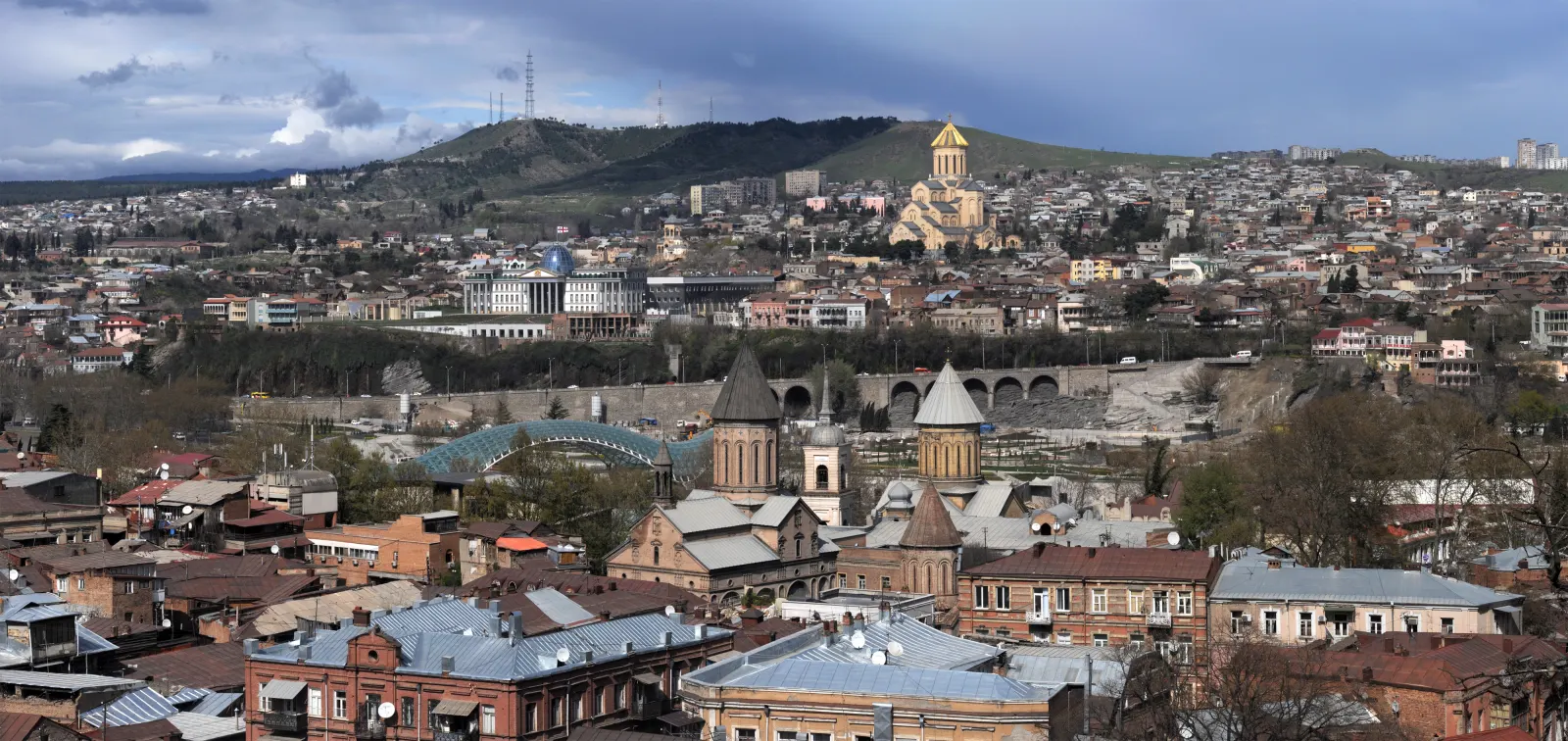
Photo: User:Ggia / Wikimedia Commons

Country
Georgia

About Tbilisi

Tbilisi is the capital of Georgia, an inland city with its main sights close to the old quarter. In Old Tbilisi you can climb to Narikala Fortress, soak in the Abanotubani sulphur baths and walk the streets around Sioni Cathedral. Holy Trinity Cathedral (Sameba) stands in Avlabari. First-timers often stay in the Old Town or Sololaki. Chugureti suits nightlife, and Vake is quieter. The best months to visit are September, October and April.

How many days do you need in Tbilisi?

Plan around the sights. Old Tbilisi streets and Sioni Cathedral take half a day. The Georgian National Museum and Mtatsminda Park each need 2–3 hours. Many sights are in Old Tbilisi, so you can combine several in one day.

Top attractions in Tbilisi

  1. 1Narikala Fortress

    1–2 hours

    Old Tbilisi

    The ruined fortress walls run along the ridge above the old town and give the best overall views of the city. You can walk up from the old town or take the cable car from Rike Park. The Mother of Georgia statue stands on the same ridge.

  2. 2Abanotubani (Sulphur Baths)

    1–2 hours

    Old Tbilisi

    This is the old bath district. Brick domes cover bathhouses fed by natural hot sulphur springs. You can book a private room or use a shared bath, then walk up the small gorge behind the baths to a waterfall.

  3. 3Old Tbilisi streets and Sioni Cathedral

    half a day

    Old Tbilisi

    Narrow lanes, wooden carved balconies and small churches fill the old town. Sioni Cathedral is one of the city's main Orthodox churches. The Gabriadze puppet theatre with its leaning clock tower is nearby.

  4. 4Metekhi Church

    under 1 hour

    Metekhi

    A stone church sits on a cliff above the Mtkvari River, with a statue of King Vakhtang Gorgasali, the city's founder, beside it. The view across the river to the baths and the fortress is one of the classic Tbilisi views.

  5. 5Holy Trinity Cathedral (Sameba)

    1 hour

    Avlabari

    This is Georgia's largest Orthodox cathedral, a modern building on a hill with gold-topped domes that you can see from much of the city. Visitors can watch services, and modest dress is expected inside.

  6. 6Georgian National Museum

    2–3 hours

    Rustaveli Avenue

    The main museum branch on Rustaveli Avenue holds the country's archaeology collections. Highlights include the gold treasury and the early human finds from Dmanisi. It is the best single place to understand Georgia's long history.

  7. 7Rustaveli Avenue

    1–2 hours

    Mtatsminda

    This is the city's main boulevard, running from Freedom Square past the Parliament building, the Opera and Ballet Theatre and several museums. It is good for a walk and for seeing the city's political and cultural centre.

  8. 8Mtatsminda Park and Funicular

    2–3 hours

    Mtatsminda

    A funicular climbs from the city to an amusement park on top of Mtatsminda mountain, where you get wide views over Tbilisi. Halfway up is the Pantheon, where many famous Georgian writers and public figures are buried.

  9. 9Bridge of Peace and Rike Park

    1 hour

    Old Tbilisi

    A modern glass-and-steel footbridge crosses the Mtkvari River and links the old town to Rike Park. The bridge lights up after dark, and the cable car to Narikala starts from the park.

  10. 10Dry Bridge Market

    1–2 hours

    Mtatsminda

    A flea market spreads out around the Dry Bridge and in the small park beside it. Sellers offer Soviet-era badges, cameras, old household items, paintings and jewellery, and browsing is half the fun.
Tbilisi by month

Average weather and our month score, from 10 years of climate data.

Weather by month and month scores for Tbilisi
Month High / low Rain days Sunshine Score
January 7°C / -1°C 5 days (19 mm) 7.2 h/day 3.9/10
February 9°C / 0°C 5 days (24 mm) 7.8 h/day 4.6/10
March 13°C / 3°C 12 days (63 mm) 8.2 h/day 4.9/10
Best month: April 18°C / 7°C 11 days (71 mm) 9.6 h/day 7.8/10
May 23°C / 12°C 13 days (97 mm) 10.9 h/day 7.3/10
June 29°C / 18°C 11 days (63 mm) 12.4 h/day 6.4/10
July 31°C / 20°C 7 days (47 mm) 12.5 h/day 6.0/10
August 32°C / 21°C 5 days (30 mm) 11.9 h/day 6.2/10
Best month: September 26°C / 16°C 8 days (54 mm) 10.1 h/day 8.3/10
Best month: October 19°C / 10°C 9 days (59 mm) 8.0 h/day 8.2/10
November 13°C / 4°C 7 days (43 mm) 7.2 h/day 5.8/10
December 8°C / 0°C 6 days (22 mm) 6.5 h/day 3.5/10
  1. Jan

    Cold, with highs of 7.2°C and lows of -1.4°C. Only 4.6 rain days, but freezing nights and a score of 3.9 make this a month to avoid.

  2. Feb

    Still cold, with 9.3°C highs, 0°C lows and 5.1 rain days. An ok month, scoring 4.6, if you pack warm layers.

  3. Mar

    Highs reach 12.6°C, but rain days jump to 12.1. It scores 4.9, so it is ok, though often wet and cool for walking.

  4. Apr

    One of the best months, scoring 7.8. Highs of 18.3°C and 10.9 rain days, so bring a light rain jacket.

  5. May

    Good, with a score of 7.3 and pleasant 22.8°C highs. But it is the wettest month, with 13.4 rain days and 97 mm of rain.

  6. Jun

    Good, scoring 6.4. Highs climb to 29°C, with 10.7 rain days and long days of 12.4 sun hours.

  7. Jul

    Hot, with 31.1°C highs and 19.9°C lows. Rain drops to 7.4 days. Good, scoring 6, but plan walks for mornings and evenings.

  8. Aug

    The hottest month at 31.6°C, with only 5.2 rain days. Good, scoring 6.2, if you handle heat well. Otherwise choose September.

  9. Sep

    The top score of the year, 8.3. Highs of 26.1°C, 8.3 rain days and 10.1 sun hours. The best time to go.

  10. Oct

    Best, scoring 8.2. Mild 18.8°C highs, 10°C lows and 8.8 rain days. Good for walking, but bring a jacket for the evenings.

  11. Nov

    Cooling to 12.7°C highs and 4°C lows, with 6.6 rain days. An ok month, scoring 5.8, if you do not mind cool, shorter days.

  12. Dec

    The lowest score of the year, 3.5, so avoid it. Highs of 8°C, lows of 0.3°C and only 6.5 sun hours, the fewest all year.

Climate averages 2015–2024 · Best time to visit Georgia →

Where to stay in Tbilisi

The best areas to base yourself and who each one suits.

Old Town

Good for first-timers, sightseeing

The historic core by the Mtkvari River has winding lanes, wooden balconies, the sulphur baths and the cable car up to Narikala Fortress, all within walking distance. It is the easiest base for a short first trip. Streets are steep and cobbled, and the busiest lanes are touristy and can be loud at night.

Sololaki

Good for first-timers, architecture lovers, food

Sololaki sits just west of the Old Town, below the Mother of Georgia statue. It has grand 19th-century houses, courtyards, good cafés and wine bars, and is a short walk to Freedom Square and Rustaveli Avenue. Many streets climb uphill, and some old buildings have no lift.

Vera

Good for couples, cafés, longer stays

This leafy residential area north of Rustaveli Avenue has quiet streets, local bakeries and a relaxed daily rhythm. You can walk to the main museums and the Philharmonic, so it feels central without the crowds. The hills are steep, and the walk down to the Old Town takes some time.

Chugureti

Good for nightlife, young travellers, creatives

Across the river, around Marjanishvili and Aghmashenebeli Avenue, Chugureti mixes restored 19th-century streets with the Fabrika hostel and creative hub. It has a lively bar scene, good-value places to eat and a metro link to the centre. Some blocks feel rundown, and nights around Fabrika can be noisy.

Vake

Good for families, quiet, upscale

Vake is a greener, wealthier district west of the centre, with Vake Park, modern cafés and a calmer pace. It suits travellers who want space and quiet after a day of sightseeing. It is not on the metro, so you will rely on taxis or buses to reach the Old Town, and traffic on main roads can be heavy.

Getting to and around Tbilisi

From the airport
Tbilisi International Airport lies east of the city. Most visitors take a taxi or a ride-hailing app such as Bolt, or a city bus to the centre. Agree a taxi fare before you set off, or book through an app.
Public transport
Tbilisi has a metro, city buses and minibuses called marshrutkas. There is also a cable car up to Narikala and a funicular to Mtatsminda Park. Tip: buy a rechargeable transport card at a metro station, because buses do not take cash.
On foot
Old Tbilisi is compact. Narikala Fortress, the Sulphur Baths, Sioni Cathedral and the Bridge of Peace are a short walk apart, and Sololaki is next door. Expect steep hills and uneven cobbles.

Food to try in Tbilisi

Khinkali

Twisted dumplings filled with spiced meat and hot broth. Locals eat them by hand, holding the knot at the top and leaving it on the plate. Khinkali houses serve them all day.

Khachapuri

Georgian cheese bread, found in bakeries and restaurants across the city. Imeruli is round and filled with cheese. Adjaruli is boat-shaped and topped with egg and butter, which you stir in.

Badrijani nigvzit

Thin slices of fried aubergine rolled around a garlicky walnut paste, often topped with pomegranate seeds. It is a common cold starter at a supra, the traditional Georgian feast.

Lobio

A thick, herby bean stew, often served in a clay pot. Locals usually eat it with mchadi, a dense cornbread, and pickled vegetables.

Mtsvadi

Chunks of meat, usually pork, grilled on skewers over vine cuttings or coals. It is a favourite at family gatherings and outdoor meals, served with raw onion and pomegranate.

Churchkhela

Strings of walnuts dipped again and again in thickened grape juice, then dried. It looks like a candle, and you will see it hanging at markets and street stalls.

More of Georgia

Georgia travel guide →

Tbilisi: frequently asked questions

When is the best time to visit Tbilisi?

September and October are the best months, with April close behind. September has highs of about 26°C and 8.3 rain days. October is cooler at around 19°C, with 8.8 rain days. April is similar at about 18°C, but it is a little wetter, with 10.9 rain days. These 3 months score highest on our scale: 8.3, 8.2 and 7.8 out of 10.

Is Tbilisi too hot in August?

August is the hottest month in Tbilisi, with average highs of about 32°C and nights that stay near 21°C. The upside is that it is also one of the driest and sunniest months. It has only 5.2 rain days, 30 mm of rain and about 12 hours of sun a day. Plan hilltop walks, such as the one to Narikala Fortress, for the morning or evening.

What is Tbilisi like in winter?

Winter in Tbilisi is cold but dry. January highs are about 7°C and lows drop to around -1°C. December is similar, with highs near 8°C. Rain is light, with about 19–22 mm a month, but days are short. December gets only about 6.5 hours of sun. The city is quieter, and it suits travellers who don't mind cold weather.

What is the rainiest month in Tbilisi?

May is the wettest month, with about 97 mm of rain over 13.4 days. It is still warm, with highs of about 23°C, so showers rarely spoil a whole day. March and April are also fairly wet, with 12.1 and 10.9 rain days. For drier weather, go in August or January, when rain falls on only about 5 days.

How many days do I need in Tbilisi?

About 2 full days cover the main sights. Old Tbilisi can fill most of 1 day. Its streets and Sioni Cathedral take half a day, and Narikala Fortress and the Sulphur Baths take 1–2 hours each. On a second day you could visit the Georgian National Museum and Mtatsminda Park, which need 2–3 hours each. Add Holy Trinity Cathedral and Dry Bridge Market if you have time.