Skip to content
wheretotravel.info
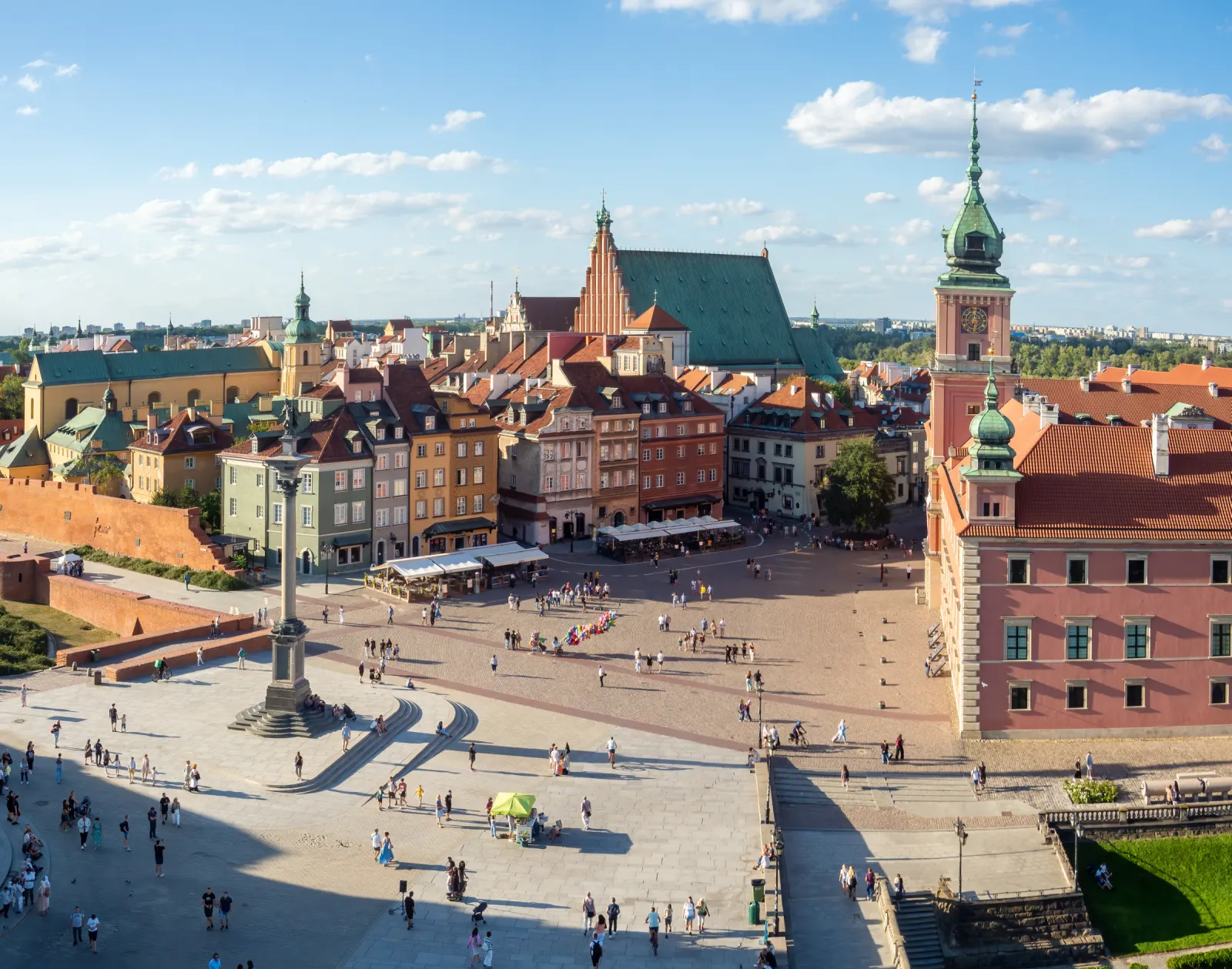
Warsaw Old Town square with historic buildings and people

Warsaw travel guide

What to see, where to stay and the best time to visit Warsaw, Poland.

Best: May, Jun, Aug, Sep

Photo: Rhododendrites / Wikimedia Commons

Country
Poland

About Warsaw

Warsaw is Poland's capital, a city of 1,862,402 people that mixes a rebuilt Old Town with Soviet-era landmarks and a fast-growing modern skyline. Visitors come for the history: the Royal Castle, the Warsaw Rising Museum and the POLIN Museum all tell parts of a hard 20th-century story. There's also green space in Royal Łazienki Park and newer attractions like the Copernicus Science Centre. The best months to visit are May, June, August and September, when weather is milder and outdoor sightseeing is easier.

How many days do you need in Warsaw?

Plan for 2 to 3 days. That's enough time to cover the Old Town, Royal Castle, one or two museums and a walk along the Royal Route, with a half-day left over for Praga or Wilanów Palace.

Top attractions in Warsaw

  1. 1Old Town (Stare Miasto)

    2–3 hours

    Śródmieście

    The historic centre around the Old Town Market Square, with narrow lanes, merchant houses, the city walls and the Barbican. It was destroyed in the Second World War and carefully rebuilt from old paintings and drawings, and it is now on the UNESCO World Heritage list. Come in the early morning or evening for quieter streets.

  2. 2Royal Castle

    2 hours

    Śródmieście

    The former home of Polish kings and the seat of parliament, standing on Castle Square at the edge of the Old Town. Inside are restored royal apartments, state rooms and paintings, including city views by Canaletto (Bernardo Bellotto).

  3. 3Warsaw Rising Museum

    2–3 hours

    Wola

    A large museum about the Warsaw Uprising against the German occupation, the city's defining wartime event. It uses photos, film, sound and personal objects to tell the story, and it helps visitors understand why so much of Warsaw looks new.

  4. 4POLIN Museum of the History of Polish Jews

    3 hours

    Muranów

    This museum stands in the area of the former Warsaw Ghetto and covers a thousand years of Jewish life in Poland. The main exhibition is detailed and interactive, so plan plenty of time. The Monument to the Ghetto Heroes is right in front of the building.

  5. 5Royal Łazienki Park

    2–3 hours

    Śródmieście

    A large landscaped park with the Palace on the Isle, smaller pavilions, ponds and free-roaming peacocks. It is home to the Chopin Monument, where open-air piano concerts take place in summer. A good place to walk and slow down between museums.

  6. 6Palace of Culture and Science

    1–2 hours

    Śródmieście

    A huge Soviet-era tower in the city centre, a gift from Stalin that many locals still have mixed feelings about. It holds theatres, a cinema and museums. Its viewing terrace gives one of the best views over Warsaw.

  7. 7Wilanów Palace

    half a day

    Wilanów

    A baroque royal residence in the south of the city that survived the war in much better shape than the centre. You can visit the richly decorated interiors and the formal gardens that run down towards a lake. It takes some time to get there by bus, so plan a half day.

  8. 8Royal Route (Krakowskie Przedmieście and Nowy Świat)

    1–2 hours

    Śródmieście

    An elegant street that runs south from Castle Square past churches, palaces, the University of Warsaw and the Presidential Palace. The Church of the Holy Cross, where Chopin's heart is kept, is on the way. Nowy Świat continues it with cafés and shops.

  9. 9Copernicus Science Centre

    3–4 hours

    Powiśle

    A large hands-on science museum on the Vistula riverbank, popular with families and adults alike. Hundreds of interactive exhibits invite you to test, build and experiment. It gets busy, so it is worth booking ahead.

  10. 10Praga

    half a day

    Praga-Północ

    The district on the east bank of the Vistula kept many of its pre-war tenement buildings, so it feels very different from the rebuilt centre. Today it mixes old courtyards with street art, the Neon Museum and bars in former factories. It shows a rougher, more local side of the city.
Warsaw by month

Average weather and our month score, from 10 years of climate data.

Weather by month and month scores for Warsaw
Month High / low Rain days Sunshine Score
January 2°C / -3°C 13 days (50 mm) 2.9 h/day 1.1/10
February 5°C / -2°C 11 days (49 mm) 4.6 h/day 2.0/10
March 9°C / 0°C 10 days (40 mm) 6.9 h/day 3.0/10
April 14°C / 4°C 11 days (48 mm) 9.4 h/day 5.8/10
Best month: May 19°C / 9°C 12 days (69 mm) 11.4 h/day 7.6/10
Best month: June 24°C / 14°C 10 days (65 mm) 12.6 h/day 7.9/10
July 25°C / 15°C 13 days (81 mm) 11.8 h/day 7.4/10
Best month: August 25°C / 16°C 11 days (76 mm) 11.1 h/day 7.8/10
Best month: September 20°C / 11°C 10 days (61 mm) 8.8 h/day 8.0/10
October 14°C / 7°C 12 days (65 mm) 5.9 h/day 4.9/10
November 7°C / 3°C 10 days (41 mm) 3.5 h/day 2.0/10
December 4°C / 0°C 12 days (52 mm) 2.4 h/day 1.3/10
  1. Jan

    Cold and dark: highs of 2°C, lows of -2.8°C, 13.3 rain days, just 2.9 sun hours. Low season, tough weather.

  2. Feb

    Still cold, highs of 4.6°C, lows of -1.5°C, 10.9 rain days. Light improves to 4.6 sun hours, but scores stay low.

  3. Mar

    Highs reach 8.6°C, lows near freezing at 0.2°C, 10.3 rain days. Transitional month, weather still raw, low score of 3.

  4. Apr

    Milder, highs of 13.8°C, lows of 4.2°C, 10.7 rain days, 9.4 sun hours. Conditions turn workable, score rises to 5.8.

  5. May

    Highs of 19.2°C, lows of 9°C, 12 rain days, 11.4 sun hours. Warm and bright, one of the best months to visit.

  6. Jun

    Highs of 24.2°C, lows of 14.1°C, 10.3 rain days, 12.6 sun hours. Long sunny days make this a top month.

  7. Jul

    Highs of 24.8°C, lows of 15.4°C, 13.1 rain days, 81mm rain. Warm but wetter, still rated a good month overall.

  8. Aug

    Highs of 25.3°C, lows of 15.5°C, 11 rain days, 11.1 sun hours. Warmest month, sunny and highly rated.

  9. Sep

    Highs of 20.1°C, lows of 11.3°C, 10 rain days, 8.8 sun hours. Mild, drier air and the top-scoring month.

  10. Oct

    Highs drop to 13.7°C, lows of 6.7°C, 12.2 rain days, sun falls to 5.9 hours. Cooling fast, an okay month.

  11. Nov

    Highs of 7.2°C, lows of 2.5°C, 9.6 rain days, just 3.5 sun hours. Dark and damp, low season returns.

  12. Dec

    Highs of 3.8°C, lows of -0.3°C, 11.6 rain days, only 2.4 sun hours. Cold, dark, low score for travel.

Climate averages 2015–2024 · Best time to visit Poland →

Where to stay in Warsaw

The best areas to base yourself and who each one suits.

Śródmieście

Good for first-timers, short stays, transport

The modern city centre around the Palace of Culture and Science, with the main railway station, both metro lines and many tram routes close by. It is the easiest base for getting around and for day trips by train. Wide roads and heavy traffic make some streets loud and not very charming.

Old Town

Good for first-timers, sightseeing, couples

The rebuilt historic core with the Royal Castle, the Market Square and the Royal Route leading south through Nowy Świat. You can walk to most major sights, and the lanes are pleasant in the evening. It is the most touristy part of the city, with busy squares in summer and fewer everyday shops.

Praga

Good for repeat visitors, art, bars

The district across the Vistula, with older pre-war buildings, the Neon Museum, the Praga Museum and converted factory spaces like Koneser. It feels less polished and more local than the centre, and the metro links it quickly to the other bank. Some streets are still run-down and quiet after dark, so check the exact location before you book.

Mokotów

Good for families, longer stays, quiet

A large, green residential district south of the centre, with Łazienki Park nearby, Morskie Oko park and local restaurants on streets like Puławska. It is calmer than the centre, and metro line M1 runs through it. You will need public transport for most sights, as the Old Town is too far to walk comfortably.

Wola

Good for business travellers, modern stays

A former industrial district west of the centre, now full of office towers, newer apartments and the Warsaw Rising Museum. Metro line M2 connects it to the centre and to Praga. Parts of it feel corporate and empty in the evenings, with less street life than older neighbourhoods.

Getting to and around Warsaw

From the airport
No specific route data is available for getting from Warsaw's airport to the centre. The usual options are a train, a city bus, or a taxi, all commonly used by visitors to reach central districts like Śródmieście.
Public transport
Warsaw has a metro, trams, and buses that cover the city well. A practical tip: buy a travel card or ticket that works across all three, since they share the same fare system, making transfers simple.
On foot
Śródmieście and the Old Town are close together and easy to explore on foot. Sights such as the Royal Castle, Royal Łazienki Park, the Palace of Culture and Science, and the Royal Route all sit within this walkable core.

Food to try in Warsaw

Pierogi

These are dumplings filled with options like potato and cheese, meat, or sweet fruit. Locals eat them as a main meal or snack in milk bars and restaurants across Warsaw any time of day.

Żurek

This is a sour rye soup, often served with boiled egg and sausage. It is a common lunch or dinner choice, especially in colder months.

Bigos

Known as hunter's stew, this dish mixes sauerkraut, fresh cabbage, and various meats. It is a hearty winter meal, often slow-cooked and reheated over several days.

Kotlet schabowy

This is a breaded pork cutlet, similar to a schnitzel, usually served with potatoes and cabbage salad. It is a classic home-style and restaurant main course in Warsaw.

Flaki

This tripe soup is a traditional Polish comfort food, often flavored with marjoram. It is popular in local milk bars, especially during cooler seasons.

Paczki

These are round, filled doughnuts, often with rose or plum jam, dusted with powdered sugar. Locals enjoy them as a treat throughout the year, especially around Fat Thursday.

More of Poland

Poland travel guide →

Warsaw: frequently asked questions

Is Warsaw good in August?

Yes. August scores 7.8 out of 10 and counts as one of the best months. Days reach 25.3°C on average with a low of 15.5°C, and there are 11.1 hours of sun. It does rain on about 11 days with 76mm total, so pack something light for showers, but overall it's warm and bright.

What is the best time to visit Warsaw?

May, June, August and September score highest, all rated 'best', with June topping out at 7.9 and September at 8. Highs sit between 19.2°C and 25.3°C in this window, with plenty of sun hours (8.8 to 12.6) and moderate rain. July is also good, scoring 7.4, though it brings the most rain of the year at 81mm over 13.1 days.

How many days do I need in Warsaw?

Plan on 3 to 4 days. The main sights add up to roughly that: Old Town and the Royal Castle take 2–3 and 2 hours, the Warsaw Rising Museum and POLIN Museum need 2–3 and 3 hours, Łazienki Park takes another 2–3 hours, and Wilanów Palace or Praga each need half a day on their own.

Is Warsaw cold in winter?

Yes. December, January and February all score low, between 1.1 and 2 out of 10, and are rated 'avoid'. January is the coldest month, with highs of just 1.9°C and lows of -2.8°C. Sunshine is also scarce then, only 2.4 to 4.6 hours a day, though snow and quieter streets can still appeal to some travellers.

What is Warsaw like in October?

October is a transition month, scoring 4.9 and rated 'ok'. Highs drop to 13.7°C and lows to 6.7°C, with rain on about 12.2 days totalling 65mm. Sunshine falls to 5.9 hours a day, noticeably less than the 8.8 hours of September, so expect greyer, cooler conditions as autumn sets in.