Skip to content
wheretotravel.info
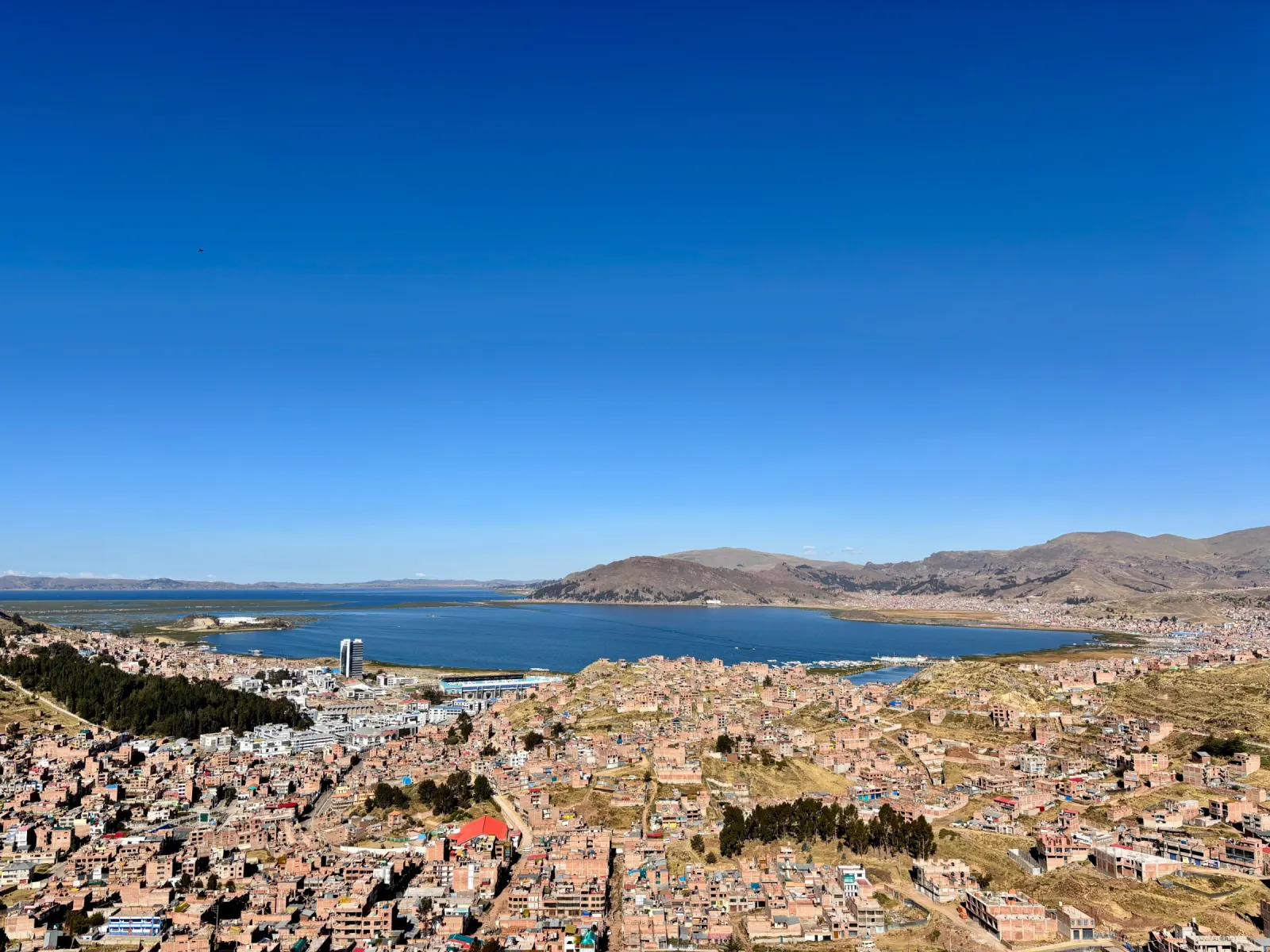
Aerial view of Puno city and lake

Puno travel guide

What to see, where to stay and the best time to visit Puno, Peru.

Best: Jun, Jul, Aug

Photo: Jaime Joel Vargas Huacre / Pexels

Country
Peru

About Puno

Puno is a city of 128,637 people in southern Peru and a base for trips on Lake Titicaca. Most visitors come for the lake: the Uros Floating Islands, Taquile Island and Amantaní Island. On land, you can visit the Sillustani site near Atuncolla, the Yavari Ship Museum on the lakefront, Puno Cathedral on the Plaza de Armas and the Kuntur Wasi Viewpoint. For a quieter stay, Chucuito suits slow travel. The best months to visit are June, July and August.

How many days do you need in Puno?

Plan several days, because the lake trips set the pace. The Uros Floating Islands take half a day, Taquile Island 1 full day and Amantaní Island 1–2 days. Add half a day for Sillustani and a few hours for the city sights.

Top attractions in Puno

  1. 1Uros Floating Islands

    half a day

    Lake Titicaca

    Small man-made islands built from layers of totora reeds, where Uros families still live. Boats leave from Puno's port, and visitors can walk on the soft reed ground, see how the islands are made and ride a reed boat. It is the most popular trip from Puno.

  2. 2Taquile Island

    1 full day

    Lake Titicaca

    A hilly island known for its hand-woven textiles, knitted by the men. Paths lead up past stone arches and farm terraces to a small main square with wide views over the lake. The boat trip is long, so most people combine it with the Uros islands.

  3. 3Amantaní Island

    1–2 days

    Lake Titicaca

    A quiet farming island where many visitors stay overnight with a local family. You can walk up to the hilltop temples of Pachamama and Pachatata for sunset views. It suits travellers who want a slower, more personal visit.

  4. 4Sillustani

    half a day

    Atuncolla

    Tall stone burial towers called chullpas, built by the Colla people and later the Incas, stand on a peninsula above Lake Umayo. The best-made towers show fine, tightly fitted stonework. The open, windswept setting is especially striking in late afternoon light.

  5. 5Yavari Ship Museum

    1 hour

    Puno lakefront

    A historic steamship built in Britain, shipped to Peru in pieces and carried over the Andes by mule before being assembled on the lake. Today it is a museum where you can see the engine room, the bridge and old photos of the journey.

  6. 6Puno Cathedral

    30 minutes–1 hour

    Plaza de Armas

    A stone cathedral on the main square with a finely carved baroque façade that mixes European and Andean designs. The inside is simpler than the front. The square around it is a good place to start a walk through the centre.

  7. 7Kuntur Wasi Viewpoint

    1–2 hours

    Puno city

    A hilltop viewpoint topped by a large metal condor statue, reached by a long flight of steps. From the top you see the whole city and the bay of Lake Titicaca. The air is thin at this height, so climb slowly.

  8. 8Huajsapata Park

    1 hour

    Puno city

    A small hill close to the centre with a large statue of Manco Cápac, the legendary first Inca, who is said to have come out of Lake Titicaca. It offers good views over the rooftops and the lake with a shorter climb than Kuntur Wasi.

  9. 9Carlos Dreyer Museum

    1 hour

    Puno centre

    A city museum in a colonial house near the main square, with pre-Inca and Inca objects, gold pieces, ceramics and paintings by the German artist Carlos Dreyer. It gives useful background before visiting Sillustani and the islands.

  10. 10Chucuito and Inca Uyo

    2–3 hours

    Chucuito

    A small lakeside town south of Puno with colonial churches and the Inca Uyo, a walled site filled with stone carvings linked to fertility. It is an easy half-day trip by road, often done on the way to or from the border with Bolivia.
Puno by month

Average weather and our month score, from 10 years of climate data.

Weather by month and month scores for Puno
Month High / low Rain days Sunshine Score
January 14°C / 6°C 26 days (221 mm) 10.5 h/day 5.1/10
February 14°C / 6°C 26 days (211 mm) 9.9 h/day 5.1/10
March 14°C / 6°C 27 days (161 mm) 10.4 h/day 5.0/10
April 14°C / 4°C 16 days (84 mm) 10.8 h/day 5.1/10
May 15°C / 2°C 7 days (24 mm) 10.8 h/day 7.0/10
Best month: June 15°C / 1°C 2 days (7 mm) 10.7 h/day 8.0/10
Best month: July 15°C / 1°C 3 days (9 mm) 10.8 h/day 7.9/10
Best month: August 16°C / 2°C 4 days (14 mm) 11.2 h/day 8.0/10
September 16°C / 3°C 10 days (41 mm) 11.4 h/day 7.0/10
October 16°C / 4°C 14 days (67 mm) 11.6 h/day 6.3/10
November 17°C / 5°C 17 days (101 mm) 11.6 h/day 6.4/10
December 15°C / 6°C 25 days (165 mm) 10.9 h/day 5.7/10
  1. Jan

    Wet season at its peak: 26 rain days and 221 mm of rain, with highs of 14°C. Rated ok with a score of 5.1.

  2. Feb

    Still very wet, with 26 rain days and 211 mm of rain. Highs reach 14°C and lows 6°C. Rated ok, scoring 5.1.

  3. Mar

    The rainiest month by rain days, at 26.5, though rainfall eases to 161 mm. Highs of 14°C. Rated ok with a score of 5.

  4. Apr

    The rain eases to 16 days and 84 mm. Highs stay at 14°C, but nights cool to 4°C. Rated ok, scoring 5.1.

  5. May

    The dry season begins, with just 6.5 rain days. Highs of 14.7°C, but nights drop to 2°C. Rated good with a score of 7.

  6. Jun

    One of the best months: only 1.5 rain days and 10.7 sun hours. Nights are cold, with lows of 1.2°C. Scores 8.

  7. Jul

    Rated best with a score of 7.9. Dry, with 2.5 rain days and highs of 14.9°C. Nights are cold, around 1.3°C.

  8. Aug

    Rated best, scoring 8. Highs of 15.8°C, 4.3 rain days and 11.2 sun hours. Cold nights, with lows of 1.6°C.

  9. Sep

    Warmer days of 16.1°C and 11.4 sun hours, but rain returns on 10.3 days. Rated good with a score of 7.

  10. Oct

    Highs of 16.2°C and 11.6 sun hours, with 14 rain days and 67 mm of rain. Rated good, scoring 6.3.

  11. Nov

    The warmest month, with highs of 16.8°C. Rain builds to 16.9 days and 101 mm. Rated good with a score of 6.4.

  12. Dec

    The wet season is back: 24.8 rain days and 165 mm of rain, with highs of 15.3°C. Rated ok, scoring 5.7.

Climate averages 2015–2024 · Best time to visit Peru →

Where to stay in Puno

The best areas to base yourself and who each one suits.

Barrio Mañazo

Good for culture, festival visitors

A traditional working neighbourhood close to the centre, known for its folk dance groups and strong role in local festivals such as the Candelaria. It gives a more local feel than the tourist streets around Jirón Lima. It has fewer services for visitors and gets loud and crowded during festival rehearsals and celebrations.

Uros Islands

Good for homestays, unusual experiences

Floating reed islands on the lake near Puno, where some families host visitors overnight. You see daily life on the water and quiet evenings after the day-trip boats leave. Rooms are simple, nights are cold, and you depend on boats to get back to the city.

Chucuito

Good for quiet, couples, slow travel

A small lakeside town south of Puno with colonial churches and the Inca Uyo stone site. It suits travellers who want calm nights and wide lake views away from city traffic. It is outside the city, so you need a taxi or minibus to reach Puno's restaurants and the port.

Getting to and around Puno

From the airport
Puno has no airport route in our data. Most visitors fly into the nearest regional airport, then take a shared shuttle bus, a taxi or a hotel transfer into the centre. Check times and prices when you book.
Public transport
Puno has no metro or tram. Locals use minibuses and taxis. Boats from the port reach the Uros Floating Islands, Taquile and Amantaní. For Sillustani or Chucuito, join a tour or take a taxi.
On foot
The centre is compact and easy to walk. Puno Cathedral, the Carlos Dreyer Museum and Huajsapata Park sit close together. The Yavari Ship Museum is on the lakefront, and Kuntur Wasi Viewpoint is uphill.

Food to try in Puno

Trucha from Lake Titicaca

Trout raised in Lake Titicaca, usually fried or grilled and served with rice, potatoes and salad. It appears on most restaurant menus in Puno and at simple lakeside eateries.

Chairo

A thick Andean soup with meat, often lamb or beef, plus chuño, vegetables and grains. Locals eat it as a warming lunch, especially on cold days in the high plateau.

Pesque de quinua

A creamy quinoa dish cooked with milk and cheese, rather like a savoury porridge. It is common home cooking in the Puno region and often comes with meat or a fried egg.

Chuño and tunta

Potatoes freeze-dried with the traditional Andean method of night frost and sun. They go into soups and stews or are served boiled with cheese as a side dish.

Cancacho

Lamb marinated with chilli and spices, then roasted in a clay or wood oven. It is linked to Ayaviri in the Puno region and is a popular dish for Sundays and festivals.

Kispiño

Small, hard quinoa cakes made from quinoa flour and baked or steamed. They keep for a long time, so people carry them on journeys or eat them as a snack.

More of Peru

Peru travel guide →

Puno: frequently asked questions

What is the best month to visit Puno?

June, July and August are the best months to visit Puno. This is the dry season. June has only 1.5 rain days and 7 mm of rain, and August has 4.3 rain days. Days get about 11 hours of sun, with highs of 14.6–15.8°C. Nights are cold, with average lows between 1.2 and 1.6°C, so bring warm layers.

Is Puno good to visit in the rainy season, December to March?

Yes, Puno works from December to March, but expect rain on most days. These months have 24.8 to 26.5 rain days each. January is the wettest month, with 221 mm of rain. Nights are milder than in the dry season, with lows around 6°C, and you still get about 10 hours of sun a day. We rate these months as ok.

How cold does Puno get at night?

Puno is cold at night all year, and coldest in June and July. Average lows then are 1.2°C and 1.3°C. Even in the mildest months, lows only reach about 6°C, with 6.1°C in February. Daytime highs stay between 14°C and 16.8°C in every month. Pack warm layers whichever month you go.

How many days do I need in Puno?

Plan at least 2 full days in Puno. You can see the Uros Floating Islands and Sillustani in 1 day, as each takes half a day. Taquile Island needs 1 full day. Amantaní Island takes 1–2 days if you want to stay overnight. Smaller city sights, like the Yavari Ship Museum and Puno Cathedral, take about 1 hour each.

Is Puno good in September?

Yes, September is a good month for Puno. It is drier than the rainy season, with 10.3 rain days and 41 mm of rain. Highs reach 16.1°C, warmer than in June to August, and there are 11.4 hours of sun a day. Nights are still cold, with an average low of 3.3°C. October is also good, but has more rain, with 14.1 rain days.