Skip to content
wheretotravel.info
Oranjestad

Oranjestad travel guide

What to see, where to stay and the best time to visit Oranjestad, Aruba.

Best: Apr, May

Photo: falco / Pixabay

Country
Aruba
Currency
AWG

About Oranjestad

Oranjestad is the capital of Aruba, a compact waterfront city built for walking rather than long stays. You can see Fort Zoutman, stroll Main Street for shopping, and spend an hour or two at the National Archaeological Museum, all in the city centre. The waterfront adds Wilhelmina Park, Renaissance Marketplace and Linear Park, while the Aruba Aloe Museum & Factory sits out in Hato. April and May bring the best weather for visiting, so plan city walks and museum time around those months if you can.

How many days do you need in Oranjestad?

One day covers the main sights: the fort, Main Street, the museum and the waterfront parks. Most visitors use Oranjestad as a base and take day trips to beaches like Eagle Beach or Druif rather than staying longer in the city itself.

Top attractions in Oranjestad

  1. 1Fort Zoutman and Willem III Tower

    1–2 hours

    City centre

    Fort Zoutman is the oldest building on Aruba, and its tower once worked as a lighthouse and public clock. Inside is the Historical Museum Aruba, which tells the island's story from early settlers to modern times. It is the best first stop to understand the town.

  2. 2Main Street (Caya G.F. Betico Croes)

    1–2 hours

    City centre

    This is the main shopping street of Oranjestad. It is lined with colourful Dutch-colonial buildings, shops and cafés. It is a pleasant walk and a good place to see everyday local life.

  3. 3National Archaeological Museum Aruba

    1–2 hours

    City centre

    The museum shows objects from Aruba's Indigenous peoples, including pottery, tools and burial finds. It sits in a restored historic family complex. The displays are clear and modern, and it is a good choice on a very hot afternoon.

  4. 4Wilhelmina Park

    Under 1 hour

    Waterfront

    A small, tidy park on the seafront with tropical plants and a statue of Queen Wilhelmina of the Netherlands. It has views over the harbour and is a calm place to rest between sights.

  5. 5Renaissance Marketplace

    1–2 hours

    Waterfront

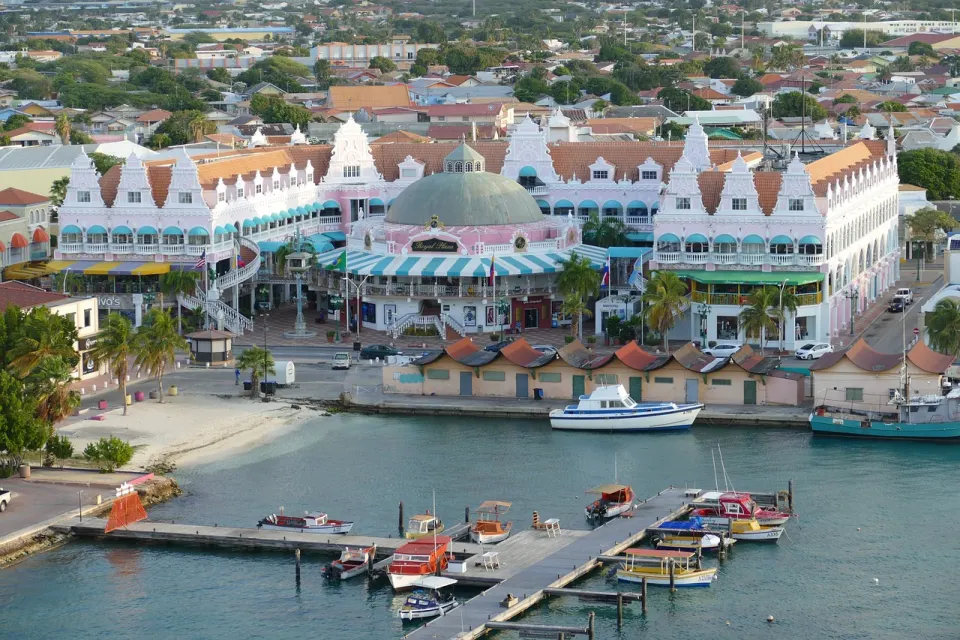
    An open-air area by the marina with restaurants, bars and shops. It is busiest in the evening, when people come to eat by the water and watch the boats.

  6. 6Linear Park

    1–2 hours

    Waterfront, towards the airport

    A long seaside path for walking, running and cycling that starts near the town centre. It passes small beaches and has sea views most of the way. Go early or late in the day, as there is little shade.

  7. 7Aruba Aloe Museum & Factory

    About 1 hour

    Hato

    Aloe has been grown on Aruba for a long time, and here you can see how the plant is farmed and turned into skin products. Guided tours walk you through the factory, and there is a shop at the end.

Oranjestad by month

Average weather and our month score, from 10 years of climate data.

Weather by month and month scores for Oranjestad
Month High / low Rain days Sunshine Score
January 28°C / 25°C 13 days (35 mm) 11.0 h/day 5.3/10
February 28°C / 25°C 10 days (29 mm) 11.5 h/day 5.8/10
March 29°C / 25°C 11 days (28 mm) 11.6 h/day 5.5/10
Best month: April 29°C / 26°C 5 days (15 mm) 11.6 h/day 6.2/10
Best month: May 30°C / 26°C 5 days (20 mm) 11.5 h/day 6.0/10
June 30°C / 27°C 7 days (24 mm) 12.0 h/day 5.5/10
July 30°C / 27°C 10 days (33 mm) 11.9 h/day 4.9/10
August 31°C / 27°C 9 days (32 mm) 11.7 h/day 4.7/10
September 31°C / 27°C 8 days (40 mm) 11.2 h/day 4.7/10
October 31°C / 27°C 13 days (62 mm) 10.4 h/day 4.2/10
November 29°C / 26°C 20 days (115 mm) 10.3 h/day 4.4/10
December 29°C / 26°C 17 days (54 mm) 10.8 h/day 4.6/10
  1. Jan

    Highs reach 28.2°C with 13.2 rain days, so showers are fairly frequent. Score 5.3, an ok month overall.

  2. Feb

    Highs of 28.3°C and 10.1 rain days make this a drier stretch. Score 5.8, an ok month.

  3. Mar

    Highs climb to 28.7°C with 10.7 rain days, similar to February. Score 5.5, an ok month.

  4. Apr

    Highs hit 29.4°C and rain drops to just 5.3 days, one of the driest months. Score 6.2, a good month to visit.

  5. May

    Highs of 29.9°C with only 5.3 rain days keep conditions dry and sunny. Score 6, a good month.

  6. Jun

    Highs reach 30.2°C and rain days rise to 7.1. Score 5.5, an ok month.

  7. Jul

    Highs of 30.1°C come with 10.4 rain days, more showers return. Score 4.9, an ok month.

  8. Aug

    Highs climb to 30.8°C with 9.4 rain days. Score 4.7, an ok month as heat builds.

  9. Sep

    Highs peak near 31.3°C, the hottest month, with 8.4 rain days and 40mm of rain. Score 4.7, an ok month.

  10. Oct

    Highs of 30.6°C with 12.6 rain days and 62mm of rain bring wetter, muggier conditions. Score 4.2, the lowest score of the year.

  11. Nov

    Rain peaks hard: 19.9 rain days and 115mm, the wettest month by far, though highs stay at 29.3°C. Score 4.4, an ok month if you don't mind frequent showers.

  12. Dec

    Highs ease to 28.8°C but rain stays heavy with 17.1 rain days and 54mm. Score 4.6, an ok month to close the year.

Climate averages 2015–2024 · Best time to visit Aruba →

Where to stay in Oranjestad

The best areas to base yourself and who each one suits.

Downtown Oranjestad

Good for first-timers, shoppers, no car

The compact old centre has pastel Dutch-style buildings, the main shopping street, the harbour front and the free streetcar. You can walk to restaurants, the ferry and bus terminal, and small museums. Cruise ship days make the streets crowded, and the town has no real swimming beach of its own.

Eagle Beach

Good for beach lovers, couples, families

This wide, calm stretch of white sand sits just north of the centre and is known for its fofoti trees. It is quieter and less built-up than the high-rise strip further north, with a mix of low-rise resorts and apartments. Nightlife is limited, so you will need a taxi, bus or car for evenings out.

Druif

Good for mid-range travellers, longer stays

This area lies between downtown and Eagle Beach and has smaller guesthouses, apartments and local shops. It gives you easy access to both the town and the beach at a slower pace. The streets are more residential than scenic, and some spots are a longer walk from the sand.

Tanki Leendert

Good for self-caterers, budget travellers, drivers

This residential neighbourhood inland from Eagle Beach has holiday rentals, supermarkets and everyday local life. It feels more like living on the island than staying in a resort area. It has no beach or sea view, and you will want a car or rely on buses to get around.

Getting to and around Oranjestad

From the airport
No route data is given for Oranjestad's airport. Visitors usually rely on taxis or rental cars to reach the centre, since no fixed-price shuttle or public bus numbers are available here.
Public transport
Aruba has little formal public transport in the usual sense. Buses run around the island, but most visitors use rental cars or taxis to get between Oranjestad and the beaches or hotel strips.
On foot
Downtown Oranjestad is walkable. Fort Zoutman, Main Street, and the Archaeological Museum sit close together, and the Waterfront's Wilhelmina Park and Renaissance Marketplace are a short walk from the centre too.

Food to try in Oranjestad

Keshi Yena

This is a baked dish of edam cheese stuffed with spiced meat, often chicken or beef. It is a classic Aruban dish, commonly served at family gatherings and festive meals in Oranjestad.

Pastechi

A fried pastry filled with cheese, meat, or fish. Locals eat these as a quick breakfast or snack, often bought from small stands around the city.

Funchi

A cornmeal side dish similar to polenta, served with fish or stew. It is a staple on local lunch and dinner tables across Oranjestad.

Pan Bati

A soft, slightly sweet cornmeal flatbread cooked on a griddle. It is typically eaten alongside fish or meat dishes at home-style restaurants.

Keri Keri

Shredded fish cooked with onions, peppers, and spices. This dish shows up at local eateries as a hearty, flavorful main course.

More of Aruba

Aruba travel guide →

Oranjestad: frequently asked questions

Is Oranjestad good in August?

August is an okay month, not the best. It scores 4.7 out of 10 in our data. Expect highs of 30.8°C and lows of 27.1°C, with rain on about 9.4 days and 32mm of rain for the month. Sun hours sit at 11.7 a day, so you still get plenty of daylight for sightseeing.

What is the best time to visit Oranjestad?

April and May score highest, at 6.2 and 6 out of 10. April has highs of 29.4°C and only 5.3 rain days, with 15mm of rain. May is a touch warmer at 29.9°C high, also with 5.3 rain days, but slightly more rain at 20mm. Both months get around 11.5–11.6 sun hours a day.

How many days do I need in Oranjestad?

One full day covers the main sights. The city centre has Fort Zoutman and Willem III Tower, Main Street, and the National Archaeological Museum, each taking 1–2 hours. Add the waterfront, with Wilhelmina Park, Renaissance Marketplace, and Linear Park, for another half day. The Aruba Aloe Museum in Hato takes about 1 hour if you have extra time.

Is November a bad time to visit Oranjestad?

November is the wettest month, with 19.9 rain days and 115mm of rain, the highest rainfall of the year. Its score of 4.4 out of 10 reflects this. Temperatures stay warm, with highs of 29.3°C and lows of 26.2°C, and sun hours drop to 10.3, the lowest alongside October.

Is Oranjestad rainy year-round?

No, rainfall varies a lot by month. The driest months are April and May, each with 5.3 rain days and 15–20mm of rain. Rain picks up from October onward, peaking in November at 115mm over 19.9 days. January to March sees moderate rain, between 28mm and 35mm.