Skip to content
wheretotravel.info
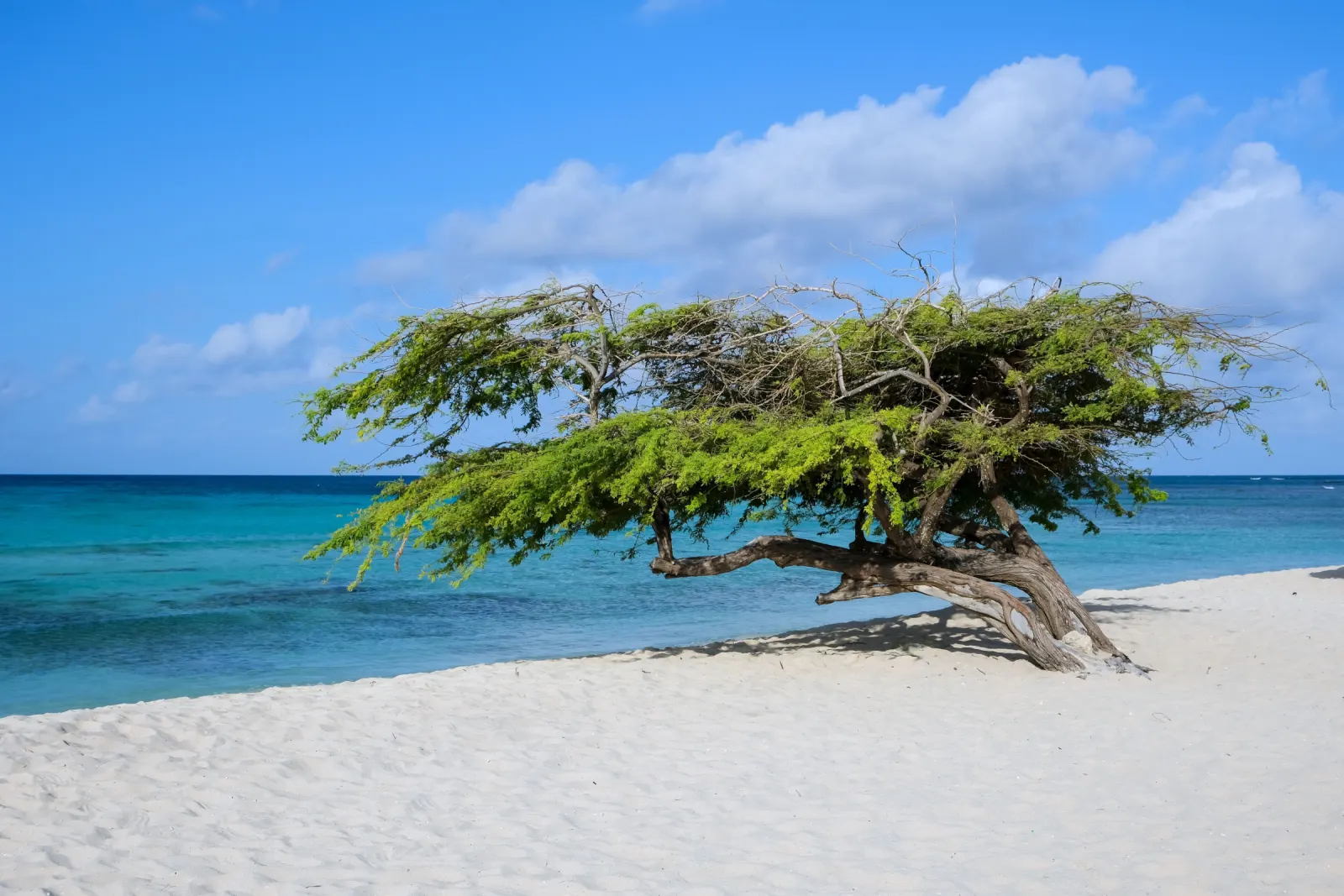
Iconic divi-divi tree on white sand beach

Aruba travel guide

A small Caribbean island of 180 km² for a short, easy trip, best in April and May

Best: Apr, May

Photo: Diego HG / Pexels

Capital
Oranjestad
Languages
Dutch, Papiamento
Currency
Aruban florin (AWG)
Time zone
UTC-04:00
Plugs
Type A, B, F · 127 V
Driving
On the right
Emergency
911

Why visit Aruba

Aruba is a compact Caribbean country of 180 km² and about 110,625 people, with Oranjestad as its capital. It suits a short, simple trip where you base yourself in one place, since distances stay small. Locals speak Dutch and Papiamento, and the currency is the Aruban florin. The best months to go are April and May. One honest limitation is size: with so little land, there is less variety than on larger destinations, so a long stay may feel repetitive.

  • A small island to explore

    Aruba covers just 180 km2 and has about 110,625 people. The distances are short, so you can base yourself in one place and still reach the rest of the island. Traffic drives on the right, which many visitors will already know.

  • Clear best time: April and May

    The data points to April and May as the best months to visit Aruba. This applies across the capital, Oranjestad, and the towns of Noord and Paradera, so you can plan one trip around these months wherever you stay.

  • Dutch and Papiamento culture

    Aruba has 2 official languages, Dutch and Papiamento. This mix reflects its Dutch ties and its Caribbean setting. You will see and hear both, which gives the island its own character alongside its Caribbean neighbours.

  • Easy practical setup

    Power is 127 V with plug types A, B and F, so many travellers can use their chargers without an adapter. The emergency number is 911. The island runs on UTC-04:00, and you pay in the Aruban florin (AWG).

  • Choose your base: Oranjestad, Noord, Paradera

    Oranjestad is the capital and the obvious starting point for most trips. Noord and Paradera are other towns you can stay in. All of them share the same best months, April and May.

Is Aruba right for you?

Great for

  • Warm-weather seekers: average highs stay between 28 and 31 °C in every month.
  • Spring travellers: April and May bring only about 5 rain days and 15–20 mm of rain.
  • Sun lovers: every month averages 10 to 12 hours of sunshine a day.
  • Short trips: the island covers just 180 km², so distances are small.
  • Visitors with type A or B plugs, which Aruba uses at 127 V.

Less ideal for

  • Autumn trips: November averages 115 mm of rain over about 20 rain days.
  • Heat-sensitive travellers in September, when highs reach 31 °C and nights stay near 27 °C.
  • Anyone wanting cool evenings: average lows never drop below 25 °C.
  • December visitors hoping for dry days: expect about 17 rain days.

Aruba right now: October

4.2/10
Avg high
31°C
Avg low
27°C
Rain days
13

Averages for Oranjestad.

Weather by month

In Oranjestad, April and May are the best months: highs reach 29–30°C, rain falls on only about 5 days a month, and totals are just 15–20 mm. October and November are the weakest months, with November bringing 115 mm of rain over about 20 days, though no month rates worse than ok.

Average highs and lows in Oranjestad by month January: high 28°C, low 25°C , 13 rain days . February: high 28°C, low 25°C , 10 rain days . March: high 29°C, low 25°C , 11 rain days . April: high 29°C, low 26°C , 5 rain days . May: high 30°C, low 26°C , 5 rain days . June: high 30°C, low 27°C , 7 rain days . July: high 30°C, low 27°C , 10 rain days . August: high 31°C, low 27°C , 9 rain days . September: high 31°C, low 27°C , 8 rain days . October: high 31°C, low 27°C , 13 rain days . November: high 29°C, low 26°C , 20 rain days . December: high 29°C, low 26°C , 17 rain days . 28°C 25°C JAN 13d 28°C 25°C FEB 10d 29°C 25°C MAR 11d 29°C 26°C APR 5d 30°C 26°C MAY 5d 30°C 27°C JUN 7d 30°C 27°C JUL 10d 31°C 27°C AUG 9d 31°C 27°C SEP 8d 31°C 27°C OCT 13d 29°C 26°C NOV 20d 29°C 26°C DEC 17d
Best months Other months (low–high) Nd = rain days

Oranjestad · averages 2015–2024

Best time to visit Aruba: month-by-month weather →

Where to go in Aruba

City guides with their own best months and weather.

Sample itineraries

7 days

One week across three Aruba towns

  1. Day 1–3

    Oranjestad

    Start in the capital. Settle in, get some Aruban florins (AWG) and plan the week. Aruba covers only 180 km2, so a single base could work if you prefer fewer moves.

  2. Day 4–5

    Paradera

    Move inland to Paradera for a slower pace. If you rent a car, remember that Aruba drives on the right. Learn a few words of Papiamento, one of the 2 official languages.

  3. Day 6–7

    Noord

    Finish in Noord. Use these last days for whatever you liked most earlier in the week. For the best weather at all 3 stops, plan this trip for April or May.

10 days

Ten slow days in Aruba

  1. Day 1–3

    Oranjestad

    Begin in the capital, Oranjestad. Take time to adjust, sort out local money (Aruban florin, AWG) and a local plug adapter: sockets are types A, B and F at 127 V.

  2. Day 4–6

    Paradera

    Head to Paradera for 3 quieter days. With 10 days on an island of 180 km2, you can explore without rushing. Aruba drives on the right if you rent a car.

  3. Day 7–9

    Noord

    Spend 3 days based in Noord. Use this stop to revisit favourite spots or simply rest. Dutch and Papiamento are the official languages, so a few local phrases help.

  4. Day 10

    Oranjestad

    Return to Oranjestad for your last day before leaving. Keep it light. April and May are the best months for all 3 towns on this route.

Where to stay

One good base in each main city and who it suits.

Downtown Oranjestad

Oranjestad

Good for first-timers, shoppers, no car

The compact old centre has pastel Dutch-style buildings, the main shopping street, the harbour front and the free streetcar. You can walk to restaurants, the ferry and bus terminal, and small museums. Cruise ship days make the streets crowded, and the town has no real swimming beach of its own.

Palm Beach

Noord

Good for first-timers, nightlife, families

This is the high-rise hotel strip, with calm water, beach bars, restaurants, casinos and shops all within walking distance. It is the easiest base if you do not want to rent a car. The drawback is crowds: the beach fills with loungers, and the main road is busy and noisy in the evenings.

Piedra Plat

Paradera

Good for budget travellers, self-caterers

This residential area lies on the road between Paradera and Oranjestad, with supermarkets and local snack bars close by. It is handy for reaching the capital and the south coast while paying less attention to tourist zones. The drawback is that it feels like an ordinary suburb, with little to see on foot.

Food to try in Aruba

Keshi yena

A round of Dutch-style cheese, often Gouda or Edam, filled with spiced chicken or meat and then baked. It is a classic main dish in local restaurants and shows the island's Dutch links.

Pastechi

A fried pastry filled with cheese, meat or fish. Arubans often eat it for breakfast or as a quick snack, and you find it at snack bars and bakeries.

Pan bati

A slightly sweet, thick pancake made with cornmeal and flour. It is served as a side with fish, soups and stews in local restaurants.

Funchi

Cornmeal cooked until firm, similar to polenta, then sliced and sometimes fried. It is a common side dish with stews and fish.

Stoba

A slow-cooked stew, often made with goat or beef, and flavoured with local spices. It is home-style food you will see on menus in local, non-tourist restaurants.

Balashi beer

A light lager brewed on Aruba. It is widely sold in bars, restaurants and shops across the island and suits the hot climate.

Know before you go

  • Plugs and voltage: Aruba uses plug types A, B and F, and the voltage is 127 V. Check that your chargers and devices accept this voltage before you plug them in, and pack an adapter if your plugs differ.
  • Driving side: Traffic drives on the right. If you come from a country that drives on the left, take extra care at junctions and when you pull out of car parks.
  • Emergency number: Dial 911 for emergencies. Save it in your phone before you arrive so you do not have to search for it in a stressful moment.
  • Currency: The local currency is the Aruban florin (AWG). Check the current exchange rate before you travel so you can judge prices quickly.
  • Language: The official languages are Dutch and Papiamento. Learning a simple greeting in Papiamento is a friendly gesture that locals will notice.
  • Phone calls: The country calling code is +297. Add it in front of local numbers when you call Aruba from abroad or from a foreign SIM card.
  • Time zone: Aruba is on UTC-04:00. Check the time difference with home before you book calls, flights or tours.

Aruba: frequently asked questions

What is the best time to visit Aruba?

April and May are the best months to visit Aruba. They have the highest scores in our data, at 6.2 and 6. Both months average 5.3 rain days, with 15 mm of rain in April and 20 mm in May. Daytime highs are 29.4°C and 29.9°C, and you get 11.6 and 11.5 hours of sun a day.

Is November a bad time to go to Aruba?

Yes. November is the wettest month in Aruba, so avoid it if you want dry beach days. Oranjestad averages 19.9 rain days, 115 mm of rain and only 10.3 hours of sun. October has the lowest score of the year at 4.2. December is still wet, with 17.1 rain days. It stays warm, though, with November highs of 29.3°C.

Is Aruba good in August?

August is an okay time to visit Aruba, but it is hot and not the best month. Highs average 30.8°C and nights stay at 27.1°C. Expect about 9.4 rain days and 32 mm of rain, with 11.7 hours of sun a day. August scores 4.8, well below April at 6.2 and May at 6.

How hot is Aruba all year round?

Aruba is warm in every month. In Oranjestad, average highs range from 28.2°C in January to 31.3°C in September. Night lows never drop below 25°C. September is the hottest month, with a low of 27.4°C, so there is little relief from the heat after dark. These figures are averages for 2015–2024.

What plugs and voltage does Aruba use?

Aruba uses plug types A, B and F, and the voltage is 127 V. If your devices are made for a different voltage, check the label before you plug them in, or bring a converter.

What currency and language do they use in Aruba?

Aruba's currency is the Aruban florin (AWG). The languages are Dutch and Papiamento. Cars drive on the right, and the emergency number is 911. The country calling code is +297, and the time zone is UTC-04:00.

Similar destinations

Countries with a year of weather much like Aruba.