Skip to content
wheretotravel.info
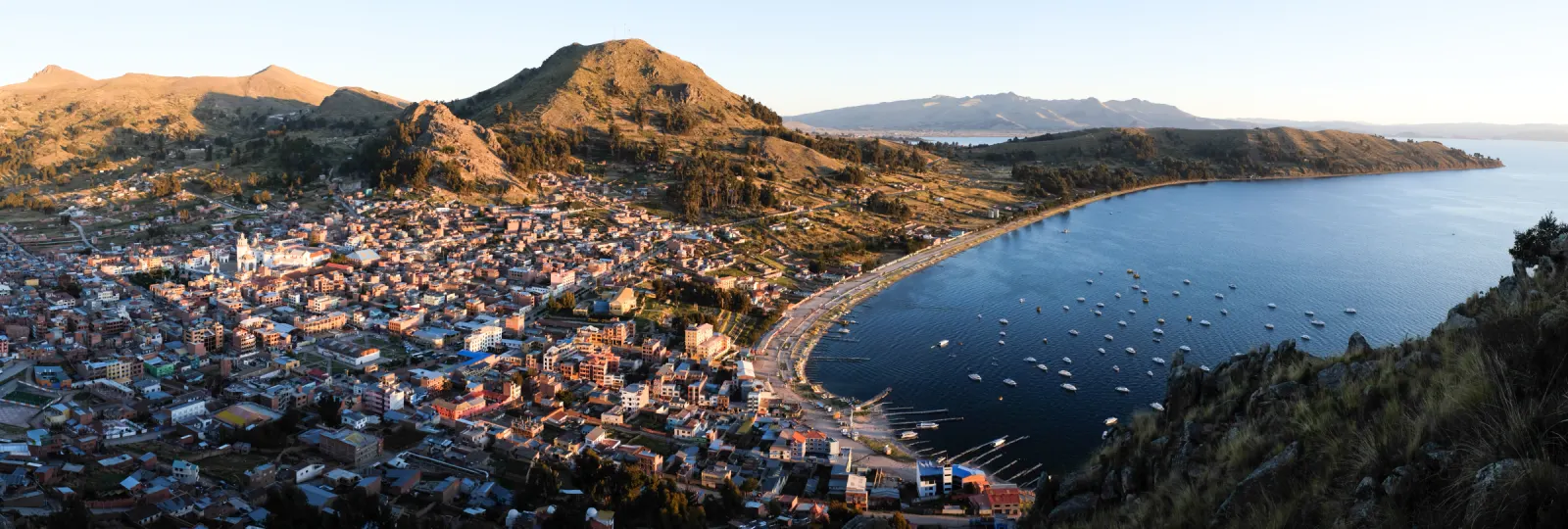
Panoramic view of town, hill and bay at sunset

Copacabana travel guide

What to see, where to stay and the best time to visit Copacabana, Bolivia.

Best: Jul, Aug

Photo: Christopher Crouzet / Wikimedia Commons

Country
Bolivia

About Copacabana

Copacabana sits on the shore of Lake Titicaca in Bolivia, a small town built around its basilica and the lake itself. Visitors come for the lakefront, the hill walks, and boats out to Isla del Sol and Isla de la Luna. It's a slow, low-key place: a town square, a market, and wide views over the water. July and August are the best months to visit, with clearer, drier conditions typical of the Altiplano winter.

How many days do you need in Copacabana?

Two days is enough to see the basilica, Cerro Calvario, the lakefront and the market. Add a third day if you want to walk the Yampupata Peninsula or take a half-day boat trip to Isla de la Luna.

Top attractions in Copacabana

  1. 1Basilica of Our Lady of Copacabana

    1–2 hours

    Town centre

    This large white church with Moorish-style domes is Bolivia's most important pilgrimage site. It houses a carved statue of the Virgin of Copacabana, the patron saint of Bolivia. On many days you can watch priests bless decorated cars and buses outside the main doors.

  2. 2Cerro Calvario

    1–2 hours

    North edge of town

    A steep path lined with Stations of the Cross climbs this hill above the town. The top gives wide views over Lake Titicaca and the bay, and many people go up for sunset. Walk slowly, because the high altitude makes the climb harder than it looks.

  3. 3Isla de la Luna

    Half a day

    Lake Titicaca

    This small, quiet island is often combined with a boat trip to Isla del Sol. Its main sight is Iñak Uyu, the ruins of an Inca temple linked to the moon and to women chosen to serve the sun cult.

  4. 4Horca del Inca

    1–2 hours

    Southeast edge of town

    A short, steep climb leads to this stone structure on a rocky hill. It is thought to be a pre-Inca astronomical observatory used to track the sun. The site is small, but the views over the town and lake reward the walk.

  5. 5Lakefront and beach

    1–2 hours

    Avenida Costanera

    The shoreline is where boats leave for the islands and where local families come to relax. Small food stalls serve fresh lake trout, and you can rent pedal boats or kayaks on calm days.

  6. 6Yampupata Peninsula walk

    Full day

    Yampupata

    A rural trail follows the lakeshore from Copacabana through Aymara farming villages to the tip of the peninsula. From Yampupata you can take a short boat ride across to Isla del Sol. The route is mostly gentle but long, so bring water and sun protection.

  7. 7Intikala (Seats of the Inca)

    Under 1 hour

    Edge of town

    Here a large boulder has seats and steps carved into the rock, probably used for ceremonies. It is an easy, short walk from the centre and gives an idea of the area's long history before the Spanish arrived.

  8. 8Copacabana Market

    Under 1 hour

    Town centre, near the basilica

    The local market sells fruit, bread, snacks and simple meals to residents and pilgrims. Nearby stalls offer religious souvenirs, candles and small offerings linked to the basilica.

Copacabana by month

Average weather and our month score, from 10 years of climate data.

Weather by month and month scores for Copacabana
Month High / low Rain days Sunshine Score
January 13°C / 7°C 27 days (202 mm) 11.0 h/day 4.3/10
February 13°C / 7°C 26 days (212 mm) 10.5 h/day 4.3/10
March 13°C / 7°C 26 days (168 mm) 10.8 h/day 4.3/10
April 12°C / 6°C 17 days (89 mm) 10.8 h/day 4.1/10
May 12°C / 5°C 8 days (36 mm) 10.9 h/day 5.2/10
June 11°C / 4°C 3 days (11 mm) 10.8 h/day 5.9/10
Best month: July 11°C / 4°C 2 days (11 mm) 10.8 h/day 6.2/10
Best month: August 12°C / 4°C 4 days (15 mm) 11.2 h/day 6.3/10
September 13°C / 6°C 8 days (32 mm) 11.4 h/day 5.8/10
October 13°C / 6°C 14 days (73 mm) 11.8 h/day 4.8/10
November 14°C / 7°C 17 days (114 mm) 12.0 h/day 5.0/10
December 13°C / 7°C 25 days (181 mm) 11.3 h/day 4.5/10
  1. Jan

    Rainy season peaks: a high of 12.6°C with rain on 27.1 days and 202mm total. Score 4.3, ok verdict.

  2. Feb

    Still wet, with 25.8 rain days and 212mm of rain, the wettest month by volume. High of 12.6°C. Score 4.3, ok.

  3. Mar

    Rain eases slightly to 26 days and 168mm, high near 12.5°C. Score 4.3, ok verdict.

  4. Apr

    Rain drops to 16.9 days and 89mm as the dry season begins. High 12.2°C, nights cooler at 6.3°C. Score 4.1, ok.

  5. May

    Dry season sets in: just 8.4 rain days and 36mm of rain. High 11.7°C, low 4.9°C. Score rises to 5.2, ok.

  6. Jun

    One of the driest months, only 3.3 rain days and 11mm. High 11.1°C but nights are cold at 3.8°C. Score 5.9, ok.

  7. Jul

    Driest conditions, 2.2 rain days and 11mm, high 11.3°C. Nights stay cold near 4°C. Score 6.2, good verdict.

  8. Aug

    Dry and sunny, with 11.2 sun hours and only 3.5 rain days. High 11.9°C. Best score of the year at 6.3, good.

  9. Sep

    Still largely dry with 8.2 rain days and 32mm, high rising to 12.8°C. Score 5.8, ok verdict.

  10. Oct

    Rain picks up again to 14.2 days and 73mm. High 13.2°C. Score drops to 4.8, ok.

  11. Nov

    Warmest month on average at 14°C high, with 17.1 rain days and 114mm. Score 5, ok verdict.

  12. Dec

    Rainy season returns in force: 25.2 rain days and 181mm, high 13°C. Score 4.5, ok verdict.

Climate averages 2015–2024 · Best time to visit Bolivia →

Where to stay in Copacabana

The best areas to base yourself and who each one suits.

Plaza 2 de Febrero

Good for first-timers, sightseeing, short stays

This is the town's main square, beside the white Basilica of Our Lady of Copacabana. You can walk to the basilica, the market, the bus stops and the lake in a few minutes. Church bells, festivals and car blessings outside the basilica can make it noisy, especially at weekends.

Avenida 6 de Agosto

Good for first-timers, food, budget travellers

The main street runs downhill from the square to the lake. It is lined with cafés, travel agencies and simple guesthouses. Boat and bus tickets are easy to book here, but the street gets busy with traffic and touts during the day.

Costanera

Good for lake views, sunsets, Isla del Sol trips

The lakefront road along the beach is where boats leave for Isla del Sol, and many places look straight over Lake Titicaca. You can step out to the water and stalls selling fresh lake trout. It is more exposed to cold wind after dark, and the walk back up to the centre is uphill at high altitude.

Cerro Calvario

Good for views, quiet, fit walkers

The streets on the slopes below this hill are calmer and have wide views over the town and bay. A path with the Stations of the Cross climbs to the top, a popular sunset spot. The steep climbs are hard work at this altitude, especially with luggage.

Yumani

Good for slow travel, hikers, quiet nights

This village sits on the southern part of Isla del Sol, a boat ride from Copacabana town. Staying overnight lets you see sunrise and sunset over the lake and walk the island's trails without the day-trip crowds. Getting there means a boat trip and a steep climb up the Inca stairway from the landing, and services are basic.

Getting to and around Copacabana

From the airport
Copacabana has no airport of its own. Most visitors arrive by bus from La Paz, a 3-hour ride costing 4–7 USD. There is no train link, so the bus is the usual way in.
Public transport
Copacabana has little formal public transport. There's no metro or tram, and bus and taxi options within town are limited. Most visitors get around on foot; boats are used only for lake trips to places like Isla de la Luna.
On foot
The centre is small and walkable. The Basilica, market, Plaza 2 de Febrero, and Avenida 6 de Agosto all sit close together, with Costanera's lakefront a short stroll away.

Typical journey times and fares from the airport and other cities.

Route By Time Price
La Paz → Copacabana Operators: Manco Kapac, Trans Titicaca and Vicuña Travel, from the La Paz bus terminal. Fares come from aggregator listings in USD; I couldn't find a Bs fare. Local buses take about 3 h and run hourly. Timetabled coaches take about 4 h (Busbud lists departures from 7:00). The trip includes a short boat crossing at the Strait of Tiquina. A traveller blog says tourist double-decker buses cost about Bs 50, run twice a day and should be booked ahead. bus 3 h 4–7 USD ↗

Food to try in Copacabana

Trucha (Lake Titicaca trout)

Fried or grilled trout from Lake Titicaca is the signature dish in Copacabana. Lakeside restaurants grill it whole and serve it with rice, potatoes, and salad for lunch or dinner.

Trucha a la plancha

This is trout cooked on a hot plate with garlic and butter. It's a simple, popular way locals and visitors eat the lake's fresh catch along the waterfront stalls.

Quinoa soup (sopa de quinua)

A warming soup made with quinoa, vegetables, and sometimes meat. It's common on local menus, especially in the cooler evenings near the lake.

Api con pastel

Api is a thick, warm purple corn drink, often paired with a fried pastry called pastel. Bolivians typically drink this combination for breakfast in highland towns like Copacabana.

Salteñas

These are baked pastries filled with meat, potato, and a slightly sweet, spiced sauce. They're a popular mid-morning snack sold by street vendors and small bakeries.

Anticuchos

Skewers of grilled meat, often beef heart, are a common street food in the evenings. Vendors grill them over charcoal near the main plaza and sell them to locals and travelers alike.

More of Bolivia

Bolivia travel guide →

Copacabana: frequently asked questions

When is the best time to visit Copacabana, Bolivia?

July and August are the best months to visit Copacabana. They have the highest scores, 6.2 and 6.3, because they are the driest months. July has about 2.2 rain days and 11 mm of rain. August has 3.5 rain days and 15 mm. You also get 10.8 to 11.2 hours of sun a day. Nights are cold, with lows of about 4°C.

Is Copacabana good in January?

January is an OK month for Copacabana, but it is very wet. It has about 27.1 rain days and 202 mm of rain. February is similar, with 212 mm. Highs stay around 12.6°C and lows around 7°C. The scores for these months are 4.3. If you don't mind daily rain, the lake and hills are green at this time.

How cold is Copacabana?

Copacabana is cool all year. Daytime highs only range from 11.1°C in June to 14°C in November. Nights are colder. The coldest lows are about 3.8°C in June and 4°C in July. The mildest nights, at about 7.3°C, come in December. Pack warm layers for evenings in any month.

How many days do I need in Copacabana?

Plan enough time for at least one full day trip and a half-day trip. The Yampupata Peninsula walk takes a full day. A visit to Isla de la Luna on Lake Titicaca takes half a day. In town, the Basilica of Our Lady of Copacabana, Cerro Calvario, Horca del Inca and the lakefront each need 1–2 hours.

Is September a good time to visit Copacabana?

September is an OK month, with a score of 5.8. It is still fairly dry, with about 8.2 rain days and 32 mm of rain. You get around 11.4 hours of sun a day. Highs reach 12.8°C and lows are about 5.7°C, so nights are a little milder than in July and August.