Top score of 8.8, with a cool 28°C high, just 1 rain day and 9.9 sun hours.
Shoulder season
Feb, Oct
Tough weather
Mar, Apr, May, Jun, Jul
Capital
New Delhi
Languages
English, Hindi, Tamil
Currency
Indian rupee
Time zone
UTC+05:30
Plugs
Type C, D · 230 V
Driving
On the left
Emergency
112
Why visit India
India suits travellers who want a long, varied trip built around cities. You can combine Jaipur, Agra, Jodhpur and Varanasi inland with coastal Mumbai and Kochi, or head north to Srinagar. The best months to go are November, December and January. One honest limitation is the country's size. It covers 3,287,590 km², so you cannot see it all in one trip. Pick 1 or 2 regions, and allow time for long journeys between them.
A clear best-travel window
November, December and January are the best months to visit. If your dates are flexible, aim for this window. Outside it, check conditions for each region before you book, because travelling at the wrong time can be much harder.
Two coastal cities, different styles
Mumbai and Kochi are both on the coast. Mumbai is the largest city on our list and a major urban hub. Kochi is much smaller, so it suits travellers who want a slower coastal base.
Classic inland city circuit
Jaipur, Agra, Jodhpur and Varanasi are all inland and far smaller than Mumbai or Bengaluru. That makes them easier to explore on foot or by short local trips. Many independent travellers link several of them in one journey.
English helps you get around
English is used alongside Hindi and Tamil, which makes signs, bookings and everyday questions easier for many visitors. Expect regional languages to change as you travel, so a few local words still help.
Simple practical basics
The whole country runs on one time zone, so planning connections is easy. Traffic drives on the left. The emergency number is 112. Pack an adapter for type C or D plugs at 230 V.
Is India right for you?
Great for
Travellers who like dry, sunny days: November to January highs sit near 28-30°C with under 2 rain days a month
City-and-heritage trips, since Jaipur, Agra, Varanasi and Jodhpur are all large inland cultural hubs
Coastal breaks, with Mumbai and Kochi both large coastal cities to combine with inland sightseeing
Visitors who want strong sun exposure outside monsoon, as sun hours top 10 a month from November to March
Trips planned around the cooler, drier best months of November, December and January
Less ideal for
Travellers who dislike heavy rain, since July brings 24.2 rain days and 315 mm of rain
People sensitive to extreme heat, as highs reach 38-40°C in April and May
Anyone wanting guaranteed sun in monsoon months, when July sun hours drop to 5.9
Beach-only holidaymakers, since only 2 of the 8 listed cities are coastal
India right now: November
7.8/10
Avg high
30°C
Avg low
18°C
Rain days
2
Averages for India.
Weather by month
Climate data for this chart comes from a city in India, and November to January are the best months, with highs near 28–30°C, low rainfall of 4–13mm, and under 2 rain days a month. The toughest stretch runs from April to July: May hits 39.7°C, while July brings 315mm of rain over 24 rain days and just 5.9 hours of sun.
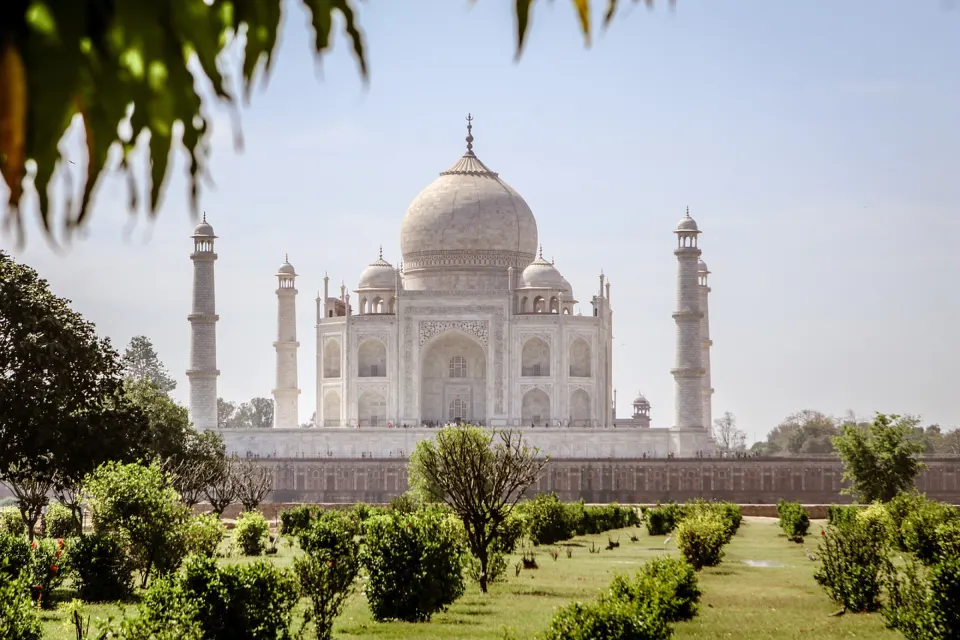
Start in Agra, home to the Taj Mahal. Use the two days to see the main monuments and walk through the old city streets.
Day 3–4
Jaipur
Move to Jaipur, a city of about 3,073,350 people. Explore its forts and palaces and the pink-walled old town.
Day 5–7
Jodhpur
Finish in Jodhpur, home to around 1,033,918 residents. Spend your last days in the blue-painted old quarter below the hilltop fort.
10 days
North India: Cities, Rivers and Mountains
Day 1–2
Agra
Begin in Agra to see the Taj Mahal and the red sandstone fort nearby.
Day 3–4
Jaipur
Head to Jaipur, population about 3,073,350, for its palaces, markets and hilltop forts.
Day 5–6
Jodhpur
Continue to Jodhpur, home to roughly 1,033,918 people, and wander the blue old town beneath the fort walls.
Day 7–8
Varanasi
Travel on to Varanasi, a city of about 1,198,491 people, to watch the ceremonies along the Ganges riverbanks.
Day 9–10
Srinagar
End in Srinagar, population around 1,180,570, where you can drift on a houseboat on Dal Lake and see the surrounding valley.
Food to try in India
Masala Dosa
A crisp, thin rice-and-lentil crepe filled with spiced potato, popular across South India. It's often eaten for breakfast or as a light evening meal, served with coconut chutney and sambar.
Butter Chicken
A North Indian dish of tandoor-roasted chicken simmered in a creamy tomato sauce. It's a staple on restaurant menus in Delhi and Punjab, usually eaten with naan or rice.
Biryani
Layered rice cooked with meat or vegetables and spices, found in regional versions from Hyderabad to Kolkata. It's a festive dish often served at weddings and special occasions.
Chaat
A term for savory street snacks like pani puri and bhel puri, mixing fried dough, chutneys, and spices. It's eaten as a quick snack on streets throughout northern and western India.
Thali
A full meal served on a platter with small bowls of rice, bread, lentils, vegetables, and pickles. Thalis vary by region and are a common way to try several dishes at once in India.
Masala Chai
Black tea boiled with milk, sugar, and spices such as cardamom and ginger. It's drunk throughout the day across India, from roadside stalls to home kitchens.
Know before you go
Plugs and voltage:
India uses plug types C and D. The supply is 230 V. Bring a travel adapter. Check that your chargers and devices accept 230 V before you plug them in.
Driving side:
Traffic drives on the left in India. If you come from a right-hand driving country, take extra care when crossing roads and when you first get behind the wheel.
Emergency number:
Call 112 for emergencies in India. Save it in your phone before you arrive. The country calling code is +91 if someone abroad needs to reach an Indian number.
Currency:
The currency is the Indian rupee. Carry some cash for small shops, markets and local transport, where cards may not be accepted.
Language:
English and Hindi are widely used, and Tamil is also an official language. India has many more regional languages, so signs and menus can change from state to state.
Time zone:
India uses one time zone for the whole country: UTC+05:30. Note the half-hour offset when you plan calls home or check flight connections.
Tap water:
Do not drink tap water. Use bottled or filtered water, and use it to brush your teeth too. Take care with ice and raw food washed in tap water.
India: frequently asked questions
What is the best time to visit India?
December, January and November are the best months, with scores of 8.8, 8.8 and 7.8 out of 10. These months have highs around 28–29°C, low rainfall of 4–13 mm, and under 2.2 rain days a month, making travel comfortable in most regions.
Is India good to visit in August?
August is rated ok, scoring 4.7 out of 10. It sits inside the monsoon, with 224 mm of rain over 20.7 days and only 7.4 hours of sun. Highs stay near 28.3°C, so it's warm but wet, with frequent downpours breaking up the day.
Why should I avoid India in June and July?
June and July score lowest, at 1.4 and 3.8 out of 10, because the monsoon peaks then. July brings 315 mm of rain across 24.2 days and just 5.9 hours of sun, while June has 158 mm over 16.6 days. Both months are humid and wet most of the time.
How hot does India get in summer?
The hottest months are April and May, with highs of 38.3°C and 39.7°C. These months score only 3 out of 10 because the heat is intense, though rainfall stays low at 18 mm and 9 mm, so the discomfort comes mainly from dry, high heat rather than rain.
What is the weather like in India in winter?
Winter months like December and January are the coolest and driest, with highs of 28°C and lows of 15.7–16.3°C. Rain is minimal, just 4–5 mm over fewer than 1.2 days a month, and sun hours stay around 9.9–10 hours a day, giving clear, dry conditions.
Which Indian cities are covered on this page?
The fact pack lists Mumbai, Bengaluru, Jaipur, Agra, Varanasi, Srinagar, Jodhpur and Kochi. Mumbai and Kochi are coastal cities, while the rest sit inland. Mumbai is the largest by population at 15,414,288, followed by Bengaluru at 12,327,000.