Skip to content
wheretotravel.info
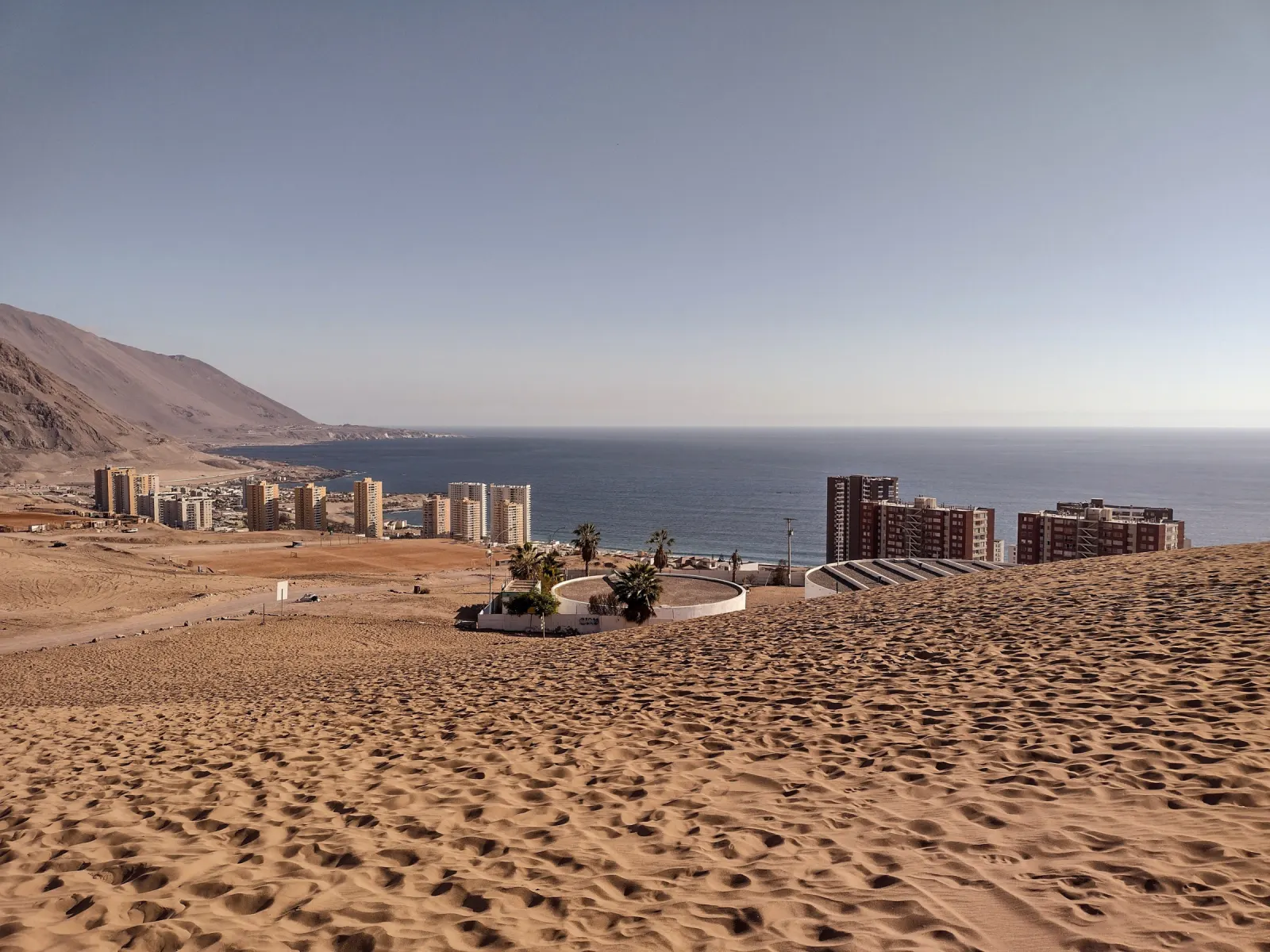
sand dune overlooking coastal buildings and ocean

Iquique travel guide

What to see, where to stay and the best time to visit Iquique, Chile.

Best: Feb, Mar

Photo: Charlotte Hilliar / Pexels

Country
Chile
Currency
CLP

About Iquique

Iquique sits on Chile's northern coast, backed by huge sand dunes and fronted by Cavancha Beach. It's a beach destination with a working port, a desert history from the saltpeter boom, and a duty-free zone (ZOFRI) that draws shoppers. The old timber-and-tin buildings around Plaza Prat and Paseo Baquedano show its 19th-century wealth. February and March bring the best weather, with warm days suited to the beach and to day trips inland to the Humberstone and Santa Laura ruins.

How many days do you need in Iquique?

Two to three days cover the city centre, Cavancha Beach, and a half-day trip to Humberstone and Santa Laura. Add a day if you want time for Cerro Dragón, the harbour boat tour, or ZOFRI shopping.

Top attractions in Iquique

  1. 1Humberstone and Santa Laura Saltpeter Works

    half a day

    Pozo Almonte (inland from Iquique)

    These are two abandoned nitrate mining towns in the desert, listed by UNESCO. You can walk through the workers' houses, the theatre, the school and the rusting factory machinery. They show how the saltpeter boom shaped northern Chile and Iquique itself.

  2. 2Paseo Baquedano

    1–2 hours

    City centre

    This pedestrian street is lined with wooden mansions from the nitrate era, with wide verandas and raised wooden walkways. It is the best place to see the old architecture of Iquique, and it has cafés along the way.

  3. 3Plaza Prat

    1 hour

    City centre

    The main square of Iquique has a white clock tower at its centre and the Municipal Theatre on one side. The theatre is a grand building from the city's wealthy nitrate years. The square is a good starting point for walking the historic centre.

  4. 4Cavancha Beach

    half a day

    Cavancha

    This is the city's main beach, a curved bay of sand close to the centre, with calmer water than much of the coast. It has a long seafront promenade for walking and cycling, plus many restaurants nearby.

  5. 5Palacio Astoreca

    1 hour

    City centre

    This large wooden mansion was built for a nitrate baron and is now a cultural centre and museum. Inside you can see period furniture, detailed woodwork and art exhibitions, which show how the richest families lived.

  6. 6Museo Corbeta Esmeralda

    1–2 hours

    City centre

    This museum is a full-size replica of the Esmeralda, the Chilean ship that sank off Iquique in the Battle of Iquique during the War of the Pacific. Guided visits take you through the decks and cabins and tell the story of the battle, which is central to Chilean history.

  7. 7Harbour boat tour from Muelle Prat

    1 hour

    Port

    Short boat trips leave from the passenger pier and go around the harbour. You pass sea lion colonies and seabirds, and boats usually stop over the spot where the Esmeralda sank.

  8. 8Cerro Dragón

    1–2 hours

    Alto Hospicio edge

    This huge sand dune rises right behind the city and is a protected natural site. It is famous as a take-off area for paragliding: steady coastal winds let pilots fly over the city and land near Playa Brava. Tandem flights with local operators are popular with visitors.

  9. 9ZOFRI (Zona Franca de Iquique)

    2–3 hours

    North of the centre

    This is the duty-free zone of Iquique, with a large shopping mall selling electronics, clothing, perfume and other goods at duty-free prices. Many Chileans travel to Iquique partly to shop here.

Iquique by month

Average weather and our month score, from 10 years of climate data.

Weather by month and month scores for Iquique
Month High / low Rain days Sunshine Sea temp Score
January 25°C / 20°C 0 days (2 mm) 12.3 h/day 19°C 7.0/10
Best month: February 26°C / 21°C 1 day (2 mm) 11.9 h/day 20°C 7.7/10
Best month: March 25°C / 20°C 0 days (1 mm) 11.8 h/day 20°C 7.5/10
April 23°C / 18°C 0 days (0 mm) 11.1 h/day 19°C 6.2/10
May 21°C / 16°C 0 days (2 mm) 10.8 h/day 17°C 5.2/10
June 19°C / 15°C 1 day (4 mm) 10.4 h/day 17°C 4.6/10
July 19°C / 14°C 1 day (4 mm) 10.3 h/day 17°C 4.4/10
August 19°C / 14°C 1 day (3 mm) 10.9 h/day 17°C 4.5/10
September 19°C / 14°C 0 days (1 mm) 11.4 h/day 17°C 4.8/10
October 20°C / 15°C 0 days (1 mm) 12.3 h/day 17°C 5.1/10
November 22°C / 16°C 0 days (1 mm) 12.8 h/day 18°C 5.5/10
December 23°C / 18°C 0 days (0 mm) 12.8 h/day 18°C 6.3/10
  1. Jan

    Highs reach 25.1°C with almost no rain, just 0.3 days, and sea temp is 19°C. Score 7, a good month to visit.

  2. Feb

    The warmest month at 25.9°C high, sea temp peaks at 20.3°C, rain stays rare at 0.7 days. Score 7.7, the best time to go.

  3. Mar

    Highs of 25°C and only 0.3 rain days keep conditions dry and sunny. Score 7.5, another top-rated month.

  4. Apr

    Temperatures cool to 22.9°C with zero rain days, a dry transition month. Score 6.2, still good.

  5. May

    Highs drop to 20.8°C and sea temp falls to 17.3°C as the cooler season begins. Score 5.2, an ok month.

  6. Jun

    Highs of 19.4°C with 1.4 rain days, the cloudiest stretch of the year with just 10.4 sun hours. Score 4.6, ok but cooler and greyer.

  7. Jul

    The coolest month, highs of 18.5°C and lows of 13.6°C, with 1.2 rain days and low sun hours at 10.3. Score 4.4, the lowest-rated month due to chilly, overcast conditions.

  8. Aug

    Similar to July, highs stay at 18.7°C with 1 rain day and limited sun at 10.9 hours. Score 4.5, still ok.

  9. Sep

    Highs rise slightly to 19.3°C with no rain days, though skies remain cool. Score 4.8, an ok month.

  10. Oct

    Highs of 20.3°C and almost no rain, 0.1 days, as sun hours climb to 12.3. Score 5.1, an ok month.

  11. Nov

    Highs of 21.7°C with sun hours up to 12.8, rain nearly absent at 0.2 days. Score 5.5, ok and warming toward summer.

  12. Dec

    Highs reach 23.4°C with zero rain days and sea temp back up to 18.4°C. Score 6.3, a good month to close the year.

Climate averages 2015–2024 · Best time to visit Chile →

Where to stay in Iquique

The best areas to base yourself and who each one suits.

Cavancha

Good for first-timers, beach lovers, families

This is Iquique's main beach area, with a long seafront promenade, calm water for swimming and plenty of cafés and restaurants. Staying here puts you on the sand and within a short taxi or colectivo ride of the centre. The drawback is that it is built up with tall apartment blocks and gets crowded and noisy on summer weekends.

Playa Brava

Good for surfers, longer stays, self-caterers

South of Cavancha, this stretch has a wide beach, sea views and many apartment buildings that suit longer stays. It is quieter than Cavancha while still close to shops and the coastal road. As the name suggests, the waves and currents are strong, so it is often better for watching the sea or surfing than for swimming.

El Morro

Good for surfers, local character

This old working neighbourhood sits between the centre and Cavancha, close to well-known surf breaks and the seafront. It has a local feel and is walkable to both the beach and downtown. Some streets are run-down, and it can feel rough at night, so check the exact location before booking.

Zona Sur

Good for families, quiet, drivers

The southern residential area, towards Huayquique and Bajo Molle, has newer housing, calmer beaches and a relaxed pace. It suits travellers who want space and quiet evenings. The main drawback is distance: you will need a car, taxi or colectivo to reach the centre and most restaurants.

Getting to and around Iquique

From the airport
No route data is available for Iquique's airport. Visitors usually rely on a taxi, a pre-booked transfer, or a shared shuttle van to reach the centre, since there's no train or metro link to the airport.
Public transport
Iquique has no metro or tram. Local buses (colectivos and micros) connect the centre with Cavancha, Playa Brava and Zona Sur. Tip: agree the fare with colectivo drivers before you get in, since routes and prices aren't fixed.
On foot
The city centre is compact and walkable: Paseo Baquedano, Plaza Prat, Palacio Astoreca and Museo Corbeta Esmeralda all sit within a short walk of each other.

Food to try in Iquique

Ceviche

Raw white fish or shellfish cured in lemon juice with onion and chili. Iquique's fish markets and seafood restaurants near the coast serve it fresh, often as a starter before lunch.

Picante de Mariscos

A spicy mixed seafood stew with shellfish, chili, and sometimes potato. It's a hearty dish locals order at seafood spots along the Iquique waterfront, especially for a filling lunch.

Empanadas de Marisco

Baked or fried pastries filled with seafood, cheese, and onion. Found at bakeries and street stalls across the city, they're a common snack or light meal any time of day.

Chorrillana

A plate of fries topped with fried egg, onions, and meat or sausage, meant for sharing. It's popular in casual bars and eateries in the evening, often alongside drinks.

Pisco Sour

A cocktail made with pisco, lime juice, and sugar, common throughout northern Chile. In Iquique it's often served in bars and restaurants as an aperitif before dinner.

Calzones Rotos

A sweet, fried pastry dusted with powdered sugar, shaped in a twisted knot. It's a traditional treat sold at local bakeries and markets, enjoyed with coffee or tea.

More of Chile

Chile travel guide →

Iquique: frequently asked questions

Is Iquique good to visit in August?

August is an okay month, not the best. It scores 4.5 out of 10. The high is only 18.7°C and the low is 13.6°C, with 1 rain day and 3mm of rain. Sea temperature is 16.6°C, which is cold for swimming. Sunshine is still decent at 10.9 hours a day.

What is the best time to visit Iquique?

February and March are the best months, both rated "best". February scores 7.7 with highs of 25.9°C and sea temperature at 20.3°C, its warmest of the year. March follows with a score of 7.5, a high of 25°C, and sea temperature of 19.8°C. Rain is minimal in both months, at 2mm and 1mm.

How many days do I need in Iquique?

Two to three days cover the main sights. The city centre attractions, like Paseo Baquedano, Plaza Prat, Palacio Astoreca and Museo Corbeta Esmeralda, each take 1–2 hours. Add half a day for Cavancha Beach and half a day for the Humberstone and Santa Laura Saltpeter Works inland, plus 2–3 hours if you want to shop at ZOFRI.

Does it rain much in Iquique?

No, rain is rare all year. Most months have under 1 rain day and 1–4mm of rain. The wettest months are June and July, with 1.2–1.4 rain days and 4mm of rain. December and April have 0mm of rain, making them the driest.

Is the sea warm enough for swimming in Iquique?

Only in summer. Sea temperature peaks at 20.3°C in February and 19.8°C in March, which is swimmable. From June to October it drops to 16.5–16.8°C, which feels cold without a wetsuit.