Skip to content
wheretotravel.info
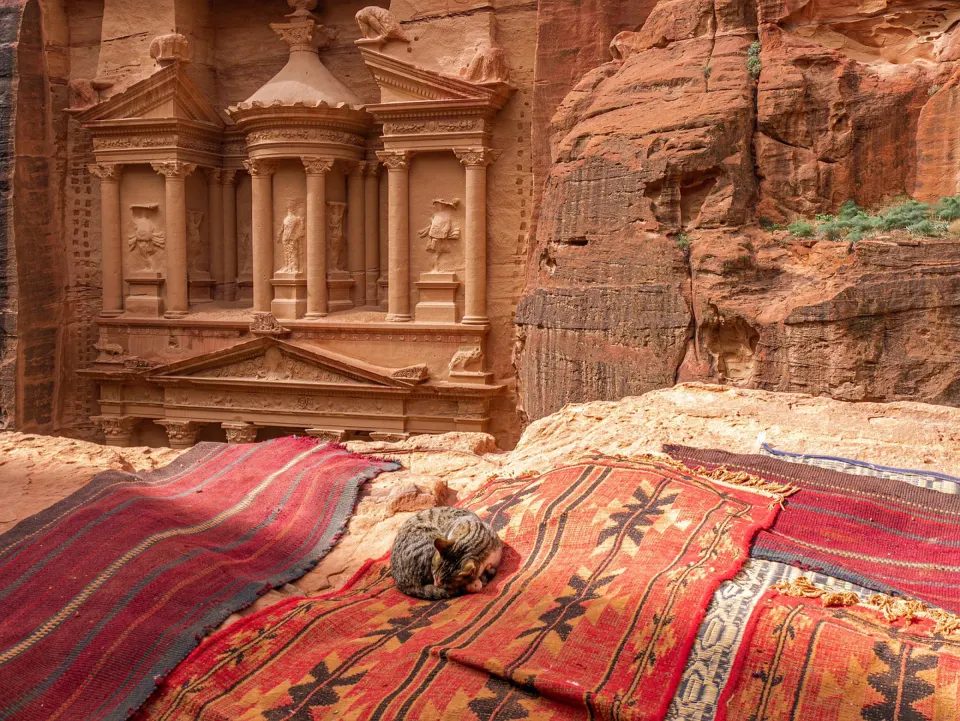
Treasury facade at Petra with cat on carpets

Jordan travel guide

Ancient cities, desert canyons and a warm Red Sea coast in one compact country

Best: Mar, Apr, Oct, Nov

Photo: ChiemSeherin / Pixabay

Capital
Amman
Language
Arabic
Currency
Jordanian dinar
Time zone
UTC+03:00
Plugs
Type B, C, F, G, J · 230 V
Driving
On the right
Emergency
911

Why visit Jordan

Jordan suits travellers who want ruins, desert landscapes and a slice of coastline without long distances between them. Petra, Jerash and Madaba cover the history, while Aqaba on the Red Sea adds warm-water time. March, April, October and November bring the mildest weather across Amman, Petra and Jerash, and Aqaba stays pleasant into December too. The honest limitation: outside these months, summer heat and desert conditions can make sightseeing hard going.

  • Comfortable weather in spring and autumn

    The best months to visit Jordan are March, April, October and November. These spring and autumn months suit long days of walking at outdoor sites, and you can travel between cities without the hottest part of the year.

  • Amman as a big-city base

    The capital, Amman, is home to 4007526 people, about a third of the country's 11937000 residents. It is the natural starting point for most trips, with an easy link to smaller towns such as Madaba.

  • Petra, Jerash and Madaba in one trip

    Jordan covers 89342 km², so Petra, Jerash and Madaba fit into a single itinerary. Jerash is a small town of 50745 people. You can combine these historic places without very long journeys, and driving is on the right.

  • A coastline at Aqaba

    Aqaba is the country's coastal city, with a population of 140000. It adds a seaside stop to a trip that is otherwise mostly inland, and it is a relaxed contrast to Amman and the desert sites.

  • Simple practical details

    Jordan uses the Jordanian dinar and Arabic is the official language. The country runs on UTC+03:00 all year, and the emergency number is 911. Sockets use 230 V, with plug types B, C, F, G and J.

Is Jordan right for you?

Great for

  • Travellers who want sites like Petra and Jerash in mild, dry weather from March to April or October to November
  • Those who enjoy very low rain, with 0 rain days in Amman from June to August
  • Visitors to Aqaba's coast, best from November to April when inland Amman is cooler or wet
  • Travellers who like high sun hours, over 13 hours a day in June and July in Amman
  • People who plan city and desert trips together, since Amman, Jerash, Madaba and Petra share the same best months

Less ideal for

  • Heat-sensitive travellers in Amman summer, when highs reach 33.7°C in July and August with no rain to cool things down
  • Beach-only travellers outside the Aqaba season, since Amman itself is landlocked and has no coastal option
  • Visitors wanting winter beach weather, as Amman turns cold and wetter from December to February with lows near 4.4°C

Jordan right now: October

9.1/10
Avg high
27°C
Avg low
16°C
Rain days
1

Averages for Amman.

Weather by month

This data is for Amman: March, April, May, October, November and December bring mild highs of 15-28°C and easier sun levels of 9-13 hours a day, making them the best months to visit. July and August are the toughest, with highs around 34°C and virtually no rain, while January and February bring the most rain, up to 8 days and 43mm a month.

Average highs and lows in Amman by month January: high 12°C, low 4°C , 8 rain days . February: high 14°C, low 5°C , 7 rain days . March: high 18°C, low 8°C , 5 rain days . April: high 24°C, low 12°C , 3 rain days . May: high 28°C, low 16°C , 1 rain days . June: high 32°C, low 19°C , 0 rain days . July: high 34°C, low 21°C , 0 rain days . August: high 34°C, low 21°C , 0 rain days . September: high 32°C, low 19°C , 0 rain days . October: high 27°C, low 16°C , 1 rain days . November: high 20°C, low 11°C , 4 rain days . December: high 15°C, low 7°C , 5 rain days . 12°C 4°C JAN 8d 14°C 5°C FEB 7d 18°C 8°C MAR 5d 24°C 12°C APR 3d 28°C 16°C MAY 1d 32°C 19°C JUN 0d 34°C 21°C JUL 0d 34°C 21°C AUG 0d 32°C 19°C SEP 0d 27°C 16°C OCT 1d 20°C 11°C NOV 4d 15°C 7°C DEC 5d
Best months Other months (low–high) Nd = rain days

Amman · averages 2015–2024

Best time to visit Jordan: month-by-month weather →

Jordan's climate regions

The weather varies across the country; each region has its own best months.

  • Amman Highlands

    Amman, Jerash, Madaba, Petra

    This region, covering Amman, Jerash, Madaba and Petra, has mild winters and hot summers. January highs reach 13°C, July highs hit 33.6°C, with about 39 rain days a year. Best months are March, April, October and November.

    Best: Mar, Apr, Oct, Nov

  • Aqaba Coast

    Aqaba

    Aqaba is warm to very hot year-round, with January highs of 20.4°C and July highs of 40°C. Rain is rare, just 7.7 days a year on average. Best months are November, December, March and April, avoiding the peak summer heat.

    Best: Mar, Apr, Nov, Dec

Where to go in Jordan

City guides with their own best months and weather.

Sample itineraries

7 days

Amman to the Red Sea in a Week

  1. Day 1–2

    Amman

    Settle into the capital and explore the Amman Citadel, which takes about 1-2 hours to see. Use the extra time to walk the downtown streets and markets.

  2. Day 3

    Jerash

    Take the short bus ride north to see the Jerash Archaeological Site, a half-day visit to its Roman ruins, then head back to Amman.

  3. Day 4

    Madaba

    Visit Madaba for its mosaics and climb Mount Nebo nearby, a 1-2 hour stop with views over the Dead Sea valley.

  4. Day 5–6

    Petra

    Spend a full day or two exploring Petra, allowing time to walk past the Treasury and further into the site at a relaxed pace.

  5. Day 7

    Aqaba

    Finish on the Red Sea coast in Aqaba. Spend your last day by the water before heading home.

10 days

A Fuller Loop Through Jordan

  1. Day 1–2

    Amman

    Start in the capital with two days to see the Amman Citadel and wander the older neighbourhoods at an easy pace.

  2. Day 3

    Jerash

    Day-trip to Jerash for its Roman ruins, a half-day visit, then return to Amman for the night.

  3. Day 4

    Madaba

    Head to Madaba to see its mosaic floors and stop at Mount Nebo, a short 1-2 hour visit close by.

  4. Day 5–7

    Petra

    Give yourself three days around Petra. Spend 1-2 days inside the ancient site itself, plus time to also visit the nearby Dana Biosphere Reserve.

  5. Day 8–10

    Aqaba

    End the trip on the coast in Aqaba, with time for the Red Sea and a day or two out at the Wadi Rum Protected Area before flying or busing back.

Getting around Jordan

Typical journey times and fares between the main places.

Route By Time Price
Amman → Petra JETT runs one daily bus. It leaves Amman (Abdali or 7th Circle) early in the morning, about 06:30, and returns from Petra (Wadi Musa) at about 17:00. The trip takes about 3.5 hours, including one rest stop halfway. The fare is about JOD 10 at the JETT office (jett.com.jo). Resellers such as 12go charge about JOD 18.44. Book a day or more ahead in high season. I could not open the JETT site, so I used a 2025 guide and a reseller listing. bus 3 h 30 min 10–18.44 JOD ↗
Amman → Aqaba JETT runs several buses a day from Abdali station in Amman to its Aqaba station. The trip takes about 4 hours, including a 20–30 minute stop at a service station. I could not find a confirmed fare in JOD. Rome2rio lists the cheapest way from about USD 17. Check the price at jett.com.jo. bus 4 h – ↗
Amman → Aqaba Royal Jordanian flies from Queen Alia (AMM) to King Hussein International (AQJ). The flight takes about 55 minutes. The 150 minutes is my own door-to-door estimate, with time for check-in and airport transfers. Expedia lists one-way fares of about USD 45–140. Fares in JOD were not available. flight 2 h 30 min 45–140 USD ↗
Amman → Jerash Public buses and minibuses leave Amman's North Bus Station (Tabarbour) when they are full. They go to Jerash bus station in 45–60 minutes. The fare is about JOD 1–2. Buses back from Jerash get fewer later in the day, so plan your return. JETT also sells day tours. bus 45 min 1–2 JOD ↗
Amman → Madaba Minibuses leave from Tabarbour station (JOD 1.20, price from 2018). There are also frequent minibuses from 7th Circle (JOD 1). The trip takes 45–60 minutes. Buses also leave from Wahadat station. A taxi costs about JOD 20–25. bus 45 min 1–1.2 JOD ↗
Petra → Aqaba Direct public minibuses run between Wadi Musa (Petra) and Aqaba, with few departures (around midday in the afternoon from Aqaba, none on Fridays). The fare is about JOD 5. You can also change in Ma'an, which is cheaper. The 150 minutes is a rough figure based on reported 2.5-hour taxi rides; I did not find a published bus time. A taxi costs about JOD 35–55. bus 2 h 30 min 5 JOD ↗

Staying connected

If your phone plan doesn't include Jordan, an eSIM set up before you leave gives you data on arrival.

Where to stay

One good base in each main city and who it suits.

Jabal Amman

Amman

Good for first-timers, cafes, walking

This hill west of Downtown holds Rainbow Street, the old circles and many cafes, restaurants and rooftop bars. It is a good base because you can walk down to Downtown and the Roman Theatre, and taxis are easy to find. The streets are steep, and Rainbow Street gets loud and crowded on weekend evenings.

Lower Wadi Musa

Petra

Good for first-timers, short stays, early starts

This is the strip of Wadi Musa closest to the Petra Visitor Centre and the main gate, so you can walk in at opening time and come back for a rest at midday. Restaurants, shops and the Petra by Night start point are all close by. It is the busiest and most tour-group-heavy part of town, so expect traffic and higher demand in peak season.

Food to try in Jordan

Mansaf

Jordan's national dish. Lamb is cooked in a sauce of jameed, a dried fermented yogurt, then served over rice and thin flatbread. It is shared at weddings, holidays and large family gatherings.

Maqluba

The name means 'upside down'. Rice, fried vegetables such as aubergine or cauliflower, and chicken or meat are cooked in one pot. The pot is then flipped onto a tray. It is a common family meal.

Falafel and hummus

Fried chickpea balls and a smooth chickpea and tahini dip, eaten with warm flatbread. Many Jordanians have them for breakfast. Small street restaurants in Amman serve them all day.

Knafeh

A warm dessert of soft white cheese under a layer of pastry, soaked in sugar syrup. Sweet shops across Amman and other cities serve it, often with a queue of locals.

Zarb

A Bedouin way of cooking. Meat and vegetables are slow-cooked in a pit dug into the sand and covered with hot coals. Desert camps in Wadi Rum often serve it to guests.

Arabic coffee

Light, bitter coffee flavoured with cardamom and poured into small cups without handles. It is a sign of hospitality. Hosts offer it to guests in homes, shops and Bedouin tents.

Know before you go

  • Plugs and voltage: Jordan runs on 230 V. Sockets take plug types B, C, F, G and J, so check your adapter before you travel, especially if you're coming from a country with a different plug shape.
  • Driving side: Traffic drives on the right. If you plan to rent a car, bring your home licence plus an International Driving Permit, which you must get before you leave home.
  • Emergency number: Dial 911 for police, ambulance or fire. If you're involved in any crash, even a minor one, stay at the scene and wait for traffic police to arrive.
  • Currency: The currency is the Jordanian dinar. It's worth carrying some cash for smaller towns and markets, alongside cards for hotels and larger shops.
  • Language: Arabic is the official language. In tourist areas like Amman and Petra, English is widely understood, but a few Arabic phrases go a long way elsewhere.
  • Road rules and speed: Speed limits are 60 km/h in towns, 80 km/h on rural roads and 120 km/h on motorways, but they change often, so watch the signs. Speed cameras check seatbelt use, and holding a phone while driving is not allowed.
  • Driving hazards: Watch for unmarked speed bumps and livestock crossing rural roads, which are often poorly lit at night. The Desert, King's and Dead Sea highways are toll-free, and no vignette is needed anywhere in the country.

Jordan: frequently asked questions

When is the best time to visit Jordan?

April, November, October and March score highest, rated 'best' in the data. April hits a high of 23.7°C with only 2.9 rain days, while November has a high of 20.1°C and 3.5 rain days. These months avoid the summer heat and the heaviest winter rain.

Is Jordan good to visit in August?

August is rated 'ok', not 'best'. Amman highs reach 33.7°C with lows of 20.6°C, and there's no rain at all. It's dry and sunny (12.9 sun hours a day), but the heat is intense for sightseeing, especially at Petra.

Is Jordan cold in January?

January is mild by European standards but cool for a desert country. Amman's high is 12.3°C and the low drops to 4.4°C, with 8 rain days and 43 mm of rain, the wettest month of the year. Sun hours are also at their lowest, 8.7 a day.

How many days do I need in Jordan?

A short loop covering Amman, Jerash, Madaba, Petra and Aqaba can work well since the bus rides are short. Amman to Jerash and Amman to Madaba each take 45 minutes, Amman to Petra is 3 h 30 min, and Petra to Aqaba is 2 h 30 min. Add time for Petra itself since it rewards slower exploring.

How do you get from Amman to Petra and Aqaba?

Bus is the main option. Amman to Petra takes 3 h 30 min and costs 10–18.44 JOD. Amman to Aqaba takes 4 h by bus, or 2 h 30 min by flight for 45–140 USD. Petra to Aqaba is a shorter 2 h 30 min bus ride for 5 JOD.

Is Jordan rainy?

Rain is light overall and falls mostly between November and March. January is wettest with 43 mm over 8 rain days, while June through August see no rain days at all. Outside winter, you can expect dry, sunny conditions.

Similar destinations

Countries with a year of weather much like Jordan.