Skip to content
wheretotravel.info
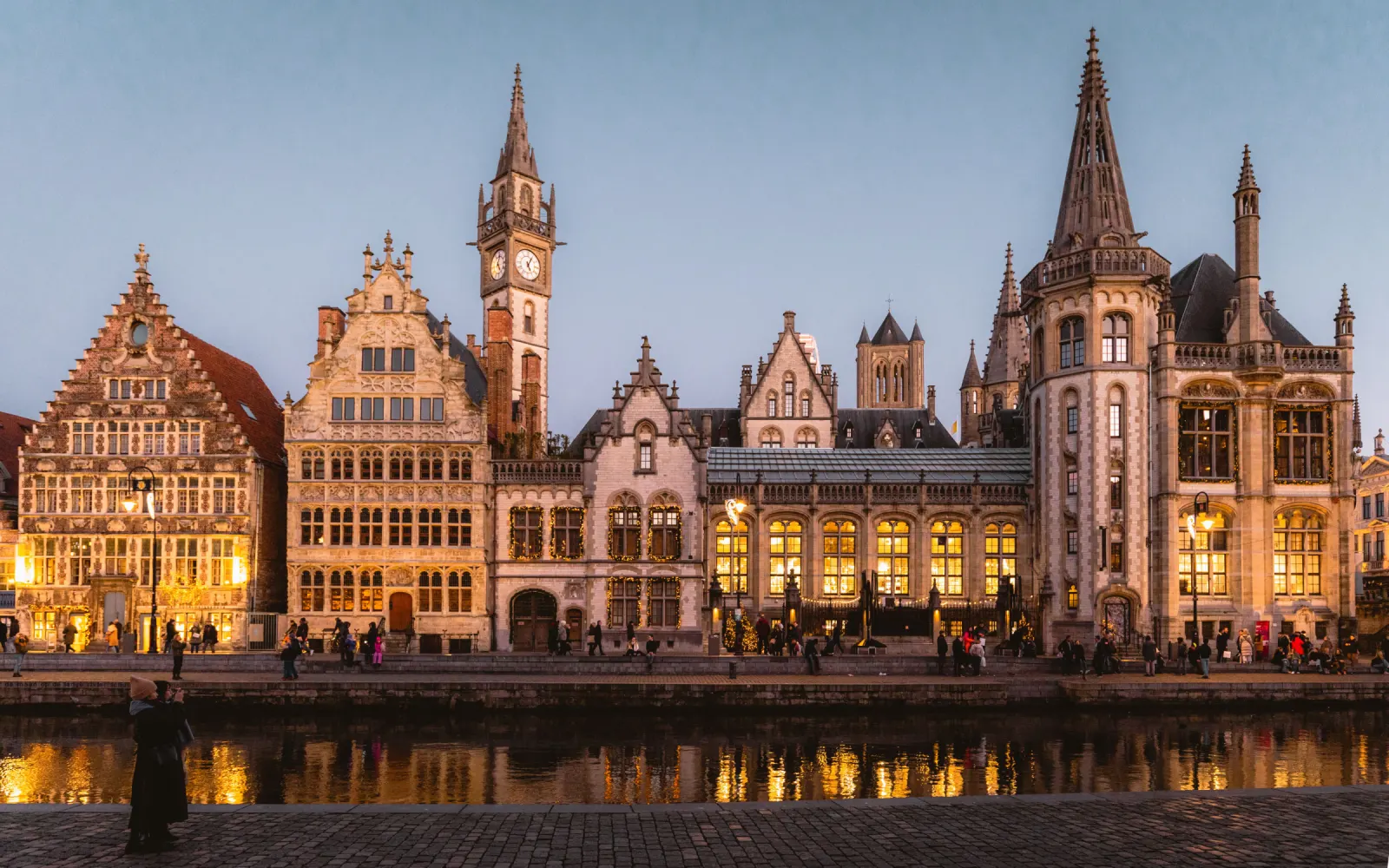
Graslei buildings illuminated at dusk

Ghent travel guide

What to see, where to stay and the best time to visit Ghent, Belgium.

Best: Jun, Jul, Aug, Sep

Photo: Dylan Chan / Pexels

Country
Belgium

About Ghent

Ghent is a Belgian city of about 272,657 people. Most of its main sights sit close together in the historic centre: St Bavo's Cathedral, the Gravensteen castle, the Belfry, St Michael's Bridge and the Graslei and Korenlei. Patershol suits couples and food lovers. The art museums MSK and S.M.A.K. are in Citadelpark. The best months to visit are June to September.

How many days do you need in Ghent?

Most main sights are in the city centre and take 30 minutes to 2 hours each, so they fit into a short stay. Allow extra time for Citadelpark. MSK alone takes 2–3 hours, and S.M.A.K. another 1–2.

Top attractions in Ghent

  1. 1St Bavo's Cathedral

    1–2 hours

    City centre

    Ghent's Gothic cathedral holds the Ghent Altarpiece (Adoration of the Mystic Lamb) by the Van Eyck brothers, one of the most important paintings in Europe. The visitor centre explains the altarpiece and its long history of thefts and restorations. Queues can be long at busy times, so arrive early.

  2. 2Gravensteen (Castle of the Counts)

    1–2 hours

    City centre

    A stone castle with a moat, right in the middle of the city. You can walk the ramparts for views over the rooftops, and an audio tour adds humour and history. Good for families.

  3. 3Graslei and Korenlei

    1 hour

    City centre

    Two quays facing each other across the Leie river, lined with old guild houses. This is the classic view of Ghent, and it looks best in the evening when the buildings are lit. Boat tours of the canals leave from here.

  4. 4Belfry of Ghent

    1 hour

    City centre

    A tall bell tower that once guarded the city's charters. It is on the UNESCO World Heritage list with other belfries of Belgium and France. A lift and stairs take you to a viewing gallery over the three famous towers of the centre.

  5. 5St Michael's Bridge

    30 minutes

    City centre

    A bridge over the Leie with the best free view of Ghent's three towers and the Graslei. It takes only a few minutes, but it is worth crossing at sunset.

  6. 6St Nicholas' Church

    30 minutes–1 hour

    City centre

    A large church in the grey-blue stone style known as Scheldt Gothic, built when Ghent was a rich trading city. It stands between the Belfry and the Korenmarkt and is free to enter.

  7. 7Patershol

    1–2 hours

    Patershol

    A small old quarter of narrow lanes and restored houses near the Gravensteen. Today it is known for its many restaurants, so it is a good place for dinner after sightseeing.

  8. 8Museum of Fine Arts Ghent (MSK)

    2–3 hours

    Citadelpark

    One of Belgium's oldest art museums, with Flemish paintings from the Middle Ages to the 20th century, including works by Bosch and Rubens. It is south of the centre, a short tram ride or a longer walk away. Pair it with S.M.A.K. across the road.

  9. 9S.M.A.K. (Municipal Museum of Contemporary Art)

    1–2 hours

    Citadelpark

    A contemporary art museum with changing exhibitions and a permanent collection of international artists. Worth it if you like modern art; skip it if you do not.

  10. 10STAM – Ghent City Museum

    1–2 hours

    Bijloke

    A museum that tells the story of Ghent from its beginnings to today, set in a former abbey. Visit it early in your stay to understand what you see in the old town.

Ghent by month

Average weather and our month score, from 10 years of climate data.

Weather by month and month scores for Ghent
Month High / low Rain days Sunshine Score
January 7°C / 2°C 14 days (79 mm) 3.7 h/day 1.1/10
February 9°C / 2°C 12 days (62 mm) 5.3 h/day 2.3/10
March 11°C / 4°C 14 days (68 mm) 7.0 h/day 3.5/10
April 14°C / 5°C 12 days (49 mm) 9.9 h/day 5.8/10
May 18°C / 9°C 12 days (64 mm) 11.0 h/day 7.6/10
Best month: June 22°C / 13°C 11 days (67 mm) 11.5 h/day 7.9/10
Best month: July 23°C / 14°C 12 days (61 mm) 11.3 h/day 7.7/10
Best month: August 23°C / 15°C 12 days (70 mm) 10.6 h/day 7.7/10
Best month: September 20°C / 12°C 11 days (61 mm) 9.0 h/day 7.8/10
October 16°C / 9°C 13 days (69 mm) 6.2 h/day 5.9/10
November 11°C / 5°C 14 days (75 mm) 4.3 h/day 2.6/10
December 8°C / 4°C 14 days (75 mm) 3.2 h/day 1.2/10
  1. Jan

    Avoid. The lowest score of the year at 1.1. Highs of only 6.7°C, lows of 1.9°C, rain on 14 days and just 3.7 sun hours.

  2. Feb

    Avoid. Still cold, with highs of 8.7°C. Rain falls on 12 days and you get only 5.3 sun hours. The score is 2.3.

  3. Mar

    Avoid. Highs reach 11°C, but rain falls on 13.6 days and sun is limited to 7 hours. With a score of 3.5, waiting a few weeks pays off.

  4. Apr

    OK. Highs of 14.2°C and the driest month, with 49 mm of rain over 11.6 days. Pack layers for cool 5.1°C nights.

  5. May

    Best. Warm 18.3°C highs and 11 sun hours. Rain still comes on 12 days, so bring a light jacket.

  6. Jun

    Best, with the top score of 7.9. Highs of 22.1°C, the fewest rain days at 10.5, and 11.5 sun hours.

  7. Jul

    Best. Highs of 23°C and 11.3 sun hours suit long days of walking. Expect some rain, on about 11.5 days.

  8. Aug

    Best. The warmest month at 23.4°C, but also 70 mm of rain over 11.7 days. Still a good time to go.

  9. Sep

    Best, scoring 7.8. Highs of 20.3°C and only 10.9 rain days make it a strong choice for a late-summer trip.

  10. Oct

    OK. Highs drop to 15.8°C and sun to 6.2 hours. Rain falls on 12.9 days, so plan some indoor time.

  11. Nov

    Avoid. Cool 10.5°C highs, 75 mm of rain over 13.7 days and only 4.3 sun hours. Grey and wet most days.

  12. Dec

    Avoid. The least sun of the year at 3.2 hours, with 8.2°C highs and rain on 13.7 days. The score is just 1.2.

Climate averages 2015–2024 · Best time to visit Belgium →

Where to stay in Ghent

The best areas to base yourself and who each one suits.

Historic centre (Korenmarkt, Graslei and Korenlei)

Good for first-timers, short stays

This is the old core around the canals, churches and Gravensteen castle, so most main sights are a short walk away. It is the easiest base for a first visit. The drawback is crowds and noise from bars and day-trippers, especially on weekend evenings.

Patershol

Good for couples, food lovers

A small maze of narrow cobbled lanes just north of the castle, with old houses and many restaurants. It feels quieter than the main squares but is still very central. Streets are narrow and cobbled, which is awkward with heavy luggage, and rooms can be small.

Vrijdagmarkt and Sint-Jacobs

Good for markets, local feel

A large square and the streets around Sint-Jacobs church, with cafés, weekly markets and a more everyday atmosphere than the canal fronts. It is an easy walk to the historic centre. Market days and busy café terraces can bring early-morning set-up noise and late-night chatter.

Kouter and Veldstraat area

Good for shoppers, convenience

The main shopping streets and the Kouter square lie between the old centre and the south of the city, with good tram links. It is practical and central, with shops and cafés close by. It feels more commercial and less atmospheric than the canal areas.

Sint-Pieters and the Citadelpark area

Good for rail travellers, families, museums

This area near Gent-Sint-Pieters station has leafy streets, the Citadelpark and the city's main art museums. It is handy if you arrive by train or plan day trips to Bruges or Brussels. The historic centre is a longer walk away, so you will often need a tram or bike.

Overpoort and university quarter

Good for students, nightlife, budget

The streets around the university are full of student bars and cheap places to eat, and they stay lively late. It suits younger travellers who want nightlife more than sightseeing. It can be very loud at night during the academic year, and it is not the prettiest part of the city.

Getting to and around Ghent

From the airport
Ghent has no main airport of its own. Most visitors fly into Brussels Airport, take a train to Gent-Sint-Pieters station, then a tram or bus into the historic centre. Check current times and fares before you travel.
Public transport
There is no metro. Trams and buses, run by De Lijn, cover the city and link Gent-Sint-Pieters station with the centre. Tip: in the old centre, walking or cycling is often quicker than waiting for a tram.
On foot
The historic centre is compact and flat. St Bavo's Cathedral, the Belfry, St Nicholas' Church, St Michael's Bridge, Graslei and Gravensteen sit close together, with Patershol next door. Citadelpark museums are further south.

Food to try in Ghent

Gentse waterzooi

A creamy stew of chicken or fish with leeks, carrots and potatoes in a broth thickened with egg and cream. Locals order it in traditional brasseries, most often on cooler days.

Cuberdons (neuzekes)

Cone-shaped purple sweets with a hard shell and a soft raspberry-flavoured centre. Locals call them 'little noses'. You buy them from sweet shops and street carts in the old centre.

Tierenteyn mustard

A sharp, freshly made mustard sold from a historic shop on the Groentenmarkt. Locals buy it by the pot and eat it with cold meats, stews and cheese.

Gentse mokken

Small, round, crunchy biscuits flavoured with anise and brown sugar. They are sold in local bakeries and eaten with coffee.

Stoverij

A slow-cooked Flemish beef stew made with dark beer, onions and bread spread with mustard. It is usually served with fries in cafés and brasseries.

More of Belgium

Belgium travel guide →

Ghent: frequently asked questions

When is the best time to visit Ghent?

The best time to visit Ghent is May to September, when every month is rated best. June scores highest at 7.9, with average highs of 22.1°C and 11.5 hours of sun a day. September scores 7.8 and is still mild, with highs of 20.3°C and 10.9 rain days. Pack a rain jacket in any month, because Ghent gets at least 10.5 rain days every month.

Is Ghent good in August?

Yes, August is a good month for Ghent. It scores 7.7 and is the warmest month, with average highs of 23.4°C and lows of 14.6°C. It is not dry, though. August gets 70 mm of rain over 11.7 days, more than June or July. Expect some wet afternoons and plan an indoor sight, such as a museum, as a backup.

Should I visit Ghent in winter?

No, winter is a poor time to visit Ghent if weather matters to you. November to March are all rated avoid. January scores just 1.1, with highs of 6.7°C, 14.1 rain days and 3.7 hours of sun a day. December scores 1.2 and has the least sun of the year, at 3.2 hours a day. Days are cold, grey and often wet.

Are April and October good months to visit Ghent?

April and October are acceptable, rated ok, but not the best. April scores 5.8, with highs of 14.2°C and the lowest rainfall of the year at 49 mm. October scores 5.9 and is a bit warmer, with highs of 15.8°C. But it has 12.9 rain days and only 6.2 hours of sun a day. Bring warm layers for both months.

How many days do I need in Ghent?

Plan for 2 days in Ghent to see the main sights without rushing. Most sights in the city centre take 30 minutes to 2 hours each, including St Bavo's Cathedral, Gravensteen and the Belfry. Add 1–2 hours to walk around Patershol. The Museum of Fine Arts in Citadelpark needs 2–3 hours on its own. S.M.A.K. and STAM take another 1–2 hours each.