Skip to content
wheretotravel.info
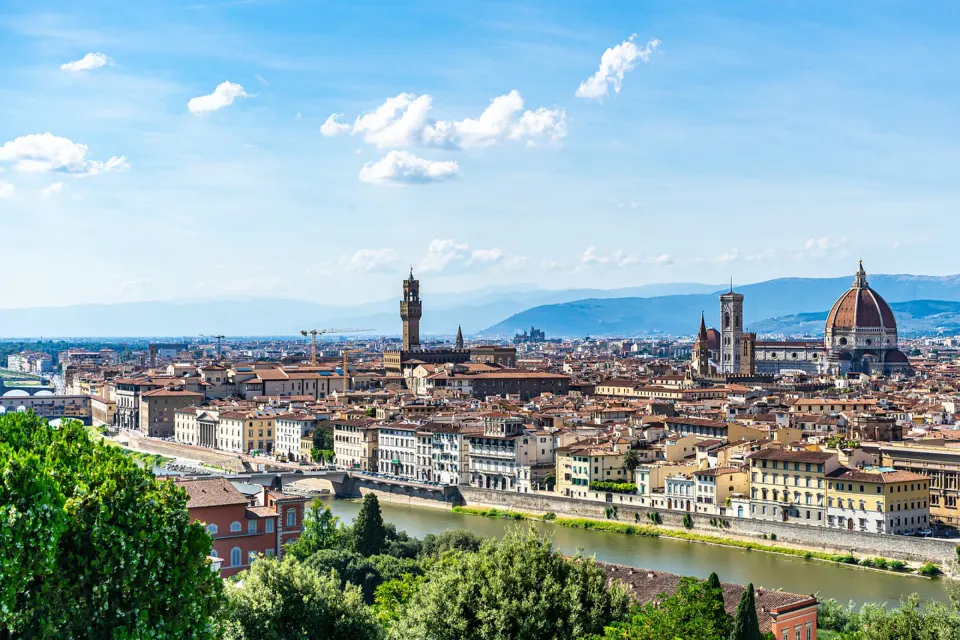
Aerial view of Florence skyline with Duomo and river Arno

Florence travel guide

What to see, where to stay and the best time to visit Florence, Italy.

Best: Apr, Sep, Oct

Photo: dominickvietor / Pixabay

Country
Italy

About Florence

Florence is an Italian city of 360,930 people, and many of its main sights are in one area, the Centro Storico. Here you find the Uffizi Gallery, the Duomo, Palazzo Vecchio and the Bargello. Cross the Ponte Vecchio to reach the Oltrarno, home to the Pitti Palace, the Boboli Gardens and many artisans. For views, go up to Piazzale Michelangelo in San Niccolò. The best months to visit are April, September and October.

How many days do you need in Florence?

Plan for more than a quick visit. The Uffizi alone takes 3–4 hours. The Duomo and the Pitti Palace with the Boboli Gardens each take half a day. Add the Accademia, Santa Croce and the Medici Chapels, at 1–2 hours each.

Top attractions in Florence

  1. 1Uffizi Gallery

    3–4 hours

    Centro Storico

    This is one of the world's great art museums, with Italian Renaissance paintings by Botticelli, Leonardo, Michelangelo and Raphael. Book a timed ticket in advance, because queues without one can be very long.

  2. 2Florence Cathedral (Duomo)

    half a day

    Centro Storico

    The cathedral complex includes Brunelleschi's Dome, Giotto's Bell Tower, the Baptistery and the Duomo Museum. Climbing the dome gives close views of its frescoes and the city, but it involves many narrow steps and needs booking. Skip the climb if you dislike tight spaces.

  3. 3Galleria dell'Accademia

    1–2 hours

    San Marco

    Most people come to see Michelangelo's David, which is far more impressive in person than in photos. The rest of the museum is small, so book a time slot and do not plan a whole morning here.

  4. 4Palazzo Vecchio and Piazza della Signoria

    2–3 hours

    Centro Storico

    The old town hall still works as Florence's city hall, and its state rooms are richly decorated. The square outside and the Loggia dei Lanzi work as a free open-air sculpture gallery.

  5. 5Ponte Vecchio

    30 minutes

    Centro Storico / Oltrarno

    This medieval bridge over the Arno is lined with small jewellery shops. It gets very crowded in the middle of the day, so walk across early in the morning or in the evening.

  6. 6Pitti Palace and Boboli Gardens

    half a day

    Oltrarno

    The former Medici palace holds several museums, including a large collection of paintings in grand rooms. Behind it, the Boboli Gardens have terraces, statues and fountains, which make a good break from indoor sights. The gardens are hilly, so wear comfortable shoes.

  7. 7Basilica of Santa Croce

    1–2 hours

    Santa Croce

    This large Franciscan church holds the tombs of Michelangelo, Galileo and Machiavelli, plus frescoes by Giotto. It is usually calmer than the Duomo.

  8. 8Bargello National Museum

    1–2 hours

    Centro Storico

    Housed in a medieval fortress-like palace, this museum has the city's best Renaissance sculpture, including works by Donatello and Michelangelo. It is often much less crowded than the Uffizi or the Accademia.

  9. 9Medici Chapels and Basilica of San Lorenzo

    1–2 hours

    San Lorenzo

    San Lorenzo was the Medici family church, and the Medici Chapels behind it contain tombs with sculptures by Michelangelo. The area around it has a big street market and the San Lorenzo Central Market for food.

  10. 10Piazzale Michelangelo

    1 hour

    San Niccolò

    This hilltop square gives the classic view over the Duomo, the river and the rooftops. It is a steep walk up from the river, and it is busiest at sunset. For a quieter view, continue up to the church of San Miniato al Monte.
Florence by month

Average weather and our month score, from 10 years of climate data.

Weather by month and month scores for Florence
Month High / low Rain days Sunshine Score
January 11°C / 2°C 11 days (74 mm) 6.1 h/day 3.7/10
February 13°C / 3°C 11 days (91 mm) 7.0 h/day 5.0/10
March 15°C / 5°C 10 days (79 mm) 8.7 h/day 6.6/10
Best month: April 19°C / 7°C 10 days (75 mm) 10.6 h/day 8.0/10
May 23°C / 12°C 14 days (104 mm) 11.5 h/day 7.2/10
June 28°C / 16°C 8 days (55 mm) 13.1 h/day 7.2/10
July 32°C / 19°C 4 days (24 mm) 13.9 h/day 4.5/10
August 32°C / 19°C 6 days (43 mm) 12.5 h/day 4.2/10
Best month: September 26°C / 15°C 9 days (111 mm) 10.6 h/day 8.0/10
Best month: October 21°C / 12°C 12 days (114 mm) 8.2 h/day 7.7/10
November 15°C / 7°C 12 days (132 mm) 6.5 h/day 5.8/10
December 12°C / 4°C 12 days (104 mm) 5.6 h/day 4.0/10
  1. Jan

    Avoid. Highs of 10.6°C, lows of 2.2°C and 10.5 rain days. Short, grey days with 6.1 sun hours. Score 3.7, the lowest of the year.

  2. Feb

    OK. Highs of 12.7°C and 10.6 rain days. Nights are still cold, with lows of 3.3°C. Score 5.

  3. Mar

    Good. Highs reach 15.3°C, with 10.2 rain days and 8.7 sun hours. Pack layers for cool mornings. Score 6.6.

  4. Apr

    Best. Mild highs of 19°C, 9.9 rain days and 10.6 sun hours. Joint top score of 8, with September.

  5. May

    Good. Warm highs of 22.5°C, but the most rain days of the year at 13.9. Bring an umbrella. Score 7.2.

  6. Jun

    Good. Hot highs of 28.3°C, only 8 rain days and 13.1 sun hours. Plan sightseeing for the mornings. Score 7.2.

  7. Jul

    Only OK. The hottest month, with highs of 32.3°C and lows of 19.3°C. Just 4.1 rain days, but the heat makes walking hard. Score 4.5.

  8. Aug

    Only OK. Highs of 32.1°C and 6.1 rain days. The heat limits long days on foot, so go out early or late. Score 4.2.

  9. Sep

    Best. Highs ease to 26.4°C with 9.1 rain days, though rainfall jumps to 111 mm. Joint top score of 8, with April.

  10. Oct

    Best. Pleasant highs of 21.4°C, but 11.7 rain days and 114 mm of rain. Pack a rain jacket. Score 7.7.

  11. Nov

    OK. Highs of 15.4°C, 12.4 rain days and the wettest month at 132 mm. Expect grey, damp days. Score 5.8.

  12. Dec

    OK, but not ideal. Highs of 11.9°C, 12 rain days and the fewest sun hours of the year at 5.6. Score 4.

Climate averages 2015–2024 · Best time to visit Italy →

Where to stay in Florence

The best areas to base yourself and who each one suits.

Santa Croce

Good for first-timers, nightlife, food lovers

A lively area to the east of the centre, around the large basilica and square of the same name. It is close to the main sights but feels more local, with many bars, wine shops and the Sant'Ambrogio food market nearby. Streets near the bars can be loud late at night, so ask for a room away from the square.

Oltrarno (Santo Spirito and San Frediano)

Good for couples, repeat visitors, artisans and food

The area across the river from the centre, known for craft workshops, the Pitti Palace, the Boboli Gardens and relaxed evenings in Piazza Santo Spirito. It feels more like a working neighbourhood and less like a museum. Piazza Santo Spirito gets noisy on warm nights, and some streets towards the hills are steeper.

San Lorenzo and Santa Maria Novella

Good for train travellers, day trips, practical stays

This area sits next to the main railway station and the Central Market, which makes arrivals and day trips to other Tuscan towns simple. There is a wide choice of places to stay, and the Duomo is a short walk away. The streets right around the station can feel busy, scruffy and less pleasant at night.

San Niccolò

Good for couples, quiet, views

A small, calm corner on the south bank, below Piazzale Michelangelo and the city walls. It has a village feel, a few good bars and restaurants, and quick access to viewpoints over the city. The drawback is the walk: it is further from the station, and the routes up to the viewpoints are steep.

Campo di Marte

Good for families, longer stays, quiet

A mainly residential district east of the historic centre, with wider streets and a more everyday Italian rhythm. It is quieter than the centre and has its own train station. You will need to walk a fair distance or take a bus to reach the main sights, and there is little to do in the evenings.

Getting to and around Florence

From the airport
Florence airport is small and close to the city. A tram runs from the terminal to Santa Maria Novella station, at the edge of the old centre. Taxis wait outside. Many visitors fly into Pisa instead and continue by train or bus.
Public transport
There is no metro. Trams and buses cover the outer districts, but few run through the old centre, which is mostly closed to traffic. Tip: buy and validate your ticket before you ride, not on board.
On foot
Very walkable. The Duomo, Uffizi, Palazzo Vecchio and Bargello sit minutes apart in Centro Storico. Cross the Ponte Vecchio for Oltrarno and the Pitti Palace. Piazzale Michelangelo is an uphill walk.

Food to try in Florence

Bistecca alla fiorentina

A thick T-bone steak grilled over coals and served rare, traditionally from Chianina cattle. It is usually priced by weight and shared at the table in trattorias.

Lampredotto

A cut of cow's stomach slow-cooked in broth and served in a bread roll, often with green sauce. Locals eat it as a quick lunch from street carts called trippai.

Ribollita

A thick soup of stale bread, beans and vegetables, especially cavolo nero (black kale). It is a winter dish, traditionally reheated the next day, which gives it its name.

Pappa al pomodoro

A soft soup of stale bread, tomatoes, garlic, basil and olive oil. It is mostly eaten in summer, warm or at room temperature, in simple trattorias.

Schiacciata

A flat, salty bread made with olive oil. Florentines buy it filled with cured meats and cheese from sandwich shops as a cheap lunch or snack.

More of Italy

Italy travel guide →

Florence: frequently asked questions

What is the best month to visit Florence?

April, September and October are the best months to visit Florence. They score 8, 8 and 7.7 in our ratings, the highest of the year. April has highs of 19°C and 10.6 hours of sun a day. September reaches 26.4°C and October 21.4°C, so both miss the peak summer heat. May and June also rate good, but May has 13.9 rain days.

Is Florence good in August?

August is possible but not ideal. It scores only 4.2 and rates 'ok'. Average highs reach 32.1°C and nights stay around 19.3°C, so walking between sights in the afternoon can be hard. July is similar at 32.3°C. The upside is dry, sunny weather, with 6.1 rain days and 12.5 hours of sun. For warm weather without the heat, choose June or September instead.

Should I visit Florence in January?

Avoid January if you can. It has the lowest score of the year at 3.7. Highs are only 10.6°C, nights drop to 2.2°C, and you get about 6.1 hours of sun a day with 10.5 rain days. December is only slightly better, scoring 4. If you must go in winter or early spring, March is milder, with highs of 15.3°C and a 'good' rating.

What is the rainiest month in Florence?

November is the wettest month, with 132 mm of rain over about 12.4 days. October (114 mm) and September (111 mm) are also wet, even though they are among the best months. September has only 9.1 rain days, so dry days are still common. July is the driest month, with 24 mm of rain on about 4.1 days.

How much time do I need for Florence's main sights?

Plan several days to see the main sights at a relaxed pace. The Uffizi Gallery alone takes 3–4 hours, and the Duomo takes half a day. The Pitti Palace and Boboli Gardens need another half day. The Galleria dell'Accademia, Santa Croce, the Bargello and the Medici Chapels each take 1–2 hours. Piazzale Michelangelo takes about 1 hour and Ponte Vecchio 30 minutes.