Skip to content
wheretotravel.info
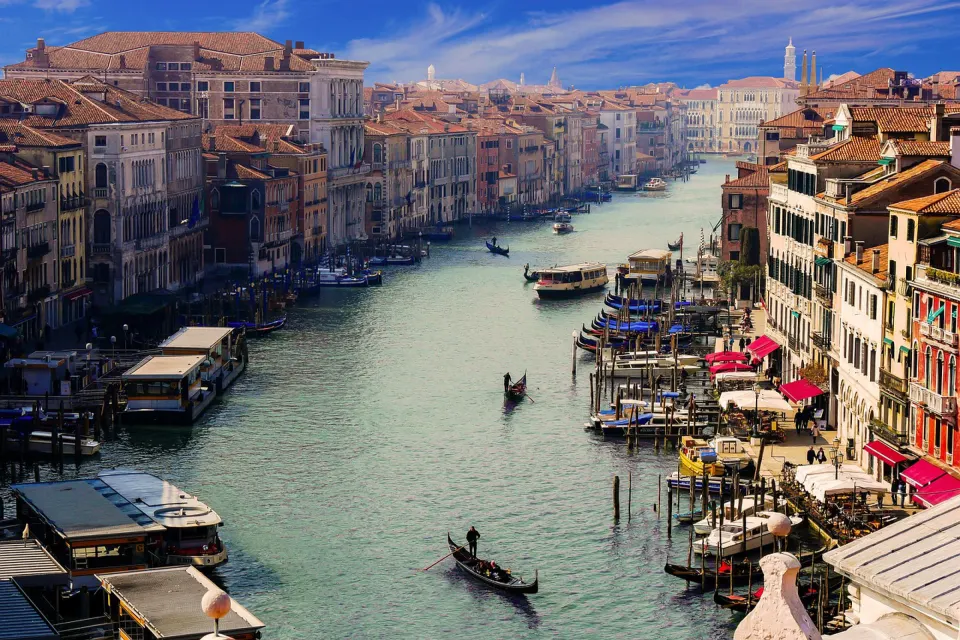
Aerial view of Grand Canal with gondolas and boats

Venice travel guide

What to see, where to stay and the best time to visit Venice, Italy.

Best: Apr, Jun, Sep, Oct

Photo: garten-gg / Pixabay

Country
Italy

About Venice

Venice sits in a lagoon on Italy's northeast coast, built across canals instead of streets. Visitors come for St Mark's Square, the Grand Canal, and museums like the Gallerie dell'Accademia and Peggy Guggenheim Collection, plus day trips to Murano and Burano. The city has six main areas, from San Marco near the main sights to quieter Giudecca and Castello. Good months to visit are April, June, September and October, when the weather is milder than the busy, hot peak summer.

How many days do you need in Venice?

With sights spread across San Marco, San Polo, Dorsoduro and the lagoon islands, plan on a few days to cover the main attractions and a lagoon trip to Murano and Burano without rushing.

Top attractions in Venice

  1. 1St Mark's Basilica

    1–2 hours

    San Marco

    Venice's cathedral, known for its gold mosaics and Byzantine domes. The inside is dark and very rich, and the church shows how Venice once traded with the East. Queues build up fast, so go early and dress with covered shoulders and knees.

  2. 2Doge's Palace

    2–3 hours

    San Marco

    For centuries this was the seat of Venice's government and the home of its ruler, the Doge. You see huge painted council halls, then cross the Bridge of Sighs to the old prison cells. It is the best single place to understand how the Venetian Republic worked.

  3. 3St Mark's Square

    1 hour

    San Marco

    The city's main square, framed by the basilica, the bell tower and long arcades of old government offices. It is very crowded in the middle of the day; early morning or evening is calmer. You can ride a lift to the top of the bell tower for views over the rooftops and lagoon.

  4. 4Grand Canal

    1 hour

    The main waterway that winds through the centre, lined with palaces built by merchant families. The cheapest way to see it is from a public vaporetto (water bus) rather than a gondola. Sit near the front or back for the best view.

  5. 5Rialto Bridge

    1 hour

    San Polo

    The oldest and best-known bridge across the Grand Canal, with shops along its stone arch. Next to it is the Rialto Market, where locals buy fish and vegetables in the morning. The bridge itself gets very busy, so combine it with the market early in the day.

  6. 6Gallerie dell'Accademia

    2–3 hours

    Dorsoduro

    The main museum of Venetian painting, with works by Bellini, Titian, Tintoretto and Veronese. It is quieter than the sights around St Mark's. Go if you want to see why Venice mattered so much in the history of art.

  7. 7Peggy Guggenheim Collection

    1–2 hours

    Dorsoduro

    A modern art museum in the former home of the American collector Peggy Guggenheim, right on the Grand Canal. It holds work by Picasso, Pollock, Magritte and other big names of the last century. The garden and canal terrace are good places for a break.

  8. 8Basilica dei Frari

    1 hour

    San Polo

    A large brick Gothic church with major paintings, including Titian's Assumption above the high altar. It also has Titian's tomb and a striking monument to the sculptor Canova. It is a good stop between the Rialto and Dorsoduro.

  9. 9Scuola Grande di San Rocco

    1 hour

    San Polo

    The meeting house of a religious brotherhood, covered from floor to ceiling with paintings by Tintoretto. Mirrors are provided so you can look at the ceilings without hurting your neck. It is close to the Frari, so many people see both together.

  10. 10Murano and Burano

    half a day

    Venetian Lagoon

    Two islands reached by vaporetto across the lagoon. Murano is known for glassmaking, and you can watch glassblowers and visit the Glass Museum; Burano has brightly painted houses and a tradition of lace. Both are busy at midday, and many shops sell imported copies, so buy from workshops that show their own work.
Venice by month

Average weather and our month score, from 10 years of climate data.

Weather by month and month scores for Venice
Month High / low Rain days Sunshine Sea temp Score
January 8°C / 1°C 7 days (52 mm) 6.2 h/day 10°C 3.3/10
February 10°C / 3°C 7 days (67 mm) 6.7 h/day 9°C 4.1/10
March 13°C / 5°C 8 days (64 mm) 9.0 h/day 11°C 5.9/10
Best month: April 17°C / 9°C 9 days (75 mm) 10.5 h/day 14°C 7.5/10
May 21°C / 14°C 14 days (126 mm) 10.8 h/day 18°C 7.2/10
Best month: June 26°C / 19°C 9 days (78 mm) 13.1 h/day 23°C 8.3/10
July 29°C / 21°C 8 days (50 mm) 13.3 h/day 26°C 7.2/10
August 29°C / 21°C 8 days (74 mm) 12.2 h/day 27°C 7.2/10
Best month: September 24°C / 17°C 10 days (110 mm) 10.3 h/day 25°C 8.1/10
Best month: October 19°C / 12°C 10 days (101 mm) 7.7 h/day 20°C 8.0/10
November 13°C / 7°C 10 days (102 mm) 6.0 h/day 16°C 5.0/10
December 9°C / 2°C 7 days (60 mm) 5.3 h/day 11°C 3.3/10
  1. Jan

    Highs reach just 7.5°C with 6.5 rain days; cold, damp air and short 6.2-hour daylight make this the toughest month, scoring only 3.3.

  2. Feb

    Highs climb slightly to 9.7°C with 7.2 rain days; still cool and grey, but conditions improve a touch, scoring 4.1, an ok month.

  3. Mar

    Highs reach 12.8°C with 7.5 rain days and 9 sun hours; spring warmth starts to show, lifting the score to 5.9, an ok month.

  4. Apr

    Highs of 16.5°C, 8.8 rain days and 10.5 sun hours bring mild, pleasant weather; this is rated the best month at 7.5.

  5. May

    Highs reach 20.7°C but rain days jump to 14.2 with 126mm of rain, the wettest month; still rated good at 7.2.

  6. Jun

    Highs of 25.8°C, only 8.5 rain days and 13.1 sun hours make for warm, sunny days; scored the best at 8.3.

  7. Jul

    Highs peak near 28.5°C with just 7.9 rain days and 50mm rain, the driest month; hot but rated good at 7.2.

  8. Aug

    Highs stay near 28.6°C with sea temperature at 26.7°C for swimming; humid and warm, still rated good at 7.2.

  9. Sep

    Highs drop to 23.8°C with 9.6 rain days and warm 24.5°C seas; comfortable conditions earn a best rating of 8.1.

  10. Oct

    Highs of 18.8°C with 9.8 rain days and 101mm rain bring cooler, showery days; still rated best at 8.0 for mild touring weather.

  11. Nov

    Highs fall to 13°C with 10.1 rain days and just 6 sun hours; damp, dim days bring the score down to 5.0, an ok month.

  12. Dec

    Highs of only 8.5°C, 6.6 rain days and 5.3 sun hours bring cold, dark conditions and the lowest score, 3.3, alongside the shortest days of the year.

Climate averages 2015–2024 · Best time to visit Italy →

Where to stay in Venice

The best areas to base yourself and who each one suits.

San Marco

Good for first-timers, short stays

This is the historic centre, around St Mark's Square and the Doge's Palace, so most major sights are a short walk away. It is the easiest base for a first or very short visit. The drawback is heavy crowds by day, and restaurants aimed at tourists.

Cannaregio

Good for first-timers, budget-minded, local feel

A large residential district that runs from the train station towards the Rialto, with canal-side bars along the Fondamenta della Misericordia and the old Jewish Ghetto. It is handy if you arrive by train and feels more lived-in than the centre. The area near the station and along Strada Nova can be crowded and noisy with people passing through.

San Polo

Good for first-timers, food lovers

A compact area around the Rialto Bridge and Rialto Market, with small bacari (wine bars) and easy walks to San Marco. It is central without being quite as packed as St Mark's Square. The lanes near the Rialto Bridge get very congested during the day.

Dorsoduro

Good for art lovers, couples, students

Home to the Accademia Gallery and the Peggy Guggenheim Collection, with a lively student evening scene around Campo Santa Margherita. The Zattere waterfront is good for sunset walks and it feels calmer than San Marco. Evenings around the main squares can be loud, and some parts are a longer walk from the Rialto.

Castello

Good for families, quiet, repeat visitors

The largest district, stretching east from San Marco towards the Arsenale and the Biennale gardens. The eastern parts, such as Via Garibaldi, are residential and peaceful, with washing lines and neighbourhood shops. The drawback is distance: the far east end is a long walk from the main sights.

Giudecca

Good for quiet, repeat visitors, views

A separate island across the Giudecca Canal, with wide views back to San Marco and a slower, residential pace. It suits people who want calm evenings away from the crowds. You need a vaporetto (water bus) to reach the main sights, which adds time and makes late returns less convenient.

Getting to and around Venice

From the airport
No route data is given for Venice's airport. Usual options to reach the centre are the airport bus to Piazzale Roma, a water taxi, or the Alilaguna waterbus, which lands near San Marco.
Public transport
Venice has no metro or trams. The main public transport is the vaporetto, a waterbus that runs along the Grand Canal and out to the islands. A practical tip: buy a multi-day vaporetto pass if you plan to use it often, since single tickets add up fast.
On foot
The historic centre is small and car-free, so walking is the main way to get around. San Marco, San Polo and Dorsoduro sit close together, putting St Mark's Basilica, the Rialto Bridge and the Accademia within easy walking distance of each other.

Food to try in Venice

Sarde in saor

Sardines are fried then marinated with onions, vinegar, pine nuts and raisins. It started as a way to preserve fish on boats and is still served cold as a starter in most Venetian bacari.

Cicchetti

These are small snacks served on bar counters, similar to tapas. Locals eat them standing up in the early evening, often with a glass of wine, as a casual pre-dinner ritual.

Risotto al nero di seppia

This is risotto cooked with cuttlefish ink, which turns the rice black and gives it a briny taste. It reflects Venice's long relationship with the lagoon and its seafood.

Baccalà mantecato

Dried salted cod is soaked, boiled and whipped with olive oil until creamy. It is usually spread on small pieces of grilled polenta or bread as a cicchetto.

Fegato alla veneziana

Thin slices of calf's liver are cooked slowly with onions until soft and sweet. It is a traditional main course often paired with soft polenta.

Bigoli in salsa

This is a thick wholewheat pasta served with a sauce of onions and anchovies melted slowly in oil. It's a simple, everyday dish with roots in Venetian home cooking.

More of Italy

Italy travel guide →

Venice: frequently asked questions

Is Venice good in August?

Venice is good in August, but it's hot and humid. The average high is 28.6°C and the sea reaches 26.7°C, the warmest of the year. Rain is limited to about 7.5 days that month, so most days stay dry. It scores 7.2 out of 10, rated 'good'.

When is the best time to visit Venice?

The best months are April, June, September and October. June scores highest at 8.3, with warm days near 25.8°C and relatively low rain at 8.5 days. September and October follow closely, with mild highs of 23.8°C and 18.8°C and good sun hours, making them strong shoulder-season picks.

How many days do I need in Venice?

Plan for 3 to 4 days. The main sights, including St Mark's Basilica (1–2 hours), Doge's Palace (2–3 hours), the Accademia and Peggy Guggenheim museums, each need a few hours. Add half a day for Murano and Burano in the lagoon if you want to see the islands beyond the main city.

Is Venice cold in January?

Venice is cold in January. The average high is only 7.5°C and the low drops to 0.7°C, the coldest month of the year. It also has 6.5 rain days and the least sun of any month alongside December. The month scores 3.3, rated 'avoid' for weather comfort.

What is the rainiest month in Venice?

May is the rainiest month in Venice, with 126 mm of rain spread over 14.2 days, more rainy days than any other month. Despite this, temperatures are already warm, with a high of 20.7°C, and the month still scores 7.2, rated 'good'.