Skip to content
wheretotravel.info
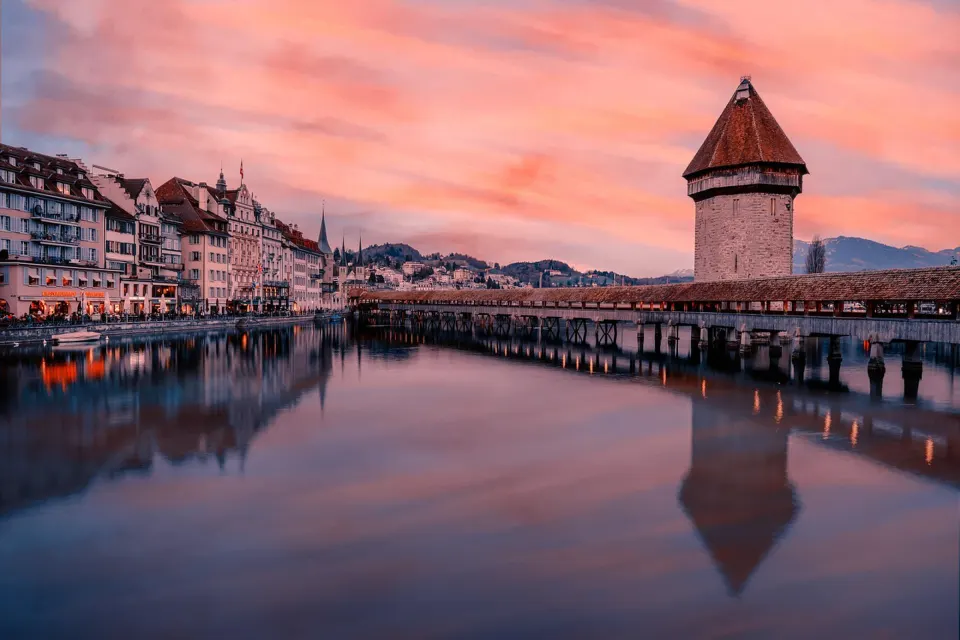
Chapel Bridge tower in Lucerne at sunset with reflections

Switzerland travel guide

Mountains, lakes and cities that run on Swiss precision

Best: Aug, Sep

Photo: bea61 / Pixabay

Capital
Bern
Languages
French, Swiss German, Italian
Currency
Swiss franc
Time zone
UTC+01:00
Plugs
Type C, J · 230 V
Driving
On the right
Emergency
112
Entry
Schengen area

Why visit Switzerland

Switzerland suits travellers who want alpine scenery alongside tidy, walkable cities like Bern, Basel and Geneva. It works well for hiking, train travel and mixing city stops with mountain towns such as Arosa or Crans-Montana. August and September are the best months, with warm days for hiking and clearer mountain views. The honest downside: Switzerland is a small country of just 41,284 km2, so distances between highlights are short, but costs run high across the board.

  • Four languages, one small country

    Switzerland packs French, Swiss German, Italian and Romansh into just 41,284 km². You can cross from Geneva to Lugano and hear three different languages, giving a strong sense of cultural variety in a single trip.

  • August and September are the sweet spot

    Bern, Basel and the rest of the country list August and September as the best months to visit. Expect settled late-summer weather without the deep winter cold, good for city walks and day trips alike.

  • City life without the crowds of bigger capitals

    Geneva (209,061 people), Basel (176,329) and Lausanne (144,873) are compact by European standards. You get real urban culture and museums without the scale or crush of a megacity.

  • Mountain towns on a smaller scale

    Places like Crans-Montana (10,447 people) and Arosa (3,185) are proper alpine towns, not just resorts bolted onto a mountain. Their small populations mean a quieter base for hiking or skiing trips.

  • A village feel in Gruyères

    With just 2,199 residents, Gruyères shows the other side of Switzerland: small, rural and far from the business centers of Geneva or Basel. It's a contrast worth building into a longer itinerary.

Is Switzerland right for you?

Great for

  • Mountain and lake travellers, since cities like Lugano, Crans-Montana and Arosa sit in Alpine or lakeside settings
  • Summer trips in August, when Bern highs reach 24°C with over 10 hours of sun a day
  • Shoulder-season visitors in September, with warm 19°C days and fewer rain days than spring
  • Landlocked-country travel, since no Swiss city here is coastal, so plan lake rather than beach time
  • Multilingual-country explorers, with French, Swiss German, Italian and Romansh all spoken

Less ideal for

  • Beach seekers, since none of the listed cities are coastal
  • Travellers wanting a dry spring, as May brings 142 mm of rain over 17 days in Bern
  • Winter sun chasers, since Bern December to February highs stay between 4 and 7°C with only 5 to 7 hours of sun
  • Budget travellers, since the Swiss franc and general Swiss price levels are high

Switzerland right now: October

6.1/10
Avg high
15°C
Avg low
6°C
Rain days
12

Averages for Bern.

Weather by month

Based on data for Bern, August and September are the best months, with warm highs of 24.1°C and 19.4°C, fewer rain days, and plenty of sunshine around 10-11 hours a day. January and December are the toughest, with highs near 4-5°C, lows below freezing, and only about 5 hours of sun daily.

Average highs and lows in Bern by month January: high 4°C, low -3°C , 14 rain days . February: high 7°C, low -1°C , 12 rain days . March: high 10°C, low 0°C , 14 rain days . April: high 14°C, low 3°C , 13 rain days . May: high 17°C, low 8°C , 17 rain days . June: high 22°C, low 13°C , 16 rain days . July: high 24°C, low 14°C , 15 rain days . August: high 24°C, low 14°C , 13 rain days . September: high 19°C, low 10°C , 11 rain days . October: high 15°C, low 6°C , 12 rain days . November: high 8°C, low 1°C , 13 rain days . December: high 5°C, low -1°C , 14 rain days . 4°C -3°C JAN 14d 7°C -1°C FEB 12d 10°C 0°C MAR 14d 14°C 3°C APR 13d 17°C 8°C MAY 17d 22°C 13°C JUN 16d 24°C 14°C JUL 15d 24°C 14°C AUG 13d 19°C 10°C SEP 11d 15°C 6°C OCT 12d 8°C 1°C NOV 13d 5°C -1°C DEC 14d
Best months Other months (low–high) Nd = rain days

Bern · averages 2015–2024

Best time to visit Switzerland: month-by-month weather →

Where to go in Switzerland

City guides with their own best months and weather.

Sample itineraries

7 days

Cities, Lakes and Alps in a Week

  1. Day 1–2

    Bern

    Start in the capital, with its old town along the river. September or August gives the best weather for walking the arcaded streets.

  2. Day 3

    Gruyères

    A small town of 2,199 people with a medieval core, good for a short, quiet stop between bigger cities.

  3. Day 4–5

    Lausanne

    Spend two days by Lake Geneva, exploring the city of 144,873 people and its lakeside paths.

  4. Day 6–7

    Geneva

    Finish in Geneva, population 209,061, for international landmarks and a final lakeside walk before departure.

10 days

Switzerland Beyond the Cities

  1. Day 1–2

    Basel

    Begin in Basel, a city of 176,329 people on the Rhine. August and September are the best months here for mild, dry days.

  2. Day 3–4

    Bern

    Move to the capital for two days among its sandstone buildings, best visited in August or September.

  3. Day 5

    Gruyères

    Break the trip with a day in this small town of 2,199 residents, known for its compact medieval centre.

  4. Day 6–7

    Lausanne

    Two days on Lake Geneva's shore in a city of 144,873 people, with time for walking the waterfront.

  5. Day 8

    Crans-Montana

    Head up to this mountain resort town of 10,447 people for a day in the Alpine air.

  6. Day 9–10

    Arosa

    End the trip in Arosa, a small mountain town of 3,185 people, for two final days surrounded by peaks.

Where to stay

One good base in each main city and who it suits.

Altstadt

Bern

Good for first-timers, sightseeing

Bern's medieval Old Town sits on a bend of the Aare River, with long stone arcades, fountains and the Zytglogge clock tower. You can walk to most sights and to the main station. Streets are cobbled and busy by day, and some lanes have bars that stay noisy late.

Grossbasel Altstadt

Basel

Good for first-timers, sightseeing, couples

The medieval old town on the left bank of the Rhine, around the Marktplatz, the red sandstone Rathaus and the Münster, puts most of Basel's main sights within walking distance. Lanes and squares are pretty and calm in the evening. The drawback: the streets climb steeply up from the river, and the cobbles are tiring with luggage.

Food to try in Switzerland

Cheese fondue

Melted cheese, usually mixed with white wine, served in a shared pot. You dip cubes of bread into it on long forks. It is mostly a winter dish and is common in the French-speaking west.

Raclette

A wheel of cheese is heated, and the soft layer is scraped onto boiled potatoes. It comes with small pickles and onions. It comes from the Valais region and is popular in ski areas.

Rösti

Grated potato fried in butter into a flat, crisp cake. It started in the Swiss German areas. Today it is eaten across the country, as a side dish or as a main with a fried egg on top.

Zürcher Geschnetzeltes

Thin strips of veal cooked in a cream and mushroom sauce. It comes from Zurich and is usually served with rösti. You will find it in traditional restaurants in the Swiss German areas.

Älplermagronen

Alpine herdsmen's macaroni: pasta and potatoes baked with cheese, cream and fried onions. It is often served with apple sauce on the side. It is a filling dish found in mountain huts and simple restaurants.

Rivella

A Swiss soft drink made with milk whey. It is fizzy and tastes a little sweet and fruity. It is sold in supermarkets, cafés and train station kiosks across the country.

Know before you go

  • Plugs and voltage: Switzerland uses plug types C and J at 230 V. Type J is a Swiss plug, so bring an adapter that covers it. Check that your devices accept 230 V before you plug them in.
  • Driving side: Traffic drives on the right in Switzerland. If you come from a country that drives on the left, take extra care at junctions and roundabouts during your first days.
  • Emergency number: Call 112 for emergencies in Switzerland. Save it in your phone before you travel so you can find it quickly.
  • Currency: The currency is the Swiss franc. Plan to pay in Swiss francs and check your bank's fees for card payments and cash withdrawals abroad.
  • Languages: Switzerland has several languages: French, Swiss German, Italian and Romansh. The language you hear depends on the region you visit, so learn a few basic words for the area you plan to see.
  • Time zone: Switzerland is on UTC+1. Check the time difference with home before you book connections or arrange calls.
  • Calling code: The country calling code is +41. Use it when you save Swiss phone numbers, such as your hotel, so you can call them from a foreign SIM.

Switzerland: frequently asked questions

Is Switzerland good to visit in August?

Yes, August is one of the best months, scoring 7.5 out of 10. In Bern, days reach 24.1°C and nights cool to 14.1°C. There are 12.6 rain days and 111 mm of rain, with 10.9 hours of sun a day, so you get long bright days with occasional showers.

What is the best time to visit Switzerland?

August and September score highest, at 7.5 and 7.8 out of 10. September in Bern has a high of 19.4°C, a low of 10.2°C, only 11 rain days and 88 mm of rain, plus 9.7 hours of sun daily. These months combine warm days, cooler nights and the least rain of the warmer season.

Is Switzerland good to visit in winter?

December and January score low, 1.5 and 1.3 out of 10. Bern highs sit at 5.4°C in December and 4.1°C in January, with lows down to -2.7°C. Sun hours drop to 5 or 5.2 a day, so days are short and cold, though this is the season for snow and winter sports in the mountains.

Is Switzerland rainy in May?

May has the most rain of the year in Bern, 142 mm over 17 rain days, more than any other month in the data. Despite this, temperatures are mild, with a high of 16.9°C and a low of 7.7°C, and the month still scores 6.7 out of 10, rated good.

How warm does it get in Switzerland in summer?

July is the warmest month in Bern, with a high of 24.4°C and a low of 14.4°C. August is close behind at 24.1°C high and 14.1°C low. Both months also bring over 10 hours of sun a day, making July and August the hottest, brightest stretch of the year.

Similar destinations

Countries with a year of weather much like Switzerland.