Skip to content
wheretotravel.info
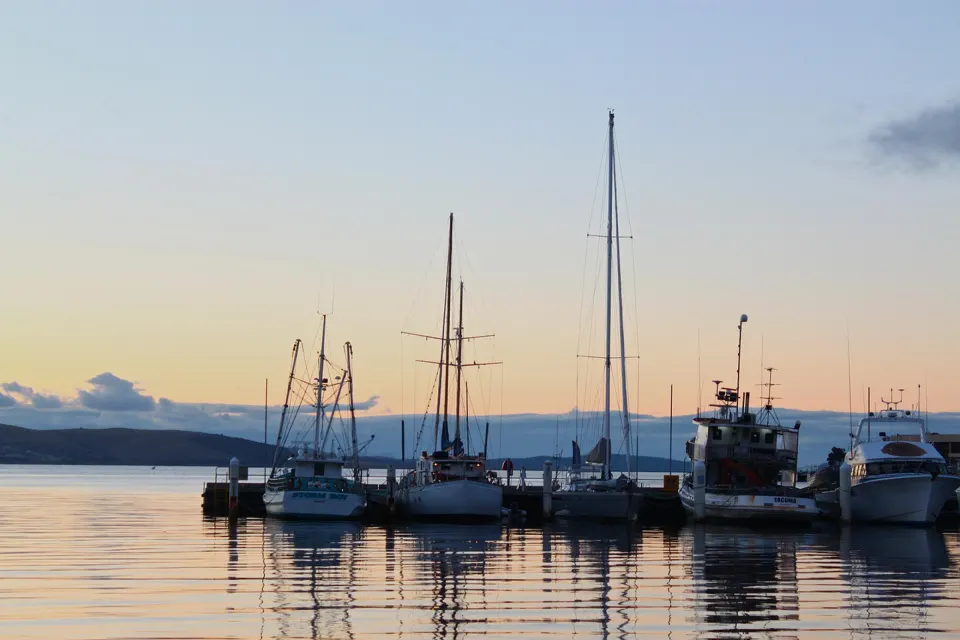
Sailboats moored at dusk with pastel sky

Hobart travel guide

What to see, where to stay and the best time to visit Hobart, Australia.

Best: Jan, Feb, Mar, Dec

Photo: KatherineSlade / Pixabay

Country
Australia
Currency
AUD

About Hobart

Hobart is Australia's second-oldest city, set on the River Derwent with kunanyi / Mount Wellington rising behind it. It's small and walkable, mixing colonial-era streets in Battery Point with modern art at MONA and a working harbour at Constitution Dock. It suits travellers who like museums, markets, food and easy access to nature without a big-city pace. The best months to visit are December, January, February and March, when the weather is warmest and most settled.

How many days do you need in Hobart?

3 days covers the main sights: MONA, kunanyi / Mount Wellington, Salamanca Place and Battery Point, plus the waterfront and museums, with time to spare for a brewery or garden visit.

Top attractions in Hobart

  1. 1MONA (Museum of Old and New Art)

    half a day

    Berriedale

    A large private museum of ancient and modern art, much of it built into the sandstone cliffs beside the Derwent River. Some works are deliberately shocking, so it is not for everyone. Many visitors arrive by the museum ferry from the city waterfront.

  2. 2kunanyi / Mount Wellington

    2–3 hours

    Wellington Park

    The mountain behind the city, with a summit road, lookouts and walking tracks. On a clear day you can see Hobart, the river and the coast below. The top is often cold, windy or in cloud, and the road can close in snow, so check the weather first.

  3. 3Salamanca Place and Salamanca Market

    2–3 hours

    Salamanca

    A row of old sandstone warehouses by the harbour, now shops, galleries, cafés and bars. The outdoor market sells Tasmanian food, crafts and produce, but it runs only one day a week, so check before you plan around it.

  4. 4Battery Point

    1–2 hours

    Battery Point

    One of Hobart's oldest neighbourhoods, just up the hill from Salamanca. Walk its quiet streets to see colonial cottages and Arthur Circus, a small ring of historic houses around a green.

  5. 5Tasmanian Museum and Art Gallery

    2–3 hours

    Hobart waterfront

    The state museum, covering Tasmanian Aboriginal history and culture, convict and colonial history, natural history and art. It is a good wet-weather option and gives useful background for the rest of your trip.

  6. 6Cascades Female Factory Historic Site

    1–2 hours

    South Hobart

    The site of a former prison for convict women, part of the Australian Convict Sites World Heritage listing. Little of the original buildings remains, so the guided tour or dramatised session is the best way to understand the stories.

  7. 7Cascade Brewery

    1–2 hours

    South Hobart

    A historic working brewery in a striking old stone building at the foot of the mountain. You can take a tour or just visit the garden and bar. It is close to the Female Factory, so the two combine easily.

  8. 8Royal Tasmanian Botanical Gardens

    1–2 hours

    Queens Domain

    Long-established gardens on the slope above the river, with plants from Tasmania and around the world. Look out for the Subantarctic Plant House, which recreates the cold, wet climate of the islands to the south.

  9. 9Hobart Waterfront and Constitution Dock

    1–2 hours

    Hobart waterfront

    The working harbour in the city centre, with fishing boats, floating seafood stalls and ferry departures. It is an easy place to walk, eat fish and chips and watch the boats.

  10. 10Mount Nelson Signal Station

    1 hour

    Mount Nelson

    A historic signal station on a hill south of the city, used in colonial times to send messages about ships. It has wide views over the Derwent estuary and is a quieter alternative when kunanyi is in cloud.
Hobart by month

Average weather and our month score, from 10 years of climate data.

Weather by month and month scores for Hobart
Month High / low Rain days Sunshine Sea temp Score
Best month: January 22°C / 13°C 8 days (59 mm) 11.3 h/day 20°C 8.3/10
Best month: February 21°C / 12°C 8 days (40 mm) 10.3 h/day 19°C 8.5/10
Best month: March 19°C / 11°C 9 days (55 mm) 8.9 h/day 18°C 8.3/10
April 17°C / 9°C 7 days (39 mm) 7.8 h/day 16°C 7.7/10
May 14°C / 6°C 10 days (56 mm) 6.7 h/day 14°C 5.4/10
June 11°C / 5°C 9 days (59 mm) 6.2 h/day 12°C 4.5/10
July 11°C / 4°C 9 days (43 mm) 7.0 h/day 10°C 4.4/10
August 12°C / 4°C 11 days (61 mm) 7.6 h/day 10°C 4.6/10
September 14°C / 6°C 10 days (51 mm) 8.8 h/day 11°C 6.0/10
October 16°C / 7°C 12 days (79 mm) 9.8 h/day 13°C 6.7/10
November 18°C / 9°C 12 days (72 mm) 10.6 h/day 15°C 7.7/10
Best month: December 20°C / 11°C 11 days (66 mm) 11.4 h/day 18°C 7.9/10
  1. Jan

    Highs reach 21.9°C with 8.4 rain days. This is one of the best months to visit, with warm, mostly dry summer weather.

  2. Feb

    Hobart's top-scoring month: highs of 20.9°C, just 7.7 rain days and the warmest sea at 19.2°C for swimming.

  3. Mar

    Still rated among the best months, with highs of 19.4°C though rain days tick up to 8.7 as autumn approaches.

  4. Apr

    Highs drop to 16.5°C and sun hours fall to 7.8, but it still scores well with only 7.3 rain days.

  5. May

    Weather turns cooler and wetter, with highs of just 13.5°C and 9.9 rain days, pulling the score down to an okay 5.4.

  6. Jun

    Winter sets in: highs of only 11.4°C, cold nights near 4.6°C, and the lowest score of the year at 4.5.

  7. Jul

    The coldest month, with highs of 11°C and lows of 4.1°C; sea temperature drops to 10°C, so this is tough weather for sightseeing.

  8. Aug

    Still cold at 11.9°C highs, and the wettest-feeling month with 11.4 rain days, keeping the score low at 4.6.

  9. Sep

    Spring brings improvement: highs rise to 13.9°C and the score climbs to a good 6, though 9.6 rain days remain.

  10. Oct

    Highs reach 16°C but rain days jump to 11.6 with 79mm of rainfall, the wettest month of the year; score is a good 6.7.

  11. Nov

    Back to a best-rated month, with highs of 18.1°C, warming sea at 15.4°C and a strong score of 7.7.

  12. Dec

    Summer returns with highs of 20.1°C and 10.7 rain days; a best-rated month to close the year with a score of 7.9.

Climate averages 2015–2024 · Best time to visit Australia →

Where to stay in Hobart

The best areas to base yourself and who each one suits.

Salamanca and the Waterfront

Good for first-timers, food and drink

Old sandstone warehouses, restaurants and bars line the harbour, and the Saturday Salamanca Market is on your doorstep. You can walk to most sights, and ferries to MONA leave from the nearby piers. The drawback is noise from bars late at night and crowds on market day.

Battery Point

Good for couples, history lovers, quiet

This is Hobart's oldest residential area, with narrow lanes, small colonial cottages and a village feel. Salamanca is a short walk down Kelly's Steps, so you get quiet nights close to the action. The streets are steep and street parking is hard to find.

Hobart CBD

Good for first-timers, transport, practical stays

The city centre has the most shops, supermarkets and bus connections, and the waterfront is only a few blocks away. It is a sensible base if you want to get around without a car. It feels quiet and a bit flat after business hours, with less character than the waterfront areas.

North Hobart

Good for foodies, film fans, repeat visitors

Elizabeth Street here is a strip of cafés, restaurants, pubs and the State Cinema, popular with locals more than tourists. It has a relaxed, neighbourhood mood in the evenings. The waterfront is a longer walk, and the return trip is uphill.

Sandy Bay

Good for families, longer stays, beach access

A leafy residential suburb along the river, home to the university, a small beach and waterside walks. It is calmer and roomier than the centre, which suits families. You will need a bus or car to reach the city, and many streets are hilly.

Getting to and around Hobart

From the airport
No route data is given for Hobart Airport. Visitors usually choose a taxi, a rideshare, a pre-booked airport shuttle, or a hire car to reach the centre, since there is no train link.
Public transport
Hobart runs on a city bus network, with no metro or tram. A practical tip: MONA is reached by a ferry from the waterfront, which doubles as a sightseeing trip along the river to Berriedale.
On foot
The CBD, Salamanca and the Waterfront, and Battery Point sit close together and are easy to cover on foot, linking sights like Salamanca Place, the Tasmanian Museum, and the Hobart Waterfront.

Food to try in Hobart

Tasmanian Salmon

Hobart sits near cold, clean waters where salmon farming is a major industry. Locals eat it smoked, grilled or raw in sushi at restaurants along the waterfront.

Fresh Oysters

Tasmania's coastline produces oysters that are served raw with lemon at seafood stalls and restaurants around the harbour, especially at the Salamanca Market on Saturdays.

Scallop Pie

This is a savoury pie filled with scallops in a creamy sauce. It's a popular quick lunch found at bakeries across the city.

Fish and Chips at the Docks

Fishing boats still unload their catch at Constitution Dock, and floating punts nearby sell fresh fish and chips eaten by the water.

Tasmanian Cheese and Whisky

The island is known for boutique cheese makers and whisky distilleries. Many bars and cafes in Hobart offer tasting plates pairing local cheese with Tasmanian single malt.

More of Australia

Australia travel guide →

Hobart: frequently asked questions

Is Hobart good in August?

Hobart gets an "ok" score of 4.6 out of 10 in August. Daytime highs average 11.9°C and lows drop to 4.4°C. It's also one of the wetter months, with rain on about 11.4 days. It suits travellers who don't mind cool, damp weather rather than those chasing sunshine.

What is the best time to visit Hobart?

February is the top-rated month, scoring 8.5 out of 10. January, March and December also score in the "best" range, from 7.9 to 8.3. These months bring the warmest days, with January highs averaging 21.9°C and sea temperatures near 19–19.5°C, making them the most comfortable for sightseeing and the waterfront.

How many days do I need in Hobart?

Plan for 2 to 3 days to see the main sights. MONA alone takes about half a day, while kunanyi/Mount Wellington, Salamanca Place and the Tasmanian Museum and Art Gallery each need 2–3 hours. Smaller stops like Battery Point, the Cascades Female Factory and the Royal Tasmanian Botanical Gardens take 1–2 hours each, so a few full days covers them comfortably.

Is Hobart warm in January?

Yes, January is Hobart's warmest month. Daytime highs average 21.9°C and overnight lows sit around 12.7°C. Sea temperature reaches 19.5°C, the highest of the year, which makes it the best month for time on the waterfront. Rain falls on about 8.4 days, less than in the cooler months.

Does it rain a lot in Hobart?

Rain is spread fairly evenly through the year, with no single dry season. October and November are the wettest months, with rain on 11.6 days each and totals of 79mm and 72mm. July is drier, with rain on about 9.2 days and only 43mm, though it's also one of the coldest months.